How Cultures Around the World Approach Sport and Fitness: France, Scandinavia, Asia and the Mediterranean
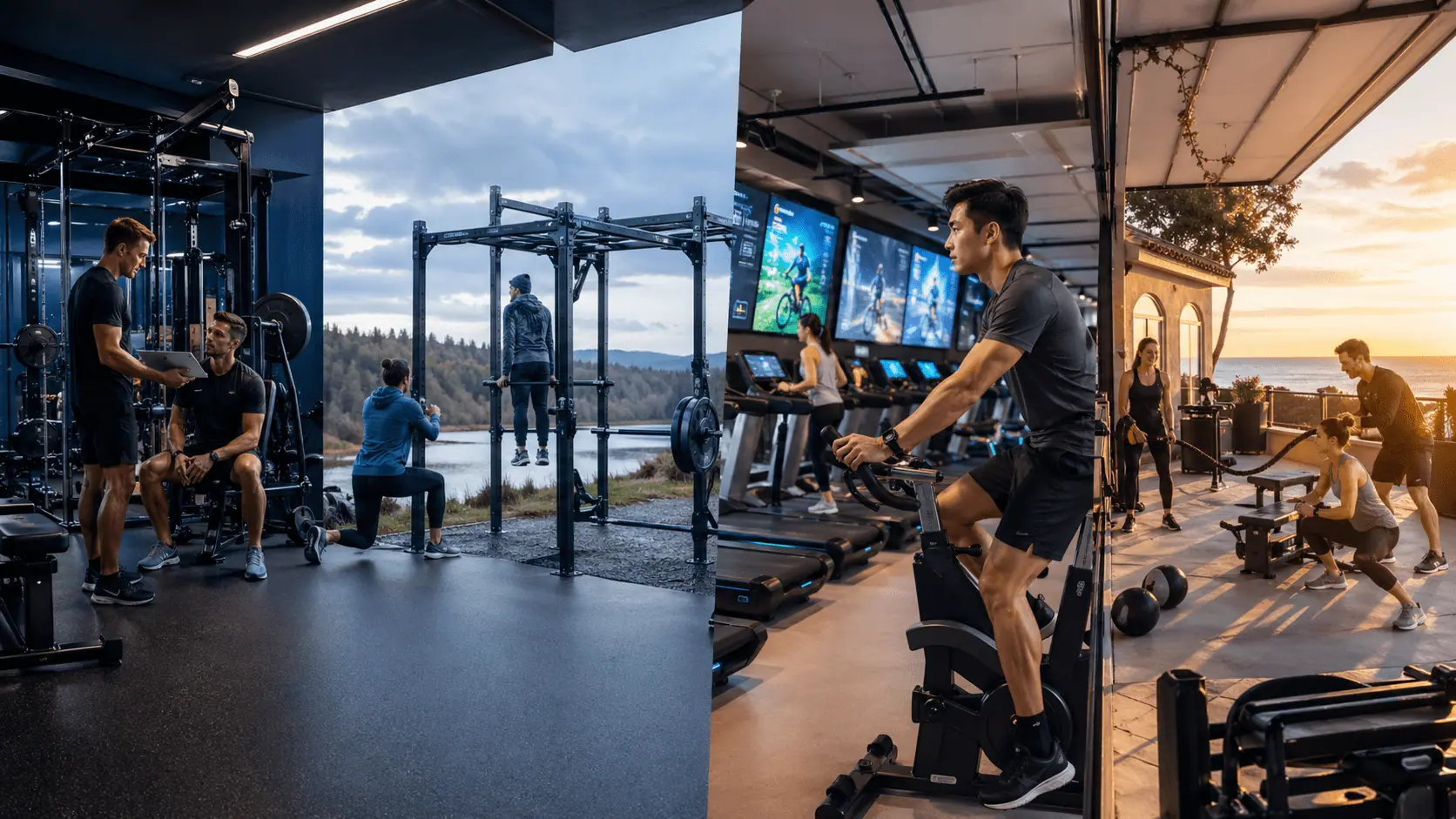
Four cultural models dominate how the world trains: France builds practice around structured programmes and supervised, specialised gyms; Scandinavia places outdoor daily movement (friluftsliv) at the centre; East Asia invests massively in connected equipment and measurement; and the Mediterranean favours informal, social movement tied to food culture and public space. None is complete on its own, and a facility being equipped today, whether a club, a hotel or a municipality, gains by combining all four: French-style programming, Nordic outdoor robustness, Asian connected tracking, Mediterranean aesthetic and social integration.
The relationship to the body, to effort and to movement varies profoundly from one culture to another. The point of this overview is not to rank the approaches; each answers a specific climate, history and urban context. It is to give concrete reference points to operators and individuals who want to enrich their own practice or facility.
France: structure, programmes and supervised expertise
French sporting culture rests on a deep federal heritage: a dense network of affiliated clubs, state-certified coaching qualifications, and a commercial gym sector shaped by professional supervision. That expertise culture shows in how training is approached: planned programmes, periodised cycles, tracked progress and verified technique.
- The programme comes first: hypertrophy blocks, strength cycles, marathon preparations, structured return-to-fitness plans. It shows in the equipment French facilities favour: selectorised machines for safe analytical work, racks and cages for strength athletics, and premium treadmills for programmed cardio. The classic French debate between guided and free-loading machines is covered in our guide to selectorised vs plate-loaded machines.
- The functional box phenomenon: the rapid growth of functional training boxes, often in converted industrial units, illustrates the same appetite for a clear frame: a timed workout of the day, codified technical standards, a tight community and a named coach.
What to borrow: measured progressiveness and technical supervision. Any facility benefits from offering members a structured path, not just access to machines.
Scandinavia: friluftsliv and everyday outdoor movement
The Norwegian word friluftsliv, literally “open-air life”, used by Ibsen as early as the nineteenth century, now runs through Norwegian, Swedish, Finnish and Danish public policy. The principle is simple: get outside whatever the weather. Walking, rowing, running, skiing and cycling belong to the day itself rather than to a gym slot.
- Nordic exports: Nordic walking was codified in Finland, utility cycling structures Danish cities, and Finnish sauna culture has been on UNESCO’s intangible cultural heritage list since 2020. Public outdoor fitness areas, urban fitness trails and calisthenics installations are deeply established, engineered from the outset to survive rain, snow and frost.
- Reproducing the spirit elsewhere: the challenge is conceptual more than technical: create spaces that invite people outside with no logistical barrier. That means robust outdoor stations certified to EN 16630, draining non-slip surfacing, and street sports furniture integrated into the landscape rather than imposed on tarmac, with materials (hot-dip galvanised steel or stainless steel) matched to the exposure.
What to borrow: movement diffused through the day, without a dedicated time slot. See our range of outdoor gym equipment for municipalities, hotels and residences.
East Asia: embedded technology and inherited discipline
South Korea, Japan, China, Singapore and Taiwan are among the global engines of fitness innovation: connected bikes streaming classes, interactive mirrors with virtual coaches, biometric sensors on machines, and app-driven gamification. Practice is increasingly mediated by data.
- The fascination with measurement is fed by smartphone ubiquity, urban density favouring indoor practice, and a culture that values quantified progress. HD screens on treadmills, heart-rate-adaptive programmes and remote virtual competitions are standard in high-end Asian gyms. For buyers, connectivity has shifted the purchasing question: consoles no longer separate two machines, the mechanics beneath them do.
- The other face is traditional discipline: Japanese martial arts, Chinese tai chi and qi gong, and yoga from the Indian subcontinent, each with their own equipment requirements, starting with the floor: mat thickness and density are chosen by discipline, as detailed in our guide to tatami mat thickness and finishes.
What to borrow: data tracking in the service of consistency, balanced by postural discipline and progressiveness.
The Mediterranean: movement, food and social connection
The Mediterranean basin, from Italy, Spain and Greece to southern France, the Maghreb and the Levant, is associated less with an identifiable “fitness culture” than with a whole way of life recognised for its longevity effects; the Mediterranean diet joined UNESCO’s intangible heritage list in 2010.
- Informal but permanent activity: daily walking in dense pedestrian centres, seaside cycling, swimming, beach games, traditional dances and amateur team sports. Movement is lived in groups, often in public space, with a relaxed relationship to performance: people move because it is pleasant and social, not to hit a number.
- The hospitality translation: for hotels, resorts and coastal clubs, the philosophy demands versatile, aesthetic equipment able to serve an air-conditioned indoor gym and an outdoor corner facing the sea. Resistance to salt air, UV and humidity becomes a primary technical criterion, which is why marine-grade stainless steel is specified over painted steel outdoors, as covered in our guide to stainless steel 316L outdoor equipment for coastal sites.
What to borrow: pleasure and social connection as the engines of adherence.
The four approaches compared
| Region | Keyword | Preferred setting | Typical equipment | What to borrow |
|---|---|---|---|---|
| France | Programme | Gym, club, box | Guided machines, racks, cages | Measured progression and technical supervision |
| Scandinavia | Friluftsliv | Outdoors, urban trails | Outdoor stations, calisthenics | Movement spread through the day |
| East Asia | Technology | Connected gyms, home | HD-screen cardio, streaming bikes | Data tracking for consistency |
| Mediterranean | Lifestyle | Public space, hospitality | Versatile indoor/outdoor equipment | Pleasure and social connection as motivators |
How to combine them in one facility
None of the four approaches is complete alone. France has programming expertise but can gain spontaneity; Scandinavia excels at everyday integration but presumes adapted public infrastructure; Asia pushes technology far, sometimes at the expense of the physical collective; the Mediterranean has the culture of social movement but can lack structured progression.
For a club, hotel or public authority equipping a fitness space today, the most robust approach crosses the influences: structured programming for rigour, Scandinavian-inspired outdoor equipment to extend practice beyond the walls, Asian-inspired connected technology for tracking and motivation, and Mediterranean aesthetics to make the space somewhere people want to return to. In practice that means pairing an indoor floor of guided and free-weight equipment with an EN 16630-compliant outdoor zone, choosing cardio with meaningful (not gimmick) connectivity, and treating finishes, light and sociable layout as functional requirements rather than decoration.
Frequently asked questions
Is one of the four models objectively better?
No. Each answers its own climate, urban form and history. The evidence on adherence suggests the decisive factor is not the model but the fit between the offer and the local population’s habits, which is why hybrid facilities outperform single-model ones.
What does outdoor training add over the gym?
Daylight exposure (mood and sleep regulation), terrain variety, zero booking friction and, in the Nordic experience, dramatically better winter adherence when equipment is genuinely weatherproof. It complements rather than replaces structured indoor work.
Is connected equipment worth the premium?
When connectivity serves consistency, adaptive programmes, progress tracking, remote competition, yes for the right clientele. The mechanical platform still determines lifespan and service cost, so judge the machine first and the screen second.
How does this translate for a coastal hotel?
Take the Mediterranean lesson literally: versatile indoor-outdoor equipment, marine-grade 316L stainless steel outside, aesthetics that fit the setting, and layouts that make training sociable rather than solitary.
Equip a facility that crosses the four cultures
From structured indoor floors and EN 16630 outdoor stations to connected cardio and hospitality-grade wellness, we design and install complete facilities with a single point of contact, from 3D layout to commissioning. Request a quote from Light In Fitness, professional fitness equipment supplier since 2013.
Réalisations documentées
- Cage street workout ultime, Carcassonne – armée française
- Cage street workout ultime, Tahiti – armée française, Polynésie
- Cage SP Max, centre EPIDE de Combrée – établissement public d’insertion
- Cage SP Max, lycée Saint-Bénigne de Dijon – établissement scolaire
Sources et références
- NF EN 16630 – modules fixes d’entraînement physique de plein air : exigences de sécurité et méthodes d’essai (AFNOR)
- Code du sport, article L322-2 – garanties d’hygiène et de sécurité des établissements d’activités physiques et sportives (Légifrance)