Pull-Ups: The Complete Guide — Technique, Programme and Equipment
La traction sollicite dorsaux, biceps, avant-bras, épaules et sangle abdominale sur un seul mouvement au poids du corps. La progression passe par les variantes assistées, élastique ou machine, avant la traction stricte. L'erreur la plus fréquente est l'amplitude partielle, qui limite le recrutement du grand dorsal.
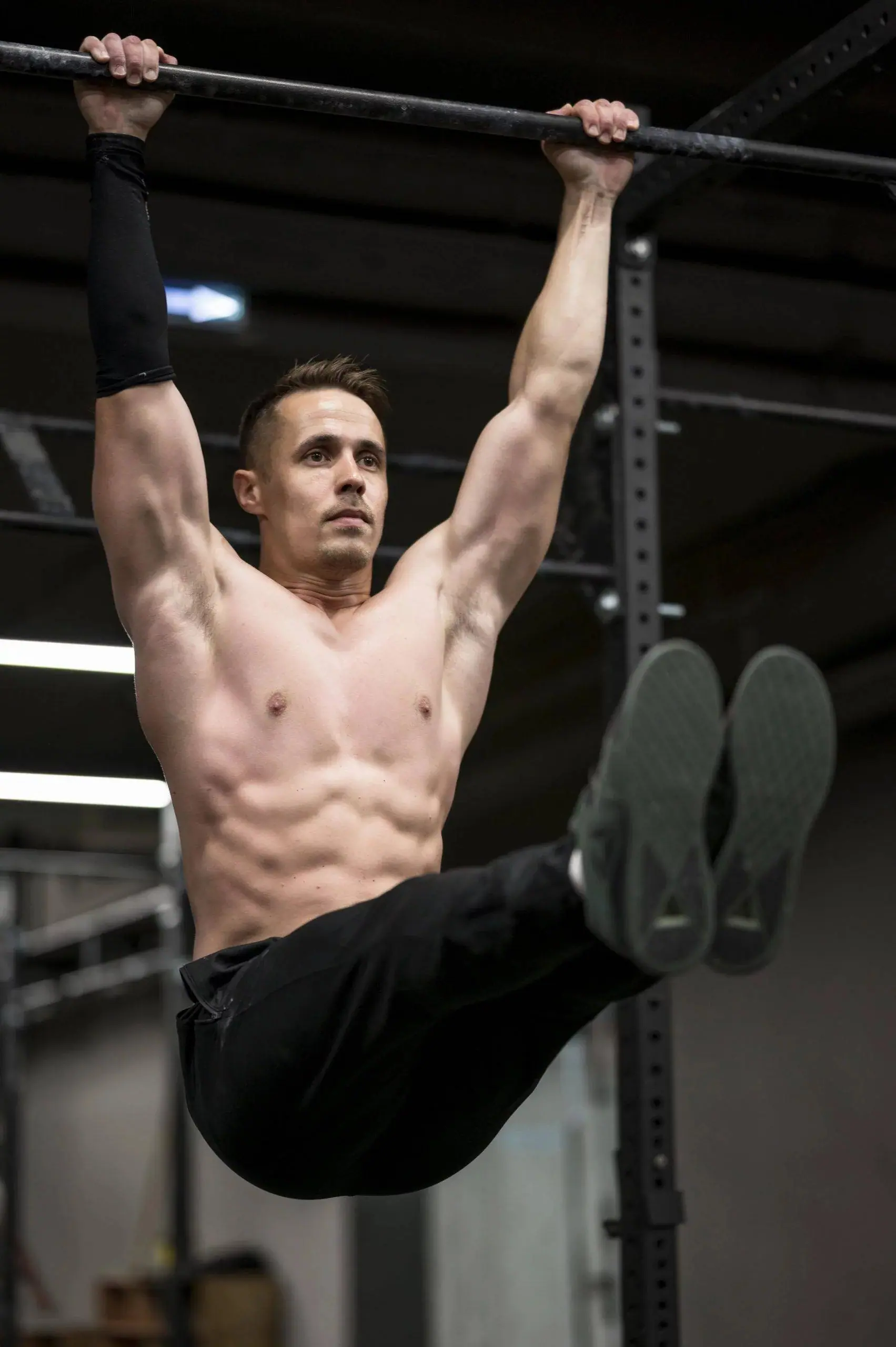
A pull-up is a bodyweight exercise in which you hang from a fixed bar with straight arms and pull yourself up until your chin clears the bar. Most healthy adults can achieve their first strict pull-up in 6 to 10 weeks with a structured progression — and the equipment you train on matters as much as the programme. This guide covers correct technique, a week-by-week plan from zero to fifteen reps, the seven mistakes that stall most lifters, and how to choose between a doorway bar, wall bars, a power rack or an outdoor calisthenics structure.
What exactly is a pull-up — and how is it different from a chin-up?
Both movements start from a dead hang and finish with the chin above the bar. The difference is the grip:
- Pull-up: overhand (pronated) grip, palms facing away. It emphasises the latissimus dorsi and is the harder of the two.
- Chin-up: underhand (supinated) grip, palms facing you. It recruits the biceps more and is typically 10–15% easier for beginners.
Beyond the lats, pull-ups work the biceps, teres major, rhomboids, lower trapezius, forearms and the deep core muscles that stop your body swinging. That is why they remain the single best test of relative upper-body strength.
Correct pull-up technique in three phases
- Start position: dead hang, arms fully extended, shoulder blades slightly engaged (not shrugged to the ears), grip just wider than shoulder width, core braced, legs still.
- Pull phase: drive the elbows down and back, lead with the chest, and pull until the chin clears the bar. Exhale on the way up. No kipping, no hip swing.
- Lowering phase: control the descent over 2–3 seconds back to a full hang. The eccentric portion builds most of the strength — never drop from the top.
From zero to your first pull-up: the 10-week progression
Each stage is trained 2–3 times per week with at least one rest day between sessions. Move to the next stage once you hit the exit criterion.
| Stage | Weeks | Exercise | Volume per session | Exit criterion |
|---|---|---|---|---|
| 1 — Passive hang | 1–2 | Dead hang from the bar | 4–5 holds of 20–40 s | 60 s continuous hang |
| 2 — Assisted pull-ups | 2–4 | Resistance-band or machine-assisted reps | 4 sets of 6–8 | 8 clean reps with light assistance |
| 3 — Negatives | 4–6 | Jump to the top, lower over 3–5 s | 4–5 sets of 3–5 | 5 negatives of 5 s each |
| 4 — First strict rep | 6–10 | Single full-range attempts, then singles | 5–8 single attempts | 1 strict pull-up |
From 5 to 15 reps: once you own five strict reps, alternate a volume day (8–10 sets of 3–4 reps, 90 s rest), a density day (max reps in 10 minutes) and a weighted day (add 2.5–5 kg on a dip belt for 5 sets of 3). Most intermediates add one rep every 10–14 days on this scheme.
The 7 mistakes that stop your progress
- Half reps — no full hang at the bottom, chin never clearing the bar.
- Kipping before you can do strict reps: momentum robs the strength stimulus.
- Training to failure every session instead of leaving 1–2 reps in reserve.
- Ignoring the eccentric phase and dropping from the top.
- A grip that is too wide, which shortens range and irritates the shoulders.
- No scapular engagement — shrugged shoulders transfer load to the neck.
- Training pull-ups daily: the tendons of the elbow need 48 h to recover.
Which pull-up equipment should you train on?
The bar itself decides how safely and how often you can train. Four options, in ascending order of stability and budget:
- Doorway bar: the entry point at home. Check the stated load limit (usually 100–120 kg) and the door-frame depth. Fine for hangs and a few reps, unsuitable for weighted work.
- Wall- or ceiling-mounted bar: bolted into masonry or joists, it takes dynamic loading and frees up floor space. The reference solution for garage gyms — see our guide to power towers, pull-up bars and wall bars.
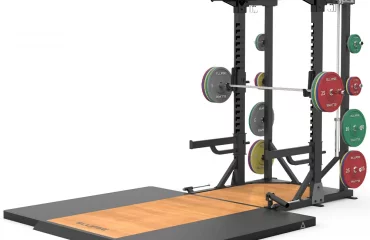
- Power rack or pull-up station: a rack with a knurled 32–33 mm bar at 2.2–2.4 m height doubles as a squat and bench station. Our buying guide to squat racks and power racks covers the specifications that matter.
- Outdoor calisthenics structure: for clubs, campsites and municipalities, hot-dip galvanised steel street workout stations certified to EN 16630 take unlimited users. A large multi-user cage such as the Z4 street workout cage costs 24,500 EUR excluding VAT; the stainless-steel C12 station for coastal sites is 24,999 EUR excluding VAT. Browse our street workout and calisthenics park guide for smaller configurations.
Useful accessories: resistance bands (15–35 kg assistance), liquid chalk for grip, and a dip belt from the moment bodyweight reps exceed ten.
How many pull-ups should you do per day?
For strength, total weekly volume matters more than daily numbers: 40–80 quality reps spread over 2–3 sessions per week outperforms a daily max-out. A daily “grease the groove” approach (frequent easy sets at 40–50% of max) works for advanced athletes, but beginners progress faster with full recovery days.
Frequently asked questions
How long does it take to do your first pull-up?
With 2–3 structured sessions per week, most beginners achieve a strict pull-up in 6 to 10 weeks. Heavier trainees or complete novices may need 12–16 weeks — the passive-hang and negative stages simply last longer.
Can I do pull-ups every day?
Not as a beginner. Elbow and shoulder tendons adapt more slowly than muscles, and daily maximal pulling is the most common route to golfer’s elbow. Keep 48 hours between hard sessions; light hangs and mobility work are fine on rest days.
Are pull-ups or rows better for back development?
They are complementary, not interchangeable. Pull-ups load the vertical pulling pattern (lats, teres major); rows load the horizontal pattern (rhomboids, mid-traps). A balanced programme includes both in roughly equal weekly volume.
What should I do when my pull-up numbers stall?
Change one variable for 3–4 weeks: add weighted low-rep work, switch to eccentric-only overload, or double your weekly volume at reduced intensity. Stalls almost always come from repeating the same sets and reps for months.
Equip your training space for pull-ups
From a single wall-mounted bar to a full outdoor calisthenics park, Light In Fitness supplies and installs professional pulling equipment across Europe — with load-tested structures, EN-certified outdoor stations and delivery on a firm quotation. Tell us about your space and audience, and our team will return a detailed professional quote within 24 working hours.
Réalisations documentées
- Cage street workout ultime, Carcassonne – armée française
- Cage street workout ultime, Tahiti – armée française, Polynésie
- Cage SP Max, centre EPIDE de Combrée – établissement public d’insertion
- Cage SP Max, lycée Saint-Bénigne de Dijon – établissement scolaire