Tatami mats for martial arts: finishes and thicknesses explained
Un tatami d'arts martiaux professionnel se définit par deux paramètres : la finition de surface et l'épaisseur. La finition canne de riz moletée reste la référence des tatamis de compétition, la finition lisse convient aux usages mixtes. Quatre épaisseurs couvrent l'ensemble des disciplines, du judo au grappling, chacune correspondant à un niveau de chute attendu.

Two decisions shape a professional tatami investment: the surface finish and the thickness. The finishes are rice-straw embossed EVA or PE foam, the reference for interlocking puzzle tiles used in judo, jiu-jitsu, aikido and MMA, and reinforced PVC vinyl bonded to polyurethane foam, the reference for competition mats. The four working thicknesses are 20 to 25 mm, 30 mm, 40 mm and 50 mm. The right combination comes from crossing the discipline, the age of the practitioners and the intensity of use.
Rice-straw embossed foam: the modular puzzle standard
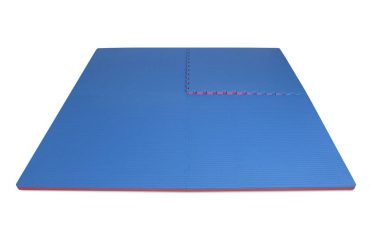
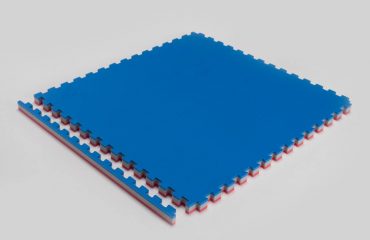
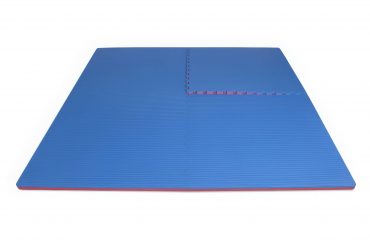
This finish reproduces the look and feel of a traditional Japanese tatami. The core is closed-cell polyethylene or ethylene-vinyl acetate foam at a density of 200 to 280 kg per cubic metre, embossed on both faces with a lightly textured rice-straw pattern that provides barefoot grip. Tiles come in a 100 by 100 cm interlocking format, waterjet cut so that adjacent tiles close with no play, and are assembled without glue or tools. The material is antibacterial, antifungal, hypoallergenic, washable and impermeable, and is supplied with a Dfl-s1 fire classification to EN 13501-1 for use in premises open to the public. Service life in intensive club use is 6 to 12 years depending on density and footfall.
The operational case is straightforward: installation and removal take minutes for one person, the surface can be cut to any dimension, worn tiles are replaced individually, and the reversible two-tone faces let a club mark out a teaching zone and a fighting zone visually. The investment is typically two to three times lower than a vinyl competition mat of the same area.
The limits are real too. Puzzle joints stay visible and can shift slightly on a very smooth substrate or under daily competition-level use. The foam does not deliver the calibrated feel of a competition vinyl under repeated heavy throws, and surface wear is faster in high-friction grappling zones such as intensive Brazilian jiu-jitsu.
Reinforced vinyl on polyurethane foam: the competition build
This is a sandwich construction: a polyester-reinforced PVC vinyl top layer bonded to high-density polyurethane foam at 80 to 220 kg per cubic metre depending on use. It is supplied as solid 100 by 100 cm or 100 by 200 cm panels, or as continuous rolls, and laid loose with ballast, semi-permanently or fully bonded according to the stability required. IJF homologation is available for official judo competition.
The continuous surface has no visible joints, cleaning takes minutes with a damp mop on a smooth non-porous surface, the polyurethane density is calibrated to absorb competition-level throws, and service life reaches 15 to 20 years in intensive club use. Against that, the initial investment is two to three times higher, handling needs two people, and solid panels or rolls do not lend themselves to spot replacement. For a recreational club or a constrained budget, the investment is rarely justified unless the venue hosts official competition.
Thickness: the four working specifications
Thickness governs the capacity to absorb falls and throws. Four references cover the large majority of B2B cases. A mat that is too thin for the discipline materially increases injury risk; an oversized mat costs 30 to 50 per cent more without adding safety.
20 to 25 mm is the professional entry specification for controlled falls and rare throws: children and beginners in martial arts initiation, recreational karate and taekwondo, yoga, pilates and stretching in multi-purpose zones, gentle gymnastics for older adults in care settings, and functional fitness warm-up and mobility areas.
30 mm is the versatile compromise for a mixed teenage and adult population in moderate practice: karate, taekwondo, kung fu wushu at club level, aikido with controlled throws, kickboxing and savate standing zones, self-defence and krav maga, and amateur MMA initiation.
40 mm is the default specification for disciplines involving repeated heavy throws and intensive ground work, and it is what Light In Fitness specifies on the majority of dojo projects: adult judo in regular club practice, Brazilian jiu-jitsu, MMA, freestyle and Greco-Roman wrestling, sambo, and close-combat military physical preparation.
50 mm is the premium specification for federal competition, heavier practitioners and daily throws over years: competition judo and jiu-jitsu dojos, accredited federal training centres, professional MMA venues with a cage, high-level aikido with repeated heavy throws, and athletes above 90 kg body weight.
Finish and thickness matrix, with indicative pricing
| Thickness | Rice-straw puzzle, EVA or PE | Vinyl on polyurethane foam |
|---|---|---|
| 20 to 25 mm | Children, fitness, care settings, yoga. 15 to 25 euros per m2 excl. VAT | Rarely offered at this thickness |
| 30 mm | Karate, taekwondo, aikido at club level. 25 to 40 euros per m2 | Premium recreational karate. 60 to 90 euros per m2 |
| 40 mm | Judo, BJJ, MMA, wrestling. Reference. 40 to 60 euros per m2 | Intensive club judo. 90 to 140 euros per m2 |
| 50 mm | Club competition judo, professional MMA. 55 to 80 euros per m2 | IJF and federal reference. 120 to 200 euros per m2 |
Specification by discipline
| Discipline | Thickness | Finish |
|---|---|---|
| Recreational karate | 25 to 30 mm | Rice-straw puzzle |
| Taekwondo | 25 to 30 mm | Rice-straw puzzle |
| Kickboxing, savate | 30 mm | Rice-straw puzzle |
| Aikido at club level | 30 to 40 mm | Rice-straw puzzle |
| Adult recreational judo | 40 mm | Rice-straw puzzle |
| Brazilian jiu-jitsu | 40 mm | Rice-straw puzzle or vinyl |
| MMA, amateur to professional | 40 to 50 mm | Rice-straw puzzle or vinyl |
| Freestyle and Greco-Roman wrestling | 40 to 50 mm | Vinyl on foam |
| Competition judo | 40 to 50 mm | IJF homologated vinyl on foam |
| Krav maga, self-defence | 30 to 40 mm | Rice-straw puzzle |
| Yoga, pilates, floor fitness | 20 to 25 mm | Rice-straw puzzle |
Standards and homologation
EN 12503-3 covers impact-attenuating sports surfaces for disciplines involving falls, defining shock absorption, energy restitution and dimensional stability. A professional tatami intended for premises open to the public should reference it on its technical sheet. For fire, EN 13501-1 applies and Dfl-s1 is the practical minimum for a public sports hall; ask for the classification report, not a claim. IJF homologation is the reference for official judo competition, covering dimensions, thickness, density, fall absorption and friction coefficient. It is chargeable and renewed periodically, and it is required for venues hosting official competition and accredited federal training centres. It is not required for recreational clubs, schools and associations. EN 1177 becomes relevant where the potential fall height exceeds 60 cm, for example children’s ninja structures or school gymnastic circuits; for conventional martial arts, where falls are essentially horizontal, federal homologation is the governing reference.
What to check before ordering
Ask for the technical sheet stating composition, measured density in kg per cubic metre, impact absorption test data and the European fire classification. On puzzle tiles, check the waterjet cutting tolerance: more than about 1 mm of play between tiles indicates low-grade industrial cutting that will show up as unstable joints in use. Confirm the hygiene properties, since a mat that is not washable and impermeable becomes unmanageable in daily club operation. Finally, price the freight. A 40 mm tile weighs 10 to 15 kg, so a 100 m2 project weighs 1 to 1.5 tonnes and transport can represent 8 to 15 per cent of the budget if it is not included in the quotation. Substrate matters as well: any clean, dry, sound floor works provided flatness is within about 5 mm over 2 m.
Frequently asked questions
What thickness of tatami for adult judo?
40 mm is the reference for regular adult club practice, absorbing repeated throws and falls. For official competition, move to 50 mm in an IJF homologated vinyl finish.
What thickness for Brazilian jiu-jitsu?
40 mm. Prolonged ground work needs even attenuation for knees, hips and shoulders, and the rice-straw puzzle finish is adequate for the large majority of BJJ clubs.
Does every dojo need IJF homologated mats?
No. Homologation is required for venues hosting official competition and for accredited federal training centres. A 40 mm rice-straw puzzle mat is sufficient for recreational clubs, schools and associations, and costs two to three times less.
How should a professional tatami be maintained?
Daily, dry wipe or light damp mop to remove sweat and dust. Weekly, a full clean with a mild pH-neutral detergent and never undiluted bleach. Monthly, full airing and inspection of the joints. Annually, replace tiles showing tears, flattening or excessive surface wear.
Specify your dojo surface
Light In Fitness has supplied professional sports surfaces from Tours, France, since 2013, holding 20 to 50 mm thicknesses in permanent stock with dispatch in 5 to 10 working days. Send us your discipline, floor area and practitioner profile and we will return a finish and thickness specification with a layout plan. Quotations are issued within 24 working hours. See our tatami mats and combat sports equipment, or request a quote.
Réalisations documentées
- Dalles et sols sportifs : livraisons documentées – plusieurs chantiers
- Sol sportif extérieur, square Georges-Vallerey – Taverny (95)
Sources et références
- Décret n° 96-1136 du 18 décembre 1996 – prescriptions de sécurité relatives aux aires collectives de jeux (Légifrance)
- NF EN 1176-1 – Équipements et sols d’aires de jeux, partie 1 : exigences de sécurité et méthodes d’essai générales (AFNOR)
- NF EN 1177 – revêtements de surface amortissants : détermination de la hauteur de chute critique (AFNOR)
- Arrêté du 19 avril 2011 – étiquetage des produits de construction ou de revêtement de mur ou de sol sur leurs émissions de polluants volatils (Légifrance)