The Evolution of the MMA Cage: From Ring to Octagon
Mixed martial arts have become one of the most closely watched combat sports in the world, and the cage is the piece of equipment that defines the discipline. The enclosure is not decoration: it is a safety structure, a training tool and, for any club that installs one, a long-term investment. This article retraces how the MMA cage evolved, and what that history tells professional buyers about the structures available today.
From open ring to closed enclosure
The roots of mixed fighting are usually traced back to ancient Greece, where pankration is regarded as the earliest form of mixed martial arts. Modern MMA took shape much later: the first Ultimate Fighting Championship was held in 1993. In those early years the sport was unregulated and widely described as barbaric, which led lawmakers in many places to ban it outright.
The first events were a clash of styles. Rules were minimal, competitors came from every discipline, and fighters often wore the equipment of their choice. The enclosure was introduced as a safety measure: it protects the athletes and it contains them, so that no one falls or rolls out of the fighting surface during an exchange. That single decision shaped everything that followed.
On the other side of the Pacific, the Japanese scene of the late 1990s built its own model, the Pride ring: a roped platform rather than a cage, on which the corners could be used to trap an opponent. It was never a cage in the strict sense, but the way it handled corners and perimeter tension fed into how modern structures are designed.
The unified rules and their impact on cage design
In 2000 the unified rules of MMA were adopted to bring consistency to the sport. Weight classes, time limits and the presence of judges were codified, and the cage changed with them.
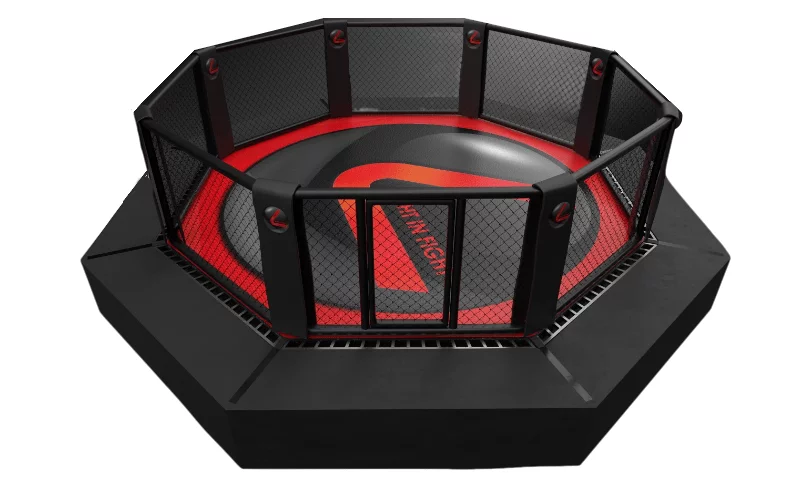
The octagonal footprint created a safer environment because it removes the sharp corners that were a major cause of injury. Additional safety measures followed: padded posts, padded floor, and a fence tensioned to keep athletes inside without turning the perimeter into a hazard.
Criticism did not stop, however. Lawmakers and health professionals argued that the cage encourages violence and has psychological effects on fighters and spectators alike. Supporters answered that a closed, controlled environment actually reduces the risk of injury. Either way, the unified rules were the turning point in the evolution of the cage.
The modern competition cage
Structures used today have little in common with the improvised barriers of the early days. Materials are lighter and more durable, padding is thicker, and barriers are stronger so that athletes cannot fall through or over the perimeter.
Commercially, the surface of the cage has become a medium in its own right: sponsor logos on the mat and on the padding generate revenue for promotions and give fighters visibility. For a club, the same surfaces are branding space for the gym itself.
Compared with other combat sports, the cage offers a more dynamic and more versatile environment. Athletes can use the fence to strike, to clinch or to escape, and the action does not have to be reset constantly as it is in boxing or kickboxing. That continuity is a large part of why the format works so well for spectators and for coaches running live rounds.
The debate around the cage
The cage has had its share of controversy. Critics consider that it encourages aggression and can cause serious injury, and the psychological effect on athletes and audiences is still discussed. Others argue that it gives fighters a structured, safe environment and lets spectators follow the action properly.
The debate is unlikely to end soon. What matters for an operator is simpler: a well-built, correctly padded and correctly anchored structure turns the safety argument into a technical question rather than an emotional one.
What comes next
There is still room for innovation. One avenue is broadcast technology built around the cage, from 360-degree camera positions to augmented reality overlays delivering live statistics during a fight. Another is the venue itself: the disruption caused by COVID-19 pushed promotions towards outdoor events with more space and better ventilation, and the UFC has already staged events in an open-air arena in Abu Dhabi.
MMA keeps growing, and the cage is part of the reason. The controversy around it may slow that growth in some markets, but the structure itself looks here to stay.
What this history means for a club buying a cage
Every design decision described above started as a safety problem: containment, corners, padding, anchoring. Those are exactly the points a professional buyer should look at, whichever format is chosen.
- A podium MMA cage raises the fighting surface, which suits promotions, galas and any venue where spectator sightlines matter.
- A floor-level MMA cage sits directly on the training floor and integrates into a daily class schedule with far less handling.
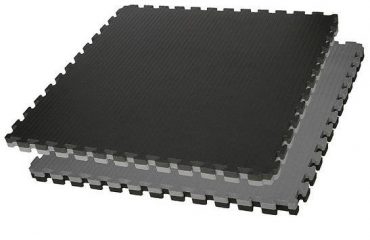
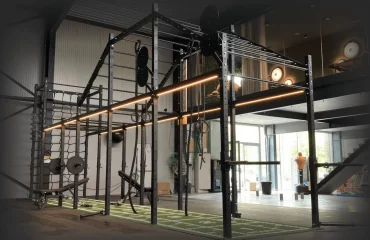
- Around the cage, the strength and conditioning area should be built with equipment certified to EN ISO 20957-1 class S, the professional class for indoor use, and with flooring able to take repeated impact.
Clubs that also run functional or hybrid classes often combine the cage with cross-training cages in the same room, so the floor plan has to be drawn before anything is ordered.
Frequently asked questions
Why is the competition cage octagonal?
Because the shape removes the corners where fighters used to get trapped, which the unified-rules era identified as a major cause of injury. An eight-sided perimeter keeps the athletes visible and keeps the action moving.
Podium cage or floor-level cage?
A podium is the right answer when the cage is used for events in front of an audience. A floor-level structure is the right answer when it is used mainly for training, because access is immediate and there is no platform to work around.
Can an MMA cage be used for other disciplines?
Yes. Clubs regularly use the same enclosure for grappling, wrestling, kickboxing drills and conditioning work, which is often what makes the investment viable in a mixed-discipline gym.
Planning your own cage project
The cage evolved because operators, athletes and regulators kept asking better questions about safety and usability. The same applies to a purchase: the right structure depends on your room height, your floor, your audience and the way your classes actually run. Send us your dimensions and your programme and we will come back with a configuration and a price. Request a quote and our team will work through the project with you.