50 mm EPDM Rubber Safety Tiles for Playgrounds
Une dalle EPDM de 50 mm couvre une hauteur de chute libre déterminée par le test HIC, selon la norme EN 1177. L'épaisseur se calibre équipement par équipement, en fonction de la hauteur de chute de chacun. L'EPDM apporte la tenue aux UV et la stabilité des coloris en extérieur.
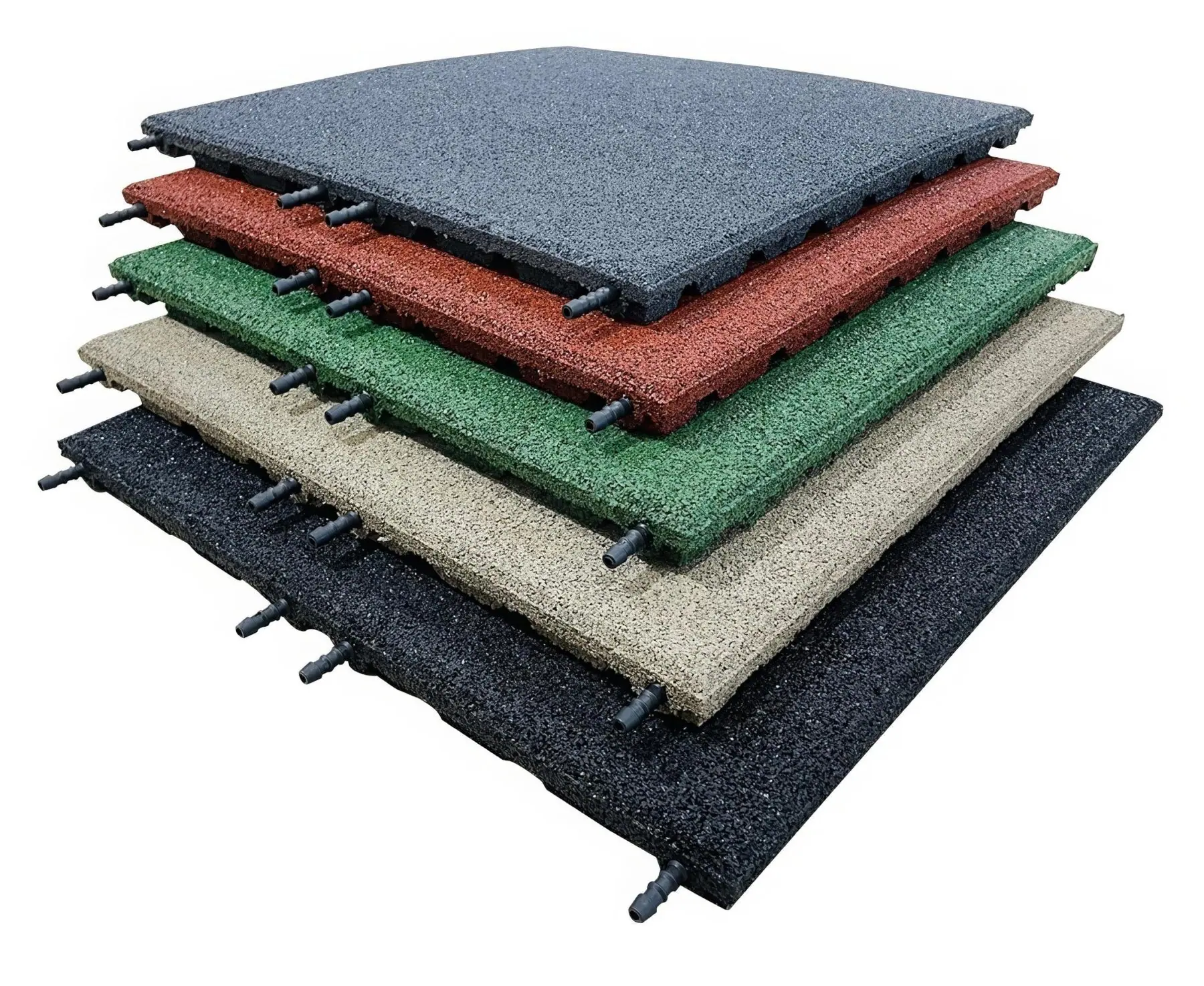
Playground safety starts at ground level. Whatever the equipment above it, the surfacing is what decides the outcome of a fall, and rubber safety tiles with an EPDM surface are one of the most reliable ways to deliver that protection on a permanent installation. A 50 mm tile is the common starting thickness. This article covers what an EPDM safety tile is, how the standard sets the thickness you actually need, how it compares with other surfacings, and how it is installed and maintained.
Definition and characteristics
A rubber safety tile is a moulded impact-attenuating surfacing designed for areas below and around play equipment. It is built from bonded rubber granulate, with an EPDM (ethylene propylene diene monomer) wearing surface on top. The 50 mm thickness is the standard entry point for playground use.
EPDM is what gives the tile its outdoor performance: resistance to UV, to weather and to temperature cycling, and colour stability over years of exposure. That last point matters more than it sounds. A coloured surfacing that fades unevenly makes a well-designed play area look neglected long before it stops performing.
Why EPDM on the surface
Compared with other surfacing materials, EPDM earns its place at the top layer. It holds its colour and its integrity under UV where cheaper compounds chalk and harden. The granulate structure underneath gives a surface that is even and comfortable underfoot rather than hard, which is what you want in an area children cross barefoot in summer and at speed all year.
Comparison with other surfacings
Set against SBR-only tiles, EPDM-topped tiles cost more but hold up considerably better under UV and keep their colour. Set against concrete or bound mineral surfaces, there is no comparison on safety: a hard surface offers effectively no impact attenuation, which rules it out under any free fall height. Rubber tiles also install straightforwardly, bonded with adhesive or mechanically fixed, whereas a poured or built surface is a construction job.
The standard that actually governs the choice
This is the part most specifications get wrong. Playground equipment falls under EN 1176-1. The impact-attenuating surfacing beneath it falls under EN 1177. These are two separate standards, and neither replaces the other. Adult outdoor fitness equipment, by contrast, falls under EN 16630, which has nothing to say about childrens surfacing.
EN 1177 works by determining the critical fall height of a surfacing: a headform is dropped onto the surface and the head injury criterion is measured, and the critical fall height is the maximum height at which the surfacing passes. The practical consequence for a specifier is direct. You do not pick a thickness and then place equipment on it. You take the free fall height of each item of equipment, and you specify a surfacing whose tested critical fall height covers it.
That means a single playground can legitimately need more than one thickness: 50 mm under low equipment, thicker tiles under a tall climbing structure or a slide platform. Ask the supplier for the tested critical fall height of the exact tile and thickness you are buying, and keep the test documentation with the installation file. A tile with no stated critical fall height is not specifiable.
Installing EPDM safety tiles
Preparing the substrate
Preparation decides how long the surfacing lasts. Clear the area of debris, gravel and anything else that would sit under the tiles. Check that the substrate is level, because an uneven base transfers straight through to the finished surface and changes how the tile performs. Build in a slight fall so water drains rather than sitting under the surfacing.
Fixing and jointing
Tiles can be bonded with an adhesive formulated for rubber surfacing, mechanically fixed, or interlocked with connecting dowels to form a continuous field. Several projects use a combination: bonded perimeter, interlocked field. Whichever method is used, alignment and joint closure are what matter. A joint that opens becomes a trip hazard and lets water into the base.
Practical installation advice
Follow the manufacturer instructions on application temperature and adhesive cure time. Work in dry, temperate conditions for the best bond. Start from one corner of the area and work outward, which keeps the courses square. When the field is complete, walk the whole surface and inspect it for defects, lipping and open joints before it is handed over.
Maintaining a rubber safety surface
Durability
EPDM-topped tiles are built to stay outside. They resist weather and temperature swings and keep attenuating impacts for many years, which is what makes them economic despite a higher entry price than loose-fill surfacings that need topping up.
Cleaning and inspection
Clean the surface periodically to remove dirt and debris that would otherwise work into it. A pressure washer is effective, but keep the pressure moderate: too high a setting damages the wearing layer. Combine cleaning with a visual inspection, which is how you catch damage while it is still a repair rather than a replacement.
Repairs and replacement
Tiles do occasionally need attention, from wear or from equipment dropped on them. Act quickly: a damaged tile compromises the surfacing locally, which is exactly where a fall is likely. Minor damage can be made good with matching material; a tile that is badly damaged should be replaced rather than patched, and the replacement must be the same specification so the tested performance is not degraded. Keeping a small stock of spare tiles from the original batch is the cheapest insurance there is, both for performance and for colour match.
Where EPDM tiles are used
Public playgrounds are the main application, particularly landing zones under swings, slides and climbing structures, where the equipment fall height drives the surfacing specification. The playground surfacing range pairs directly with the playground equipment range, which is the sensible way to buy: one supplier holding both the fall heights and the tested surfacing.
Beyond public play areas, the same tiles are used by nurseries, schools and leisure centres, around pool surrounds and on residential schemes. The related rubber gym flooring tile range covers indoor sports use, which is a different specification for a different job: do not substitute one for the other.
Frequently asked questions
Is 50 mm always enough?
No. 50 mm is the standard starting thickness, and it covers a moderate free fall height. Taller equipment requires a thicker tile. The determining figure is the tested critical fall height of the surfacing versus the free fall height of the equipment, item by item.
Can EPDM tiles be used under adult outdoor fitness equipment?
Adult outdoor fitness equipment is governed by EN 16630, not by EN 1176-1 and EN 1177. The surfacing requirement is determined by that installation, not by playground rules, so specify it separately rather than assuming a playground tile transfers across.
Can the tiles be coloured?
Yes. The EPDM top layer is available in a range of colours and holds them under UV, which is what allows colour-coded zones and graphic layouts that still look right several years in.
Specifying the right surfacing
The right tile is the one whose tested critical fall height covers your tallest piece of equipment, laid on a base that drains. Light In Fitness has been supplying professional sports and play surfacing since 2013, for local authorities, schools, nurseries, campsites and residential schemes. Send us the equipment fall heights and the area to be covered and request a quote: you will get the tile specification, the thickness per zone and the installation priced separately.
Réalisations documentées
- Parcours ninja sur mesure, Rennes – îlot des Hautes-Ourmes
- Double mur ninja extérieur, Sallanches – Haute-Savoie
- Dalles et sols sportifs : livraisons documentées – plusieurs chantiers
- Sol sportif extérieur, square Georges-Vallerey – Taverny (95)
Sources et références
- Décret n° 96-1136 du 18 décembre 1996 – prescriptions de sécurité relatives aux aires collectives de jeux (Légifrance)
- NF EN 1176-1 – Équipements et sols d’aires de jeux, partie 1 : exigences de sécurité et méthodes d’essai générales (AFNOR)
- NF EN 1177 – revêtements de surface amortissants : détermination de la hauteur de chute critique (AFNOR)