Black Artificial Turf Track for CrossFit: Specification and Installation
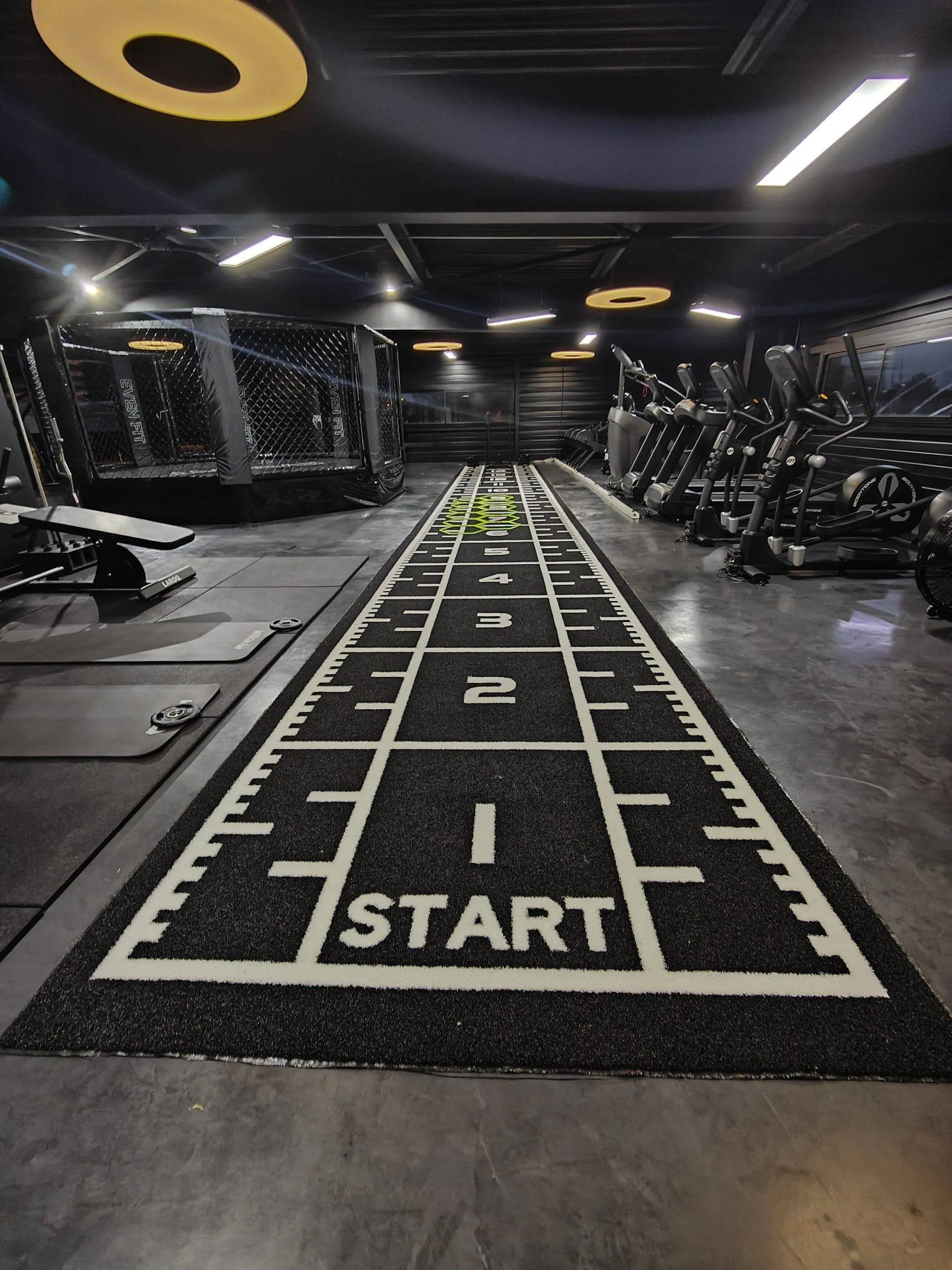
The artificial turf track is now a standard element of a cross-training box, a functional zone or a competition warm-up area. It defines the sled lane, it takes the abuse that a rubber floor does not, and in black it gives the training area a visual identity that photographs well. This article covers what the surface is, what it actually does for a facility, the colours and lengths available, and how to install and maintain it.
What an artificial turf track is
A turf track is a roll of short-pile synthetic grass, laid as a lane across the training floor. The pile is deliberately short and curled: long fibres would flatten under a loaded sled and would trap dust and chalk. The result is a firm, non-slip running and pushing surface rather than a decorative lawn.
Its main uses are sled pushes and pulls, sprints, prowler work, farmer carries, tyre and bag drags, and the movement patterns that make up the running portion of functional competition formats. Browse the range of artificial turf tracks to see the widths and configurations available.
Why operators choose black
Black turf is the option most often specified for indoor functional zones. It marks the sled lane clearly against a rubber floor, it does not show chalk and rubber dust the way lighter colours do, and it gives the space the darker, industrial character most boxes are designed around. Green, blue and red are equally available where the branding calls for them.
What the surface actually delivers
Grip for explosive work
The short curled pile gives a firm, non-slip contact for driving a sled or accelerating from a standing start. That is the property the lane is bought for, and it is what a smooth rubber floor cannot provide.
Comfort underfoot
Turf laid over a suitable underlay is easier on ankles and knees than bare concrete or a thin rubber layer. The shock absorption comes from the build-up beneath the turf, not from the pile itself, so the underlay is part of the specification rather than an optional extra.
Protection of the sled and the floor
A turf lane takes the wear of steel sled runners and keeps it off the rubber tiles and the structural floor around it. It is far cheaper to replace one lane than a whole floor. Explore the power sleds that run on it.
Very low maintenance
No watering, no mowing, no fertiliser. Routine care is a brush along the pile direction and a vacuum or blower for dust and debris. That is the whole programme.
Outdoor durability
The material is weather-resistant and UV-stable, which makes the same product usable for an outdoor training lane or a container gym apron, provided the sub-base drains properly.
Colours and dimensions
| Option | Available |
|---|---|
| Colours | Green, blue, red, black |
| Standard roll lengths | 10 m and 20 m |
| Made-to-measure lengths | From 15 m to 30 m |
| Branding | Logo personalisation available |
A reference configuration is the 20 m x 2 m black curled turf track, short pile, which suits most indoor sled lanes without joins.
Made-to-measure lengths are produced to order, so the manufacturing lead time is longer than for a standard roll. Confirm the current lead time for your market before committing to an opening date.
Installing the lane
- Prepare the substrate. The floor beneath must be flat, clean and dry. Any unevenness will be visible and will be felt underfoot once the turf is down.
- Specify the underlay. Decide the shock-absorbing build-up with the rest of the floor, not afterwards. It governs both comfort and impact noise for the rooms below.
- Plan the lane, not just the roll. Allow run-off space at both ends of a sled lane and clear circulation beside it. A lane that ends at a wall cannot be used at full speed.
- Fix the edges. Joins and perimeters are taped or bonded so that the lane cannot creep under repeated sled loading.
- Let it settle. Rolled goods need time to relax flat after unrolling before the edges are finally fixed.
Maintaining it in service
- Brush along the pile direction on a regular schedule so the fibres stay upright in the sled path.
- Remove chalk, dust and debris with a vacuum or blower.
- Inspect edges and joins where the sled turns; those are the first points to lift.
- Deal with spills promptly rather than letting them dry into the pile.
Frequently asked questions
Is a turf track suitable outdoors?
Yes. The material is weather- and UV-resistant. The critical point outdoors is the sub-base and its drainage, not the turf itself.
Can the lane be branded?
Yes. Logo personalisation is available, which is why many boxes specify a black lane with the club mark on it.
Does turf replace rubber flooring?
No. Turf is specified for the sled and sprint lane; the lifting and drop zones still need rubber. The two are complementary, and the transition between them should be planned at design stage.
What width should the lane be?
That depends on whether one or two athletes work side by side and on the sled being used. Take the width from the intended use and the product sheet rather than from a general figure.
Specifying your track
Lane length, width, colour, underlay and the transition to the surrounding floor all depend on the room and on the programming. Share the dimensions and the intended use and the specification can be built from there. Request a quote for a costed turf and flooring proposal.