Essential CrossFit Equipment: A Complete Guide for Box Operators
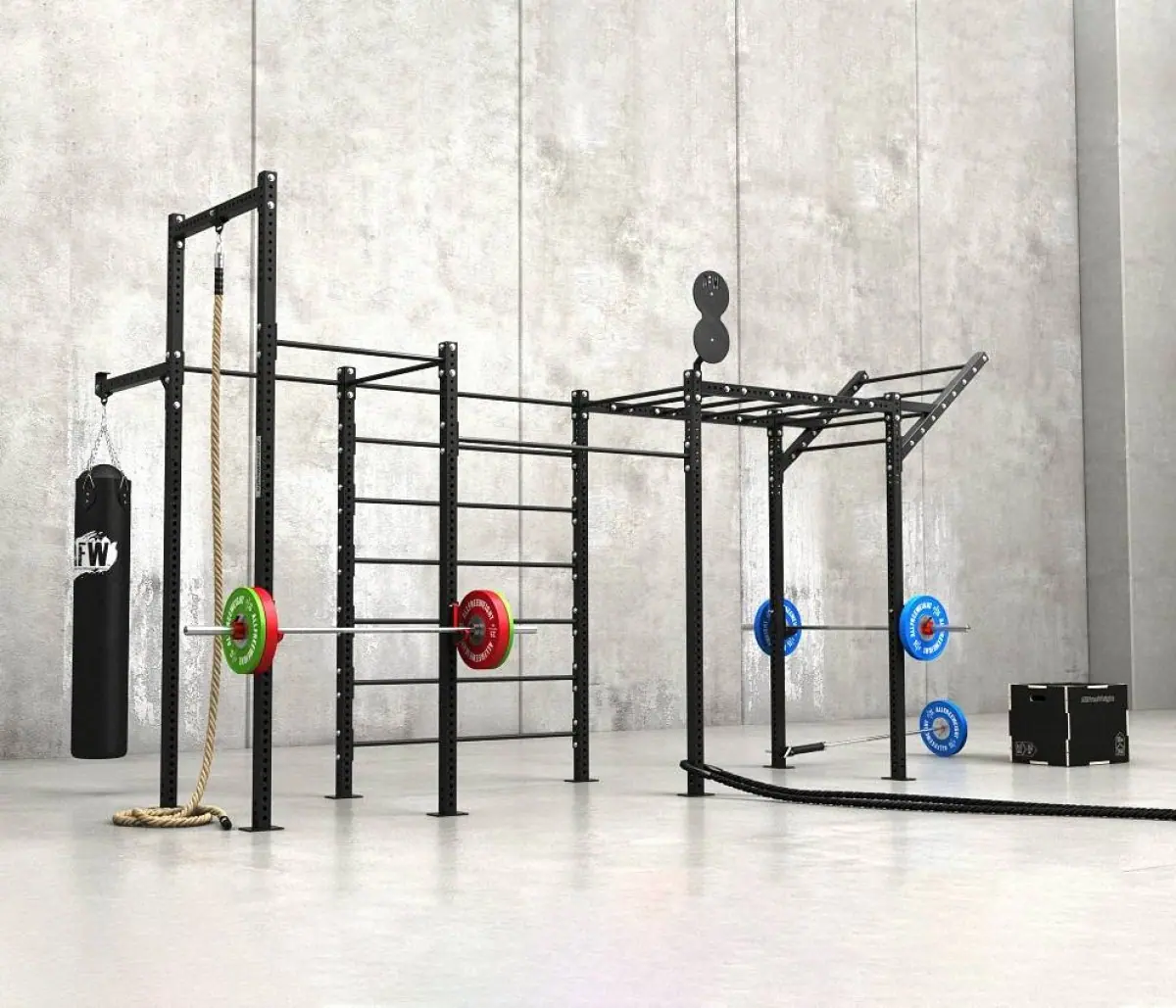
Equipping a CrossFit box comes down to four blocks: a structure to hang from, external load, conditioning machines and a floor that survives all three. Everything else is refinement. This guide sets out what a professional operator actually needs to open or upgrade a box, and how to specify each block so that it lasts under commercial use.
The core kit every box needs
Whether the site is a 200-member affiliate, a hotel functional area or a military conditioning hall, the same short list keeps coming back.
- A pull-up structure. The single most used piece of equipment in the room. It carries pull-ups, toes-to-bar, muscle-ups and gymnastic work, and it defines how many athletes can train at once. In a professional setting this means a fixed rig, not a bar clamped to a wall.
- Barbells and plates. Olympic bars with bumper plates are the backbone of the strength portion of every class. Rubber bumpers are non-negotiable: they let athletes drop safely and they protect both the bar and the floor.
- Dumbbells. Versatile and space-efficient, they cover snatches, thrusters, lunges and carries. A fixed rack in graded increments serves a whole class without reconfiguration.
- Kettlebells. The cast-iron bell with a handle is the tool of choice for swings, cleans and Turkish get-ups, and it develops power, explosiveness and muscular endurance in one movement pattern. A full professional kettlebell set in progressive weights is what makes a class scalable across ability levels.
- Skipping ropes. Simple, cheap and highly effective for conditioning, agility and coordination, in warm-ups as much as in metcons.
- Mats. Essential for floor work: core exercises, push-ups and stretching all need a surface that is comfortable and easy to clean.
Beyond that base, resistance bands, gymnastic rings and medicine balls extend what a coach can programme. The point is not quantity: it is choosing equipment whose build quality matches the number of sessions it will absorb per week and that keeps athletes safe under fatigue.
Accessories: what the box supplies, what the athlete brings
A recurring question for operators is where the line sits between facility equipment and personal kit. In practice, protective accessories belong to the athlete and the box simply informs.
- Lifting belt. Recommended when athletes handle heavy loads; it keeps the trunk stable and helps prevent injury.
- Knee sleeves. Useful protection for squats, lunges and any movement that loads the knee joint repeatedly.
- Wrist wraps. Extra support for the wrist during barbell and dumbbell work.
- Hand protection. Grips or gloves protect the palms from abrasion and tears on bars and rings.
- Sports watch. Lets athletes track heart rate, session time and progress over the season.
None of these replace coaching, but a box that stocks a small retail selection of them adds a margin line and removes a friction point for new members.
Footwear: the advice your coaches should give
Shoes are part of the equipment conversation even though the box does not buy them. A training shoe for this discipline needs stability for lateral movement and jumps, cushioning to absorb landings, a rubber outsole with real grip so the foot does not slide on the training surface, enough flexibility for natural foot movement, and breathability. Advise members to try several models and test them in class rather than buying on appearance.
Conditioning machines
Classes are not only barbell work. The conditioning side needs machines that load the whole body and survive interval abuse.
- Rowing machine. The most complete of the group, recruiting several muscle groups simultaneously and training both endurance and power. Our professional rowing machines are built for back-to-back class use.
- Air bike. A stationary bike with air resistance, ideal for high-intensity intervals and cardiovascular capacity.
- Climbing rope. A demanding tool that trains upper-body muscular endurance and grip while raising the heart rate.
- Ski ergometer. Simulating the cross-country ski movement, the ski ergometer gives a full-body workout and is now a fixture in competition programming.
These four give a coach enough variety to vary the stimulus across a training week without duplicating equipment.
The rig and the floor: the two structural decisions
Accessories can be replaced in an afternoon. The rig and the floor cannot, so they are the two line items to specify carefully. A CrossFit and HYROX cage determines training capacity per square metre, the number of stations, and what can be attached later – rings, ropes, storage, monkey bars. Indoor structures are specified to EN ISO 20957-1 class S, the reference for equipment used in professional, supervised facilities.
Underneath, the floor absorbs every dropped barbell. Rubber tiles or rolls of adequate thickness protect the slab, cut structural noise transmission and keep the surface safe when wet. Getting the floor wrong is the most expensive mistake a new box makes, because it is replaced with the rig already bolted on top of it.
How to specify your equipment
Facing a crowded market, a simple method keeps decisions sound.
- Define the objective. Affiliate box, hybrid gym, hotel functional area and rehabilitation centre do not need the same list. Start from the programming, not from the catalogue.
- Compare on build, not on price. Look at steel gauge, welds, coatings, bearing quality and the warranty behind them, then compare like for like.
- Set a budget and phase it. Structure and floor first, load second, accessories last. A phased fit-out beats a complete one made of fragile equipment.
- Test before you commit. Where possible, handle the equipment. Grip diameter, knurling and bearing feel are things a specification sheet does not convey.
- Ask people who run boxes. Experienced coaches and operators will tell you what broke after eighteen months, which is the only durability test that matters.
Frequently asked questions
What is the minimum equipment to open a box?
A rig, a set of Olympic barbells with bumper plates, dumbbells, kettlebells, skipping ropes and a rubber floor. Conditioning machines and gymnastic accessories come next, once class sizes justify them.
Can domestic-grade equipment be used in a commercial box?
No. Equipment used in a supervised professional facility is specified to EN ISO 20957-1 class S, which covers the load cycles and the safety requirements of continuous group use.
Should I buy the rig or the flooring first?
The floor is laid before the rig is anchored, so both are specified together. Deciding on the rig later means either drilling through a finished surface or rebuilding it.
Building your equipment list
Light In Fitness has equipped over 2,500 customers since 2013, from single-room affiliates to full container gyms. Send us your floor area, ceiling height, expected class size and programming, and we will return a specified list, a layout and a structure that matches them. Request a quote to get started.
À lire aussi sur le même thème
- Why avoiding snacking is worth it: weight, blood sugar and gut health
- CrossFit Rig or Power Rack: Equipping a Private Training Space
- Rack CrossFit: L’outil essentiel pour une séance d’entraînement réussie
- Entraînement fort des cuisses – les meilleurs exercices pour les parties inférieures, exemple de plan d’entraînement
- Obliques abdominales – les meilleurs exercices pour les obliques abdominales