Managing a Diet for Strength Training: Calories, Macros and Timing

Diet is the question members ask their coach most often, and the one on which they receive the most contradictory answers. The subject is not complicated in its structure: energy balance decides the direction, macronutrients decide the composition, and timing and consistency decide how much of it survives contact with a working week. This article sets out that structure in order, so that a coach or a club can give a consistent answer instead of an anecdote. Individual dietary plans, and any situation involving a medical condition, belong to a qualified nutrition professional.
1. Energy balance sets the direction
The body uses energy, measured in kilocalories, to maintain vital functions at rest and to fuel activity. The first component is the basal metabolic rate, which varies with age, sex, body weight and thyroid activity. Adding daily activity and training to it gives total energy expenditure. As an order of magnitude, average total expenditure is around 2500 kcal per day for an adult man and around 2000 kcal for an adult woman, figures that move considerably with activity level and individual factors.
- Intake above total expenditure: body weight goes up.
- Intake below total expenditure: body weight goes down.
What determines gain or loss is the surplus or the deficit, not the presence or absence of a particular food. For building muscle, a surplus of 250 to 500 kcal per day is the usual recommendation: enough to support tissue growth, small enough to limit the fat that comes with it. For losing weight, the same logic applies in reverse.
2. The three macronutrients
| Macronutrient | Role | Usual intake | Sources |
|---|---|---|---|
| Protein | Muscle protein synthesis and repair | 1.6 to 2.2 g per kg of body weight; around 1.8 g per kg is the common working figure, so about 126 g for a 70 kg person | Eggs, white meat, fish, low fat dairy, protein powder, pulses, tofu |
| Fats | Hormone production, cell membranes | In the region of 1 g per kg of body weight, which on a typical intake represents roughly a fifth to a quarter of total calories | Vegetable oils, nuts, oily fish, avocado |
| Carbohydrates | Training energy, muscle glycogen | Fill the remaining energy requirement once protein and fat are set, adjusted to the goal | Oats, brown rice, sweet potato, vegetables, fruit |
Protein can be animal or plant based. Animal sources are generally more efficient per gram for muscle growth, which does not prevent a plant based diet from meeting the same requirement with attention to quantity and variety.
Carbohydrates are the macronutrient most often cut by people worried about their weight, and the one whose absence is felt first in the gym. They refill muscle glycogen, which is what supports intense sessions on the basic lifts. Complex sources are the base of the intake; the distinction between fast and slow sources matters mainly around training.
3. Distributing intake across the day
Protein is best spread evenly across meals rather than concentrated in one, which keeps availability constant through the day. Carbohydrates are prioritised around sessions, before for energy and after for recovery. Fats are taken across the day; a large quantity immediately after training slows gastric emptying and delays the absorption of what was eaten with it, which is the practical reason to keep the post-training meal lower in fat.
A protein and carbohydrate intake after the session supports recovery. Protein rich snacks such as whey or essential amino acids can be used around sessions when a full meal is not practical, without replacing it.
4. Tracking, and enough flexibility to last
Tracking intake for a few weeks is what turns estimates into figures, and tracking applications make it fast enough to be sustainable. The point is not to weigh food indefinitely: it is to learn what a day that meets the targets actually looks like. Occasional deviations are normal and do not undo a week; a strict plan that generates frustration is a plan that gets abandoned, which costs far more than the deviation.
5. Supplements: useful, not central
Creatine, protein powders such as whey or casein, and essential amino acids can help reach an intake that food alone makes inconvenient. They supplement a balanced diet and do not replace one. Vitamin D3, omega-3 and a multivitamin have their place where a specific deficiency exists, which is a matter for testing rather than assumption.
6. Hydration and micronutrients
Hydration and micronutrients are the part of the plan that gets forgotten because nothing on the scale reflects them. Vitamins and minerals are involved throughout metabolism and recovery, and a varied diet rich in fibre, vegetables, fruit and whole grains covers most requirements without supplementation.
What this means for a club
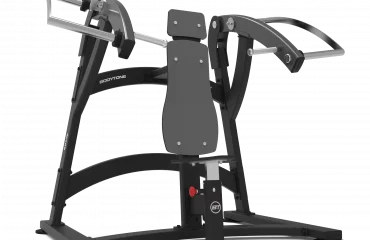
A member who eats well and trains on equipment that limits them does not progress, and neither does the reverse. The training side of the equation means enough stations to avoid queuing at peak hours, strength training machines that cover every movement pattern rather than three variations of the same one, and cardio equipment sized for the number of simultaneous users. That is the part a club actually controls.
Frequently asked questions
How much protein per day?
Between 1.6 and 2.2 g per kg of body weight for someone training with resistance, with around 1.8 g per kg as a common working figure. For a 70 kg person that is about 126 g per day.
Do carbohydrates have to be cut to lose fat?
No. Fat loss follows from an energy deficit. Cutting carbohydrates is one way of creating that deficit, not a requirement, and it usually costs training quality.
Is a surplus necessary to build muscle?
A moderate surplus, in the region of 250 to 500 kcal per day, supports muscle gain while limiting the accompanying fat. A larger surplus mostly adds fat.
Are supplements necessary?
No. They make certain intakes easier to reach. A diet that already meets its targets gains little from them.
Equipping the training side
Nutrition is only half of the result; the equipment members train on is the half a facility can specify. Send the dimensions of your room and the profile of your members, and the equipment can be built around them: request a quote.