Selectorised Chest Press Machines: A Complete Guide for Operators

The chest press is the movement most members will ask for by name, and the selectorised chest press machine is how most facilities deliver it. It is safe to leave unsupervised, it is quick to teach, and it works for a first-week beginner and a serious lifter on the same frame. This guide covers what the machine trains, how to set a member up on it, where it belongs on a floor plan, and what separates a well-specified machine from one you will regret.
What a selectorised chest press machine is
A selectorised chest press consists of an adjustable seat and back pad, a pair of handles connected through a linkage to a weight stack, and a pin that sets the load. The user presses the handles forward against the resistance until the arms are almost extended, then returns under control to the start position.
The defining characteristic is the guided path. The linkage determines the arc the handles travel through, so the user is not responsible for stabilising the load in space the way they would be under a barbell. That is what makes the machine appropriate for unsupervised use, and it is also the reason it behaves differently from a free-weight press rather than simply being an easier version of one.
The complete range sits in our chest press machines category, alongside the wider selectorised machines line.
What the movement trains
The chest press is a horizontal pressing pattern. The primary muscle is the pectoralis major, working with the anterior deltoid and the triceps, while the serratus anterior and the muscles around the scapula work to keep the shoulder blade positioned against the load. It is a compound movement, not an isolation exercise, and programming it as though it only trains the chest undersells it.
Because the frame handles stabilisation, the demand on the trunk and the smaller stabilising muscles is far lower than in a free-weight press. That is a feature in most contexts and a limitation in a few: a facility training athletes for a sport that demands stability under load needs free-weight pressing on the floor as well, not instead.
Why the machine earns its place
- Safety without supervision. The guided path and the pin-set load mean a member cannot be trapped under a weight they cannot control. On a floor where instructor coverage is thin at some hours, that matters more than any other single property.
- Speed of induction. Seat height, load, press, return. A new member is training productively within a few minutes, which frees instructor time for the members who need it most.
- Fine, fast load changes. A pin is faster than a plate change and allows smaller steps, which is what makes steady progression possible for beginners and for members returning from a lay-off.
- Rehabilitation and shoulder-sensitive members. The supported back and the controlled arc allow pressing work to be reintroduced with the load precisely managed. Any member with a shoulder history should have this cleared by a health professional first, and the setup checked by an instructor.
- Throughput. At peak hour, a machine that takes ten seconds to set up moves more members through the floor than one that takes two minutes.
Setting a member up correctly
- Seat height first. Adjust so that the handles sit at roughly mid-chest height when the member is seated with the back against the pad. Handles set too high drive the movement into the shoulder; set too low, the member presses downward and loses the pattern. This is the adjustment that decides whether the exercise works.
- Back and feet. The back stays in contact with the pad, the feet stay flat on the floor or the footplate. A member who has to arch off the pad to complete a repetition is using too much load.
- Set the load light to start. Technique before weight, always. A member should own the movement for a full set before the load goes up.
- Press and breathe. Press forward while exhaling, return slowly while inhaling. The return is where much of the useful work happens and it should be slower than the press.
- Do not lock out hard. Extend to almost straight, keeping a small amount of bend, rather than slamming the elbows into extension under load.
Members should be told to stop the set if they feel joint pain rather than muscular effort, and to raise it with an instructor rather than working around it.
Specifying the machine
Chest press machines vary more than they look, and the differences show up in daily use.
- Seat adjustment range and ease. A machine that adjusts across a wide range of body sizes, quickly and without tools, will be set up correctly. One that is awkward to adjust will be used at whatever setting the last member left it on.
- Load increment. Look at the smallest step in the stack and whether add-on weights are available. A stack with steps too large for a beginner limits their progression from the day it is installed.
- Handle options. Some machines offer both a neutral and a pronated grip position. That is genuinely useful for members with shoulder restrictions and costs nothing extra at specification.
- Converging or parallel path. A converging linkage brings the handles together as the arms extend, closer to the natural arc of the movement. Both work; know which you are buying.
- Frame, bearings and upholstery. Steel section, weld quality, sealed bearings and upholstery that survives continuous use are what determine whether the machine looks acceptable in year eight.
- Class of equipment. Indoor stationary training equipment for professional use falls under EN ISO 20957-1, class S. Ask for the documentation before you sign, not after an incident.
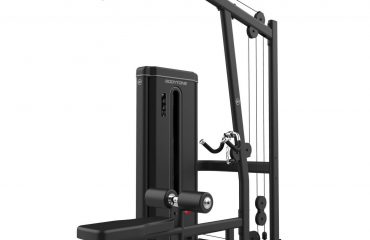
The Bodytone Forza FB01 chest press is a representative example of a machine built to that standard for continuous commercial use.
Where it fits on the floor
The chest press is one of the highest-traffic stations in any gym, which has two consequences for planning. First, one unit is frequently not enough: if your peak-hour occupancy sends four members towards the pressing area at once, one machine creates a queue and a poor member experience at the worst possible time. Second, it needs entry and exit space, not just its own footprint, and it should not be sited where a queue will block a walkway.
Position it near the rest of the upper-body pressing and pulling equipment so that a member can complete a logical block of work without crossing the floor repeatedly. That sounds trivial and it is one of the clearest differences between a floor laid out by someone who has run one and a floor laid out from a catalogue.
Frequently asked questions
What does a chest press machine train?
Primarily the pectoralis major, with the anterior deltoid and the triceps as significant contributors and the muscles around the scapula working to hold shoulder position. It is a compound horizontal pressing movement.
How often should members use it?
Two to three sessions per week covering horizontal pressing suits most members, with recovery between hard sessions. Frequency should follow the member’s programme and training experience rather than a fixed rule.
Is it suitable for members with shoulder problems?
It can be, because the seat and handle positions allow the movement to be adjusted and the load precisely controlled. Any member with a joint problem should be cleared by a health professional before starting, and the setup should be checked by an instructor.
Selectorised or plate-loaded chest press?
Selectorised for speed, fine increments and unsupervised use, which suits most memberships. Plate-loaded for facilities with a strong-training population who want a different resistance profile and independent loading. Larger floors carry both.
How many chest press stations does a gym need?
It depends on peak occupancy and how much of your programming routes through horizontal pressing, not on your total membership. We size this from your floor plan and your busiest hour.
Specifying for your facility
A chest press machine is a straightforward purchase that is easy to get slightly wrong: an adjustment range that does not fit your members, a load increment too coarse for beginners, or a single station where the traffic needs two.
Send us your floor plan, your peak occupancy and your membership profile and we will recommend a configuration and quantity, and tell you honestly where your plan is thin. Request a quote to begin.