Professional Strength Training Machines: A Buyer Guide

Strength training is the part of a facility that decides whether members stay. It is also the part that costs the most to get wrong: a machine chosen for its brochure rather than its duty cycle will be out of service within two winters, and a badly planned circuit wastes floor area that can never be recovered. This guide sets out how professional strength training machines are specified for commercial use, what separates the families from one another, and how to build a room that trains the number of people you actually have.
What a professional strength machine has to deliver
Three requirements sit above all the others.
Structural endurance. A commercial frame is loaded thousands of times a year by users who do not treat it gently. Welded steel sections, sealed bearings, guide rods that stay true under off-centre load and upholstery that survives cleaning products are what separate a machine that lasts a decade from one that develops play in a season.
Safety without supervision. Most repetitions in a commercial room happen with nobody watching. Safety catches on racks, end stops on guided paths, load pins that cannot be half-engaged and adjustment levers reachable from the training position all do the work a coach would otherwise do. This is exactly what EN ISO 20957-1 class S certification tests: the studio and club level for indoor equipment. Class I is also a professional class, intended for inclusive access rather than a higher intensity tier above class S.
Results that hold members. A machine that guides the movement correctly lets a beginner train hard on their first visit and lets an experienced lifter load properly. Both matter commercially: the beginner renews, and the experienced member does not leave for a better-equipped club down the road.
The families of strength equipment and how they fit together
- Selectorised machines. A weight stack and a pin. Load changes in one movement, which keeps circuits flowing and suits mixed-ability memberships, rehabilitation work and supervised group sessions.
- Plate-loaded machines. Olympic sleeves instead of a stack. Lower cost per station, a more natural strength curve and no stack to service, at the price of loading time and a plate storage requirement.
- Racks, cages and platforms. Squat racks, power cages and lifting platforms carry the free-weight work that no machine reproduces. A Gold Line squat rack and power cage is a typical anchor point for this zone.
- Benches. Flat, incline, decline and Olympic bench stations. An Olympic bench press station gives the pressing capacity that a selectorised chest press cannot fully replace.
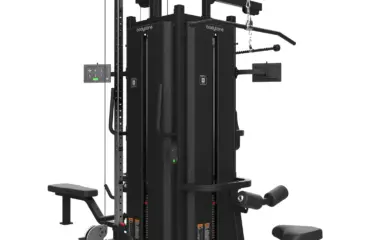
- Cable and multi-station units. Crossovers and multi-stations turn one footprint into several simultaneous training positions, which is decisive in a compact room.
The complete offer sits in our strength training machines range.
Choosing between the families
| Family | Best suited to | Plan for |
|---|---|---|
| Selectorised | Mixed-ability clubs, circuits, rehabilitation, hotels | Stack service access and clear circulation between stations |
| Plate-loaded | Strength-focused clubs, cross-training boxes | Plate storage next to every station |
| Racks and cages | Free-weight zones, athletic and team training | Impact flooring and ceiling height for overhead work |
| Benches | Every facility, at every size | Spotting space behind and beside the bench |
| Cable and multi-station | Small rooms, hotels, residences, corporate gyms | Cable travel clearance around the unit |
Ergonomics, materials and build quality
Ergonomics in a commercial room is not a comfort feature, it is a throughput feature. Seat and pad adjustments that can be made while seated shorten the time between users. Pictograms on the frame reduce the number of questions your staff answer each day. A movement path that fits users from the smallest to the largest means one machine serves your whole membership instead of half of it.
On materials, the questions worth asking a supplier are simple: what steel section and wall thickness, what finish, what upholstery density, what bearings, and what is covered by the warranty. Powder-coated heavy-gauge steel, sealed bearings and dense upholstery cost more at purchase and less over ten years. Cheap plastics and thin tube fail exactly where the load concentrates, and they fail in front of your members.
Where machines carry consoles or media, treat them as a maintenance item like any other: check that firmware, cabling and spare parts remain available for the life of the machine, not just the length of the warranty.
Facilities that need more than strength
Very few professional projects are strength only. A gym floor is usually planned alongside cardio, functional training and a stretching or recovery area. Municipal and educational clients often add outdoor equipment, and hotels combine a compact strength wall with cardio and free weights. Planning these zones together prevents the classic error of a beautiful strength area with no space left to warm up in.
Specification support, installation and warranty
The equipment list is the easy part. What determines whether a project works is the layout: how many stations fit, how people move between them, where the plates live, what the floor under the lifting zone is made of and how the room will be extended in two years. We work from your plan and your expected attendance rather than from a catalogue page, and the quotation reflects the room, not just the boxes.
Ask any supplier the same three questions before ordering: what is covered by the warranty and for how long, how spare parts are supplied, and who is responsible for assembly and commissioning. The answers separate a supplier from a shipper.
Frequently asked questions
Selectorised or plate-loaded for a new club?
Selectorised if your membership is broad and turnover between users is high. Plate-loaded if training is strength-focused and you want more stations for the same budget. Most rooms end up with both.
How much space does a strength area need?
It depends on the number of simultaneous users you plan for, not on the number of machines. Circulation space and the safety envelope around racks are part of the calculation from the beginning.
Does the floor have to be prepared first?
Yes for free-weight and platform zones, which need impact flooring, and for any room above an occupied level, which needs an acoustic underlay. Both are cheaper to specify with the equipment than to retrofit.
Can equipment be added in phases?
Yes. Agree the final layout first, then install in stages so anchor points, power and flooring are correct from day one.
Is home-use equipment ever acceptable in a commercial room?
No. Any room open to members, guests, employees, pupils or residents needs equipment certified for that use.
Get your strength area specified
Send us the floor plan, the ceiling height, the expected number of users and the disciplines you want to cover. You will get back a layout, a station count and a costed equipment list. Request a quote and we will work through it with you.
Réalisations documentées
- Functional Rig inox – installations sur trois continents
- iGreenMill, tapis de course extérieur – installations sur trois continents