Rowing Machine or Treadmill: Which Cardio Machine for Your Gym?
Rowing machine or treadmill? Every gym operator, hotel fitness manager and club buyer faces this question at some point, usually when floor space is tight and the budget only stretches to one more cardio bay. The honest answer is that the two machines do different jobs. This guide sets out what each one actually trains, how they differ in joint loading, and which member profile each one serves, so that the decision is made on operational grounds rather than on which unit looks better in the showroom.
The rowing machine: a full-body cardio and strength tool
A rowing machine, or rowing ergometer, reproduces the stroke of on-water rowing on a seated sliding rail. The user sits, straps the feet in, takes the handle, drives with the legs, opens the trunk and finishes with the arms. It looks simple; done properly it is one of the most complete movements available on a gym floor.
The reason operators like it is coverage: rowing recruits around 80% of the body’s muscle groups in a single, continuous movement. Legs provide most of the drive, the back and core transfer it, the arms finish the stroke. For a member who wants general conditioning rather than a single-discipline workout, that is a strong proposition, and it explains why rowers appear in almost every functional training zone and cross-training box.
Two practical points matter when you specify one. First, technique: the stroke has to be taught. Poorly coached rowing is inefficient and quickly becomes uncomfortable, so a rower deployed without an induction tends to sit unused. Second, storage: many professional rowers can be stood upright or separated after use, which changes what you can do with a small studio floor between classes.
Our range of professional rowing machines covers air, magnetic and hybrid resistance for club, hotel and functional-training use. A unit such as the Xebex Air Rower 3.0 is a typical choice for a high-traffic cross-training floor.
The treadmill: the machine members already know how to use
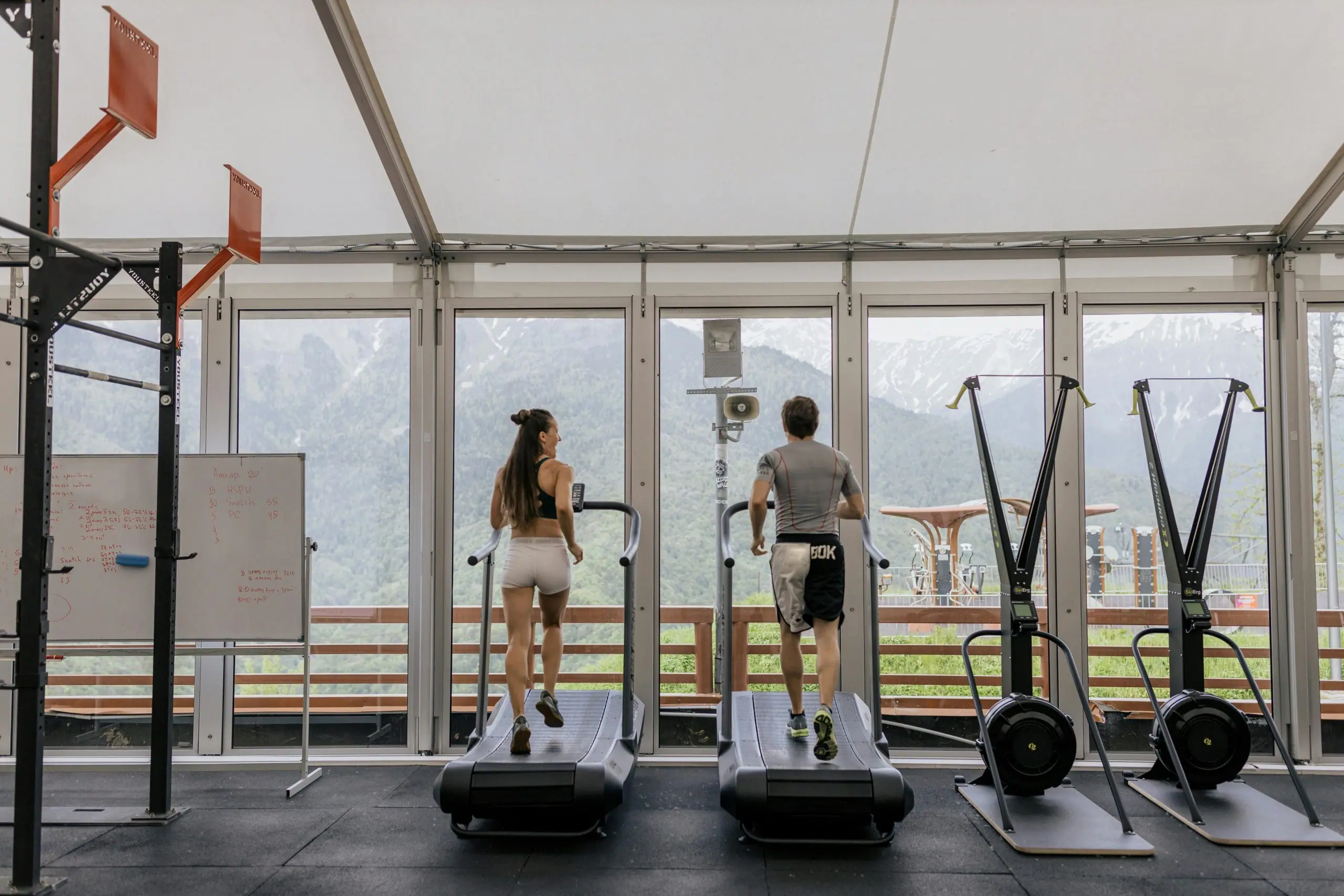
The treadmill needs no induction. A member steps on, selects a speed and an incline, and runs. That zero-friction adoption is precisely why treadmills remain the highest-utilisation machines in most commercial gyms and hotel fitness rooms, and why they are usually the first cardio line to be replaced when a club refurbishes.
What the treadmill trains is more focused than the rower: primarily the lower body, with a cardiovascular demand that scales cleanly with speed and gradient. For runners preparing for an event, for members whose objective is weight management, and for anyone who wants to keep a running routine going when the weather rules out being outdoors, it is the obvious answer.
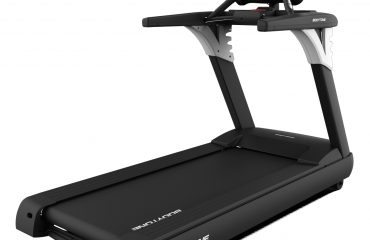
The trade-off is impact. Running is a repeated ground-contact activity, and members with knee, ankle or back problems need either a well-cushioned deck or a different machine altogether. This is not an argument against treadmills; it is an argument for reading your membership. Our professional treadmill range is built for continuous commercial duty, with cushioned decks intended for exactly this kind of sustained use.
Rowing machine vs treadmill: a side-by-side view
| Criterion | Rowing machine | Treadmill |
|---|---|---|
| Muscle groups involved | Around 80% of muscle groups, upper and lower body | Mainly the lower body |
| Joint impact | Low impact, seated and gliding | Repeated ground contact, higher impact |
| Cardiovascular demand | High | High |
| Learning curve | Technique needs to be taught | Immediate, no induction required |
| Typical use | Full-body conditioning, functional training, circuits | Running, endurance, weight management |
Read that table as a description of two complementary tools rather than a scoreboard. On cardiovascular demand they are close. On everything else they diverge, and the divergence is what should drive your purchase.
Who should choose the rowing machine
Specify a rower when your members are looking for whole-body conditioning in a limited amount of time. Recruiting around 80% of the muscle groups in one movement gives a short session a lot of training value, which suits hotel fitness rooms, corporate gyms and any site where the average session is thirty minutes rather than an hour.
It is also the machine to specify when joint comfort is a constraint. Members returning from injury, older members and rehabilitation clients can build cardiovascular fitness on a rower without the repeated impact of running. In a cross-training box, rowers are simply part of the standard kit: they take intervals, they take long steady pieces, and they can be programmed for a whole class at once.
Who should choose the treadmill
Specify treadmills when your membership contains runners, or when adoption without staff time is the priority. A treadmill is used correctly by almost everybody who steps on it, which makes it the safest utilisation bet in an unstaffed hotel fitness room or a residential building gym.
It is also the right machine for members training towards an event, for whom controlled speed and gradient work is part of a plan, and for weight-management programmes where members want a familiar, measurable session. If your floor already has rowers and no treadmill, you are almost certainly turning away the largest single group of cardio users.
Frequently asked questions
Which one burns more calories?
Both place a high demand on the cardiovascular system, and the energy cost depends far more on the intensity the member sustains than on the machine. Choose on muscle recruitment, joint loading and member profile instead.
Is a rowing machine suitable for members with joint problems?
It is low impact and seated, which makes it a common choice where running is not advisable. Any member with a specific medical condition should still follow the advice of their own clinician.
Do we need to teach members how to row?
Yes, and it is worth doing. A short induction covering the leg drive, the body swing and the arm finish is the difference between a rower that is used every day and one that is ignored.
If we can only buy one, which should it be?
Look at your members. A general fitness or functional-training floor with limited space gains more from a rower; a club or hotel serving runners and casual cardio users gains more from a treadmill. Most established gyms end up with both, in different proportions.
Specifying your cardio floor
The right mix depends on your site: available floor area, membership profile, staffing, and how the cardio zone is programmed. Tell us the surface you have, the number of members and the type of facility, and our team will propose a cardio layout and a costed configuration. Request a quote and we will come back with a specification built around your floor rather than around a catalogue page.