Private Training Room: What to Include and What to Buy
A private training room is a practical answer for anyone who does not enjoy crowded public facilities, and it becomes a necessity in towns where no club is within reasonable reach. Professional buyers meet the same question in a different form: a developer fitting out a residence, a hotelier converting a spare room, an employer building a staff facility all need to know what such a room must contain before it can honestly be called complete. Which equipment and accessories are needed for a genuine full-body session? And how should the room be programmed so that everything installed in it is actually used? This guide covers both, from the minimum kit to the extended fit-out.
What a private training room actually delivers
Before choosing equipment, it is worth being clear about what the room is for. The arguments below are the ones that decide most projects, whether the room serves one household or the residents of a whole building.
You train on your own schedule
A private room lets you train whenever you want. There are no opening hours to respect and no closures on public holidays. Just as importantly, you never wait for a machine to become free. Commercial clubs are congested at predictable times, usually late afternoon and early evening, and a crowded floor makes a well-structured session much harder to complete as written.
You save the travel time
Getting to a club and back consumes real minutes. For busy or overloaded people the round trip sometimes takes as long as the session itself. A room on site is therefore the obvious solution wherever time, not motivation, is the limiting factor, which is exactly why residences, hotels and workplaces install them.
Privacy and a calmer atmosphere
A private room gives a sense of privacy and calm. Public floors can be stressful for people who feel judged while they train, and beginners in particular often prefer to learn the movements without an audience. This is one of the strongest arguments in residential and hospitality projects, where the fitness room is a comfort feature rather than a commercial service.
The cost argument over the life of the room
There is an initial investment in equipment, and it is repaid over time by the memberships it replaces. The break-even point depends on local membership prices and on how many people use the room, so it moves considerably from one market to another. What holds everywhere is the direction of the calculation: the more users share the same room, the faster the equipment pays for itself, and a room used by a household, a staff team or a building of residents amortises far more quickly than one used by a single person. Run the figure with your own local membership prices rather than a borrowed benchmark.
The minimum equipment list
Assuming the space and the budget are available, the shortest list that still allows a complete strength session is the following.
| Equipment | Why it is on the list |
|---|---|
| Adjustable bench | Opens up flat, incline and seated variations from the same footprint. See the professional weight benches range. |
| Free-standing dumbbell handles | Separate from the bench, not built into it, so they can be loaded and stored independently. |
| Straight barbell | Around 180 cm is enough for a room of this size. |
| Screw or spring collars | So any load can be secured on the bar and on the dumbbell handles. |
| Weight plates | Prefer cast iron. Thick composite plates take up so much sleeve length that you cannot load much on a dumbbell. Around 100 kg to start is enough. |
| Training mat | An ordinary mat for abdominal work, glute bridges and floor mobility. |
Plates, collars and mats all sit in the fitness accessories category, which is usually the last line of the order and the one most often underestimated.
Is an Olympic barbell worth buying?
An Olympic barbell is generally stronger, more elastic and longer than a standard bar, and its loading sleeves are considerably wider in diameter. As a direct consequence, the plates that fit it need a much larger centre hole.
If the budget allows and you want equipment that is very solid and durable, an Olympic barbell is a sound purchase. Bear in mind, though, that you will then need one set of plates for the bar and another for the dumbbell handles, unless you also buy two short Olympic dumbbell handles matched to the same sleeve diameter. And to be honest about it, a private training room is not a competition powerlifting facility, so the decision is about durability and feel rather than about lifting standards.
Sample full-body programme with the minimum kit
The plan that runs easily on the equipment described above is a full body workout, or the classic push-pull format. Here is a full body workout split into session A and session B.
Session A
- Squat 3 x 10
- Glute bridge 3 x 10
- Barbell row 3 x 8
- Incline dumbbell press 3 x 12
- Seated dumbbell press 3 x 15
- Lying triceps extension 3 x 10
- Dumbbell biceps curl 3 x 12
Session B
- Deadlift 3 x 8
- Bulgarian split squat 3 x 10
- One-arm dumbbell row 3 x 8
- Flat dumbbell press 3 x 12
- Seated dumbbell press 3 x 12
- Two-handed dumbbell French press 3 x 12
- Barbell biceps curl 3 x 8
- Plank 3 x 30 sec
Run this plan three times a week in an alternating pattern. Week 1: Monday session A, Wednesday session B, Friday session A. Week 2: Monday session B, Wednesday session A, Friday session B.
What to add when you extend the room
The minimum list above covers a complete strength session. If you want to extend the room, the next purchases are:
- A pull-up bar, preferably fixed to the wall or ceiling with proper anchors.
- Parallel dip bars.
- A high and low pulley station, wall mounted.
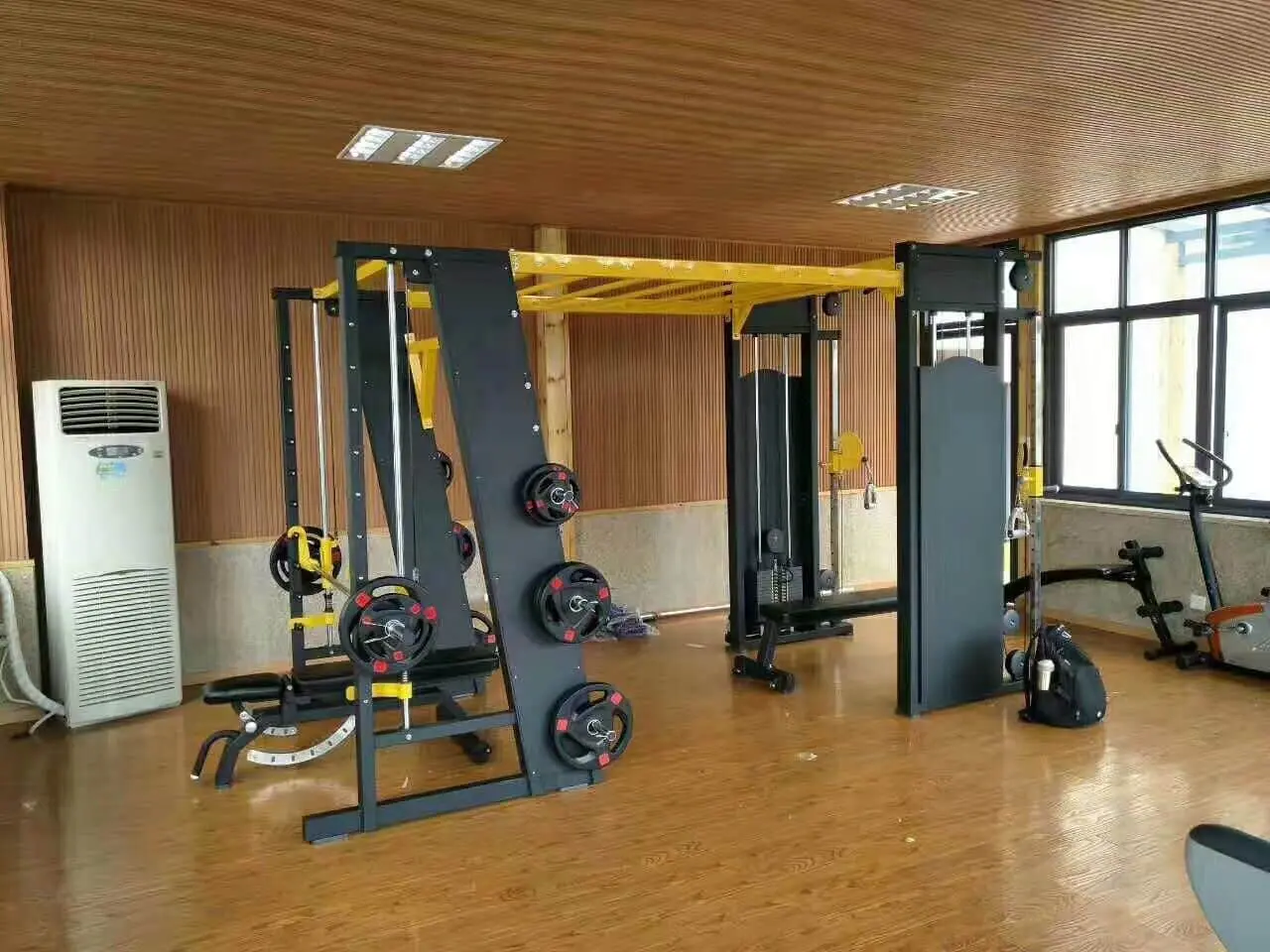
Cable work opens up the widest range of new exercises, but remember that pulley movements are normally a complement to the free-weight basics rather than a replacement for them. Keep a sensible proportion when you write the programme, so the plan does not drift entirely towards isolation movements. On the choice of station itself, the wall-mounted option is the better one: bench-mounted pulleys are less stable and less durable. Look at the cable and pulley stations range, and budget for the extra weight stack, the bars and the ropes that go with it.
Four-day upper and lower split with a cable station
Once the pulley station is installed, a four-day plan split between upper and lower body becomes possible.
Upper body A
- Barbell row 3 x 8
- Straight-arm lat pulldown 3 x 12
- Dips on parallel bars 3 x 6-8
- Incline barbell press 3 x 12
- Seated dumbbell press 3 x 15
- Front raise on the low pulley 3 x 15
- Barbell biceps curl 3 x 8
- Plank 3 x 30 sec
Upper body B
- Pull-ups 3 x 6
- Seated cable row 3 x 10
- Incline barbell press 3 x 10
- One-arm cable fly 3 x 12
- Military press 3 x 10
- Face pull 3 x 12
- Barbell French press 3 x 8
Lower body A
- Squat 3 x 10
- Romanian deadlift 3 x 10
- Hip thrust 3 x 8
- Bulgarian split squat 3 x 10
- Standing leg curl on the pulley 3 x 12
- Step-ups 3 x 10
Lower body B
- Deadlift 3 x 8
- Lunges 3 x 10
- Glute bridge 3 x 10
- Standing leg curl on the pulley 3 x 12
- Weighted crunches 3 x 30
Train four times a week, alternating the sessions: A, B, rest, A, B, rest, rest. The days of the week can be chosen freely; what matters is keeping the right frequency of work and recovery.
Is a multi-station worth buying?
The question comes up constantly. Does an all-in-one unit make sense in a room of this kind? In our view a multi-station is a good solution for older users as a complement to their general physical activity. It is worth knowing that training on a multi-station has the same value as training on individual machines; the debate about free weights versus machines is a separate one.
The clear advantage of a multi-station is the number of exercises it allows from a single footprint, but that is where most of its advantages stop. The weight stack is usually limited, and that ceiling may not be enough later on for effective training. A multi-station on its own is not the right tool for a programme designed to develop muscle optimally. If, however, the goal is simply to move the body regularly and to capture the health benefits of resistance training, a multi-station gym is a good option, and it is the format most often chosen for residence and hotel rooms precisely because it is compact and self-explanatory.
Specifying for shared use rather than single use
One point changes the specification completely: the number of people who will use the room. As soon as the space is shared beyond a single household, a residence, a hotel, a staff facility, a club room, the equipment falls under collective use and must be certified to EN ISO 20957-1 class S. That class is the professional specification for indoor equipment used in supervised or shared environments, and it governs frame strength, stability, pinch points and the durability of the moving parts.
Do not confuse it with class I, which is a professional class covering inclusive access rather than a level of intensity above class S. If the room is intended to be accessible, class I equipment is specified in addition to, not instead of, the class S requirement.
Flooring deserves the same attention. A shared room takes dropped plates, needs to protect the slab and has to keep noise out of the rooms below, which is what a proper rubber gym flooring system is for. Where the building imposes a fire performance for floor coverings, ask for the exact reaction-to-fire class in writing, including the smoke index, and check it against the building file before ordering.
Frequently asked questions
How much floor area does a private training room need?
It depends entirely on the equipment chosen and on the safety clearance around each station, so no single figure applies. Work backwards: draw the equipment list first, add the manufacturer safety zones around each item, and the required area follows. We size the room from the layout during the quotation, not from a rule of thumb.
Free weights or machines: which is better?
Both work. Free weights recruit more stabilising muscle and cost less per exercise covered; machines guide the movement, which matters for beginners, for older users and for any room used without supervision. A shared room usually needs some of each, weighted towards machines when nobody is on hand to coach.
Is a straight bar of 180 cm long enough?
For the room described here, yes. It fits the rack widths used in compact spaces and takes the loads a full body workout requires. A longer Olympic bar becomes relevant when the room grows towards a squat rack and heavier training.
Does equipment for a shared room have to be certified?
Yes. Indoor equipment for collective use must comply with EN ISO 20957-1 class S. Ask the supplier for the certificate that covers the exact model you are buying, not a general statement about the brand.
Planning your room
The equipment list changes completely between a single-user room and a room shared by a building, a hotel or a workforce, and so do the certification and the flooring. Send us the room dimensions, the number of expected users and the level of supervision, and we will return a layout and a costed equipment list. Request a quote and we will build the specification around your room rather than around a catalogue page.