Professional fitness equipment: what buyers should actually compare
Un équipement fitness professionnel se distingue par sa classe d'usage EN ISO 20957, la disponibilité de ses pièces et ses conditions de garantie en France. Ces éléments déterminent le coût d'exploitation bien plus que le prix d'achat. Light In Fitness fournit ces gammes avec devis, livraison, installation et SAV.
Fitting out a commercial site is not the same exercise as buying for a home. A hotel wellness room, a municipal sports hall, a rehabilitation centre and a cross-training box all place a very different kind of stress on the same machine, and they answer to different expectations. This guide sets out what a professional buyer should actually compare when specifying professional fitness equipment: usage classification, build quality, ergonomics, floor requirements and, above all, what the fleet will cost to keep running once the doors open.
What actually makes equipment professional
The word professional is used loosely in the fitness market, so the reliable starting point is the standard. Indoor training equipment is classified under EN ISO 20957-1, and equipment intended for supervised commercial use falls under class S. That classification is not marketing language: it sets requirements for stability, structural strength, entrapment prevention and endurance testing that a machine has to meet when it is used by people who did not buy it and have never read the manual.
One point is regularly misunderstood. Class I is also a professional classification, covering equipment designed for inclusive access. It is not a higher intensity tier sitting above class S. Choosing between them is a question of who will use the site, not of how hard they will train.
Everything downstream follows from the classification: frame gauge, weld quality, bearing specification, upholstery density and the way a machine behaves after several years of uninterrupted use by hundreds of different bodies.
Cardio: specifying for continuous duty, not peak speed
Treadmills are where the gap between consumer and commercial hardware is widest. In a staffed facility the machine is rarely switched off, users step on without warming the belt, and nobody reduces the incline before jumping off. What matters is therefore continuous motor rating rather than headline peak power, deck and belt life, the quality of the cushioning system, and how quickly a service technician can reach the drive components.
Our professional treadmill range is built around those criteria, with adjustable speed and incline, low-noise drives and cushioning designed to reduce joint impact across long sessions. The M003 professional treadmill is a typical example of the specification level expected in a commercial gym floor.
Beyond treadmills, exercise bikes, indoor cycling bikes, cross trainers and rowers each carry a different maintenance profile. Indoor cycling bikes are exposed to sweat corrosion and need serviceable bearings and a protected drive. Cross trainers and rowers are mechanically simpler but their consoles and heart-rate systems are the parts most often replaced. Programming matters too: preset interval programmes and readable displays are what keep a high-intensity class running without an instructor resetting every unit by hand.
Free weights and strength machines
A commercial strength area is usually built in two layers. Selectorised and plate-loaded machines give guided, controlled resistance, which is what makes them suitable for unsupervised members, beginners and rehabilitation work. Free weights – dumbbells, kettlebells, olympic barbells and bumper plates – cover functional and compound training and are far more space-efficient per user.
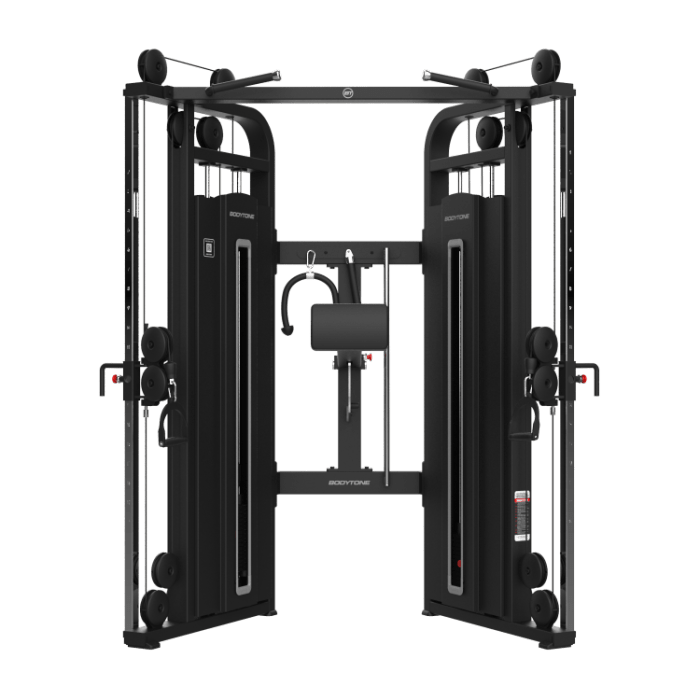
When comparing strength training machines, look at the weight stack guidance system, the cable and pulley specification, the adjustment range of seats and pads, and whether the machine can be reconfigured as your membership evolves. A machine that only fits one body size will sit unused in a facility serving a mixed population.
Storage is part of the specification, not an afterthought. Racks, trees and storage furniture keep loose weights off the floor, which is both a safety requirement and the difference between a strength area that looks maintained and one that does not.
Ergonomics and comfort as a retention tool
Ergonomics is often presented as a comfort feature. In a commercial context it is a commercial one. Members who find a machine uncomfortable simply stop using it, and equipment that goes unused still occupies floor space and still depreciates.
Practical markers are easy to check during a site visit: seat and pad adjustment that can be operated while seated, handles positioned so that wrists stay neutral, upholstery dense enough to keep its shape, and clear on-machine instructions for users training without supervision. Good ergonomics also reduces the number of incidents a site has to manage.
Flooring, footprint and load
Equipment specification and floor specification are a single decision. Free weight zones need shock-absorbing surfaces able to take dropped loads; cardio rows need dimensional stability and easy cleaning; functional zones often combine both. Rubber gym flooring is specified by thickness and density according to the drop energy expected in each zone.
Two other constraints are worth checking before ordering. Floor loading capacity, particularly above ground level or in converted buildings, determines where heavy plate-loaded equipment and free weight platforms can go. Where the flooring carries a reaction-to-fire classification, reproduce it exactly as stated in the technical file, including the smoke index, because the classification and its index are inseparable.
Total cost of ownership
What separates a professional purchase from a good-looking one is what happens in year three. Three factors drive the running cost of a fleet far more than the purchase price: the usage class the equipment was certified to, the availability of spare parts, and the warranty terms that actually apply in your country.
Ask for the specifics before signing. Which parts are held in stock and for how many years. What the warranty covers on the frame, on moving parts and on electronics, and whether it is reduced for high-traffic sites. Whether servicing is carried out on site. A machine that cannot be repaired quickly is out of service, and equipment out of service in a commercial facility is a direct revenue loss.
Frequently asked questions
Can equipment sold for home use be installed in a commercial gym?
No. Equipment for supervised commercial use must be certified to the professional class of EN ISO 20957-1. Installing lighter equipment in a facility open to third parties exposes the operator on both safety and insurance grounds, and the equipment will not survive the duty cycle.
Is class I better than class S?
Neither is better. Both are professional classifications. Class I covers equipment designed for inclusive access, which is what a rehabilitation centre, a care setting or a municipal facility with a mixed user base will typically need alongside class S equipment.
How much space should be allowed per machine?
It depends on the machine and on the circulation the layout requires, so the figure has to come from the technical drawing of each unit rather than from a rule of thumb. Send us your floor plan and we will produce the layout with real dimensions.
What should a professional quotation include?
Beyond unit prices, it should state usage classification, delivery, installation and commissioning, spare parts availability and warranty terms. Those items are what make two quotations genuinely comparable.
Getting the specification right the first time
Professional fitness equipment is judged over years, not over a first impression. Certified usage classification, ergonomics that keep members on the machines, flooring matched to each zone and a credible spare parts and warranty commitment are what turn a purchase into a facility that still works at full capacity several seasons later.
Light In Fitness has supplied professional fitness equipment since 2013 to gyms, hotels, sports clubs, local authorities, schools, rehabilitation centres and armed forces. Send us your project – surface area, user profile and opening hours – and we will come back with a specification and a costed proposal. Request a quote.