Playground equipment manufacturer: what actually separates one supplier from another
Buying a play area is not like buying a piece of gym equipment. You are commissioning an installation that will be used, unsupervised, by children who did not read the instructions, on a site you are legally responsible for, and that an inspector will look at years after your project team has moved on. The structures are the visible part. The standard, the surfacing and the documentation are the part that decides whether the installation survives its first inspection.
Light In Fitness designs, manufactures and installs play equipment from Tours, France, and has been supplying professional clients since 2013: local authorities, schools, campsites and holiday villages, hotels and resorts, social housing landlords and sports clubs. This article explains what actually separates one playground manufacturer from another, once you look past the renderings.
What a playground buyer is really buying
Four things, in this order of importance.
First, conformity: equipment designed and manufactured to the applicable standard, with the documentation that proves it. Second, a surfacing solution matched to the free fall height of every structure on the plan. Third, an installation carried out so that the free space around each unit is genuinely free. Fourth, and only fourth, the play value and the look.
Projects fail in that order too. A beautiful structure on the wrong surfacing is a liability. A correctly specified structure installed too close to a fence is a liability. Getting the sequence right at the design stage costs nothing; getting it wrong after installation costs a rebuild.
EN 1176-1 and EN 1177: two standards that never merge
Playground equipment for children is covered by EN 1176-1, which addresses the structure, materials, entrapment, protection against falls, and the information supplied with the installation. The impact attenuating surfacing underneath it is covered by EN 1177, which addresses what the ground has to absorb.
These two are complementary and never interchangeable. Quoting EN 1176-1 for a surfacing specification, or EN 1177 for a structure, is a documentation error that will be found. And a third standard sometimes appears in tenders where it does not belong: EN 16630 governs permanently installed outdoor fitness equipment for adults. It has no place on a children’s play structure. If your site serves both audiences, you are designing two installations, with two specifications and two sets of documents, even if they share a fence and a gate.
Browse the playground equipment range to see how structures are grouped, and the playground surfacing category for the ground solutions that go with them.
Age zoning: play, children’s fitness, adult fitness
The single most common design mistake is treating everyone under eighteen as one audience.
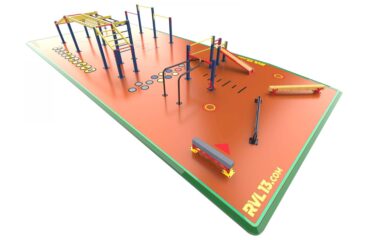
Toddlers need low structures, contained routes, low platforms and equipment scaled to short reach. Primary-age children want climbing, rotation, sliding poles, nets and swings, with enough challenge to hold their attention for a whole season. Teenagers, who are the group most often written out of a scheme and most likely to occupy it anyway, want equipment that looks like sport rather than like play: pull-up bars, calisthenics frames, ball courts, obstacle modules. Adults using the same site need a separate fitness zone specified under its own standard.
The children’s outdoor sports parks and kids outdoor fitness ranges exist precisely for that middle band, where a classic toddler play area no longer holds anyone’s interest.
Surfacing: the line item people forget until it is too late
Surfacing is regularly the largest single cost in a play area and the last thing to be priced. The requirement is driven by the free fall height declared by the manufacturer for each structure, so it is calculated unit by unit, not applied uniformly across the site.
Loose fill such as certified playground wood chips is economical, performs well and demands a real maintenance routine, because depth is what makes it work and depth is what traffic removes. Rubber tiles and bonded surfaces cost more up front and give a predictable, accessible, low-maintenance result, which matters wherever wheelchair access or year-round opening is part of the brief. Sand and gravel have their place and their drawbacks. Grass is not an impact attenuating surface, whatever a site meeting concludes.
Whichever you choose, specify the sub-base and the drainage. Most surfacing failures are drainage failures wearing a different coat.
Materials and site exposure
Choose the material for the exposure of the site, not for the mood board.
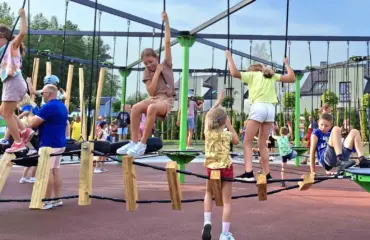
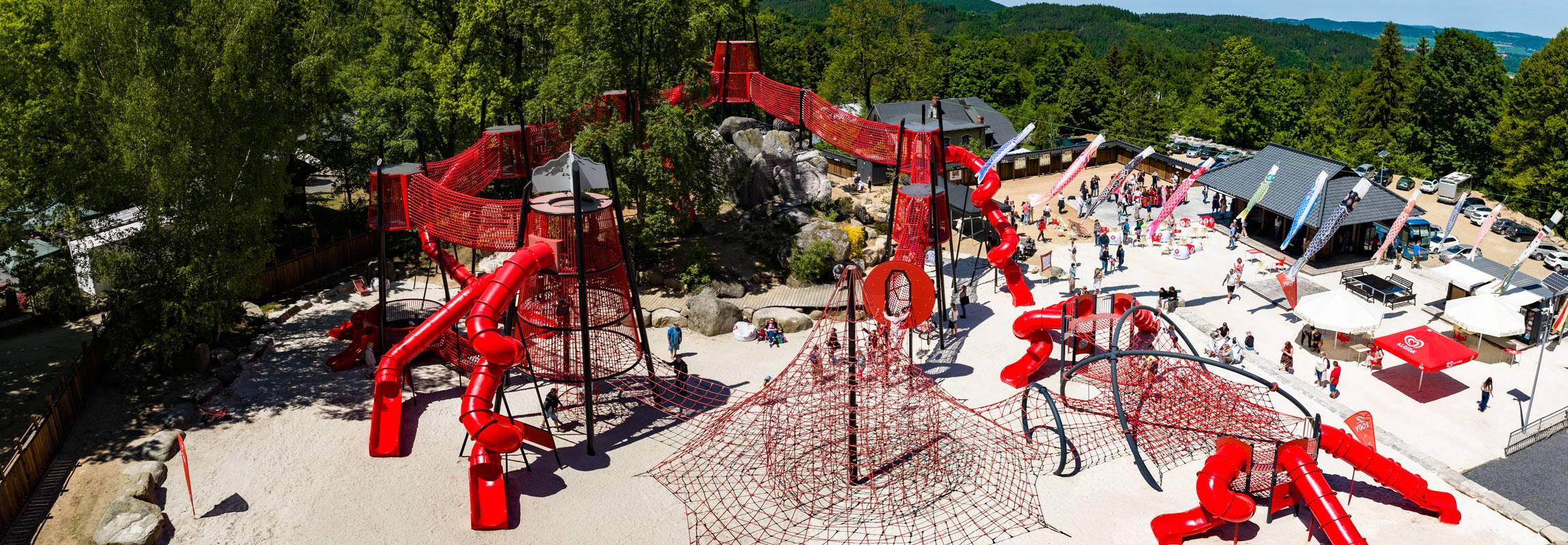
Timber suits parks, campsites and heritage settings and reads warm, and it asks for a genuine inspection routine at ground contact. Hot dip galvanised steel is the durable, repairable workhorse for high-traffic municipal sites. Stainless steel earns its premium near the coast, near pools and wherever maintenance resources are limited. Rope and net structures deliver a very high play value per square metre and depend entirely on the quality of the rope and its terminations.
Be consistent across a site so your maintenance team learns one routine rather than four.
Designing for who actually owns the site
A local authority is buying a twenty-year asset under public scrutiny, so documentation, spare parts and vandal resistance outrank novelty. A school is buying supervised playtime, so throughput at break time and clear sightlines from the staff position matter more than a signature structure. A campsite or holiday village is buying a reason for families to book again, so weather resistance across a compressed season, visibility from the terrace and a wide age spread carry the project. A hotel or resort is buying an amenity that must look right, sit quietly next to adult areas and never generate a complaint.
The same catalogue answers all four briefs, but not with the same layout. That is the part a manufacturer earns its place on.
Inspection, documentation and the life of the installation
From the day of handover you need three things in one place: the manufacturer documentation for every unit, the post-installation inspection report, and a written inspection schedule with a log that is actually filled in.
Plan routine visual checks into existing site rounds, a fuller operational inspection at the interval the manufacturer specifies, and an annual main inspection. Watch the items that fail first: fixings and ground anchors, rope terminations, timber at ground contact, moving pivots on swings and roundabouts, and the depth of loose fill under the busiest units. Every one of those is cheap to correct while it is small.
What manufacturing in Tours changes
Designing and building on our own site is not a marketing line, it is what makes three things possible: bespoke configurations that fit an awkward plot instead of forcing the plot to fit a catalogue, spare parts that remain available for structures that are already installed, and a technical conversation with the people who actually drew the part you are asking about.
For a professional buyer that is worth more than a discount. A play area that cannot be repaired in year six is a play area that will be fenced off in year seven.
Frequently asked questions
Which standard applies to our play area?
EN 1176-1 for the equipment and EN 1177 for the impact attenuating surfacing beneath it. Adult outdoor fitness equipment on the same site falls under EN 16630 and must be specified separately.
Can we install a play structure on grass?
Only where the free fall height of the unit allows it. Grass is not an impact attenuating surface in the sense of EN 1177, and its performance changes with weather and traffic. Work from the declared fall height of each structure.
How much space does a play area need?
Each structure has a declared footprint and a required free space around it, given in the manufacturer documentation. Free spaces must not overlap with each other, with fences, or with circulation routes. Layout is calculated from those drawings, not from the total area available.
Can a playground be adapted to an irregular plot?
Yes. Bespoke and modular configurations exist precisely for sites with trees, slopes, services or awkward boundaries. Send the survey and the constraints early; they shape the design rather than limiting it.
Who is responsible for inspections after installation?
The operator of the site. The manufacturer supplies the documentation and the inspection intervals; keeping the log and acting on findings sits with whoever owns or runs the installation.
Start with the plan, not the catalogue
A good play area is one that passes its inspection, absorbs a season of use without complaint, and holds the attention of the age group that actually lives nearby. Standard first, surfacing second, layout third, and finish last.
Send us your site plan, the age groups you need to serve and your constraints, and we will come back with a layout, a surfacing calculation and a costed proposal. Request a quote and we will work from your drawings.
Sources et références
- Décret n° 96-1136 du 18 décembre 1996 – prescriptions de sécurité relatives aux aires collectives de jeux (Légifrance)
- NF EN 1176-1 – Équipements et sols d’aires de jeux, partie 1 : exigences de sécurité et méthodes d’essai générales (AFNOR)
- NF EN 1177 – revêtements de surface amortissants : détermination de la hauteur de chute critique (AFNOR)