Children Outdoor Play Parks: How to Specify One Properly
A children outdoor play park is one of the few pieces of public infrastructure that gets used every single day, by users who cannot read the safety notice, without supervision from anyone who designed it. That combination is what makes specifying one a technical exercise rather than a shopping exercise. This guide sets out how a municipality, a school, a campsite, a hotel, a housing developer or a residential management company should approach it, from the standards that govern the equipment to the surfacing underneath and the inspection regime afterwards.
Light In Fitness manufactures and supplies outdoor play equipment for exactly these clients. The purpose of a well designed play park is straightforward: create a space where children can enjoy themselves while developing their motor skills and coordination, built from durable, safe materials so that the environment stays safe for years rather than months.
What a play park is actually for
Play equipment is fitted out with a variety of modules that stimulate imagination and encourage physical activity. Swings, slides, climbing structures and interactive play elements are the core of most installations. Each module is designed to offer a genuinely enjoyable experience while letting children develop physical competence, and the two goals are not in tension: children practise the movements that are fun to practise.
The developmental case is well established. Playing in these outdoor spaces develops balance, hand-eye coordination and muscular strength. Time spent outdoors also supports creativity and emotional wellbeing, which is why play provision appears in planning requirements and in school grounds strategies rather than only in leisure budgets.
The full range of playground equipment is organised by module family, which is the practical way to build an equipment schedule for a site.
The standards that govern the specification
This is the part of the decision that cannot be delegated to taste. Children playground equipment falls under EN 1176-1, and the impact attenuating surfacing beneath it falls under EN 1177. These are two different standards covering two different things, and both apply to a compliant installation.
EN 1176-1 governs the equipment itself: structural requirements, entrapment, protrusions, free space, falling space and the test methods that verify them. EN 1177 governs the surfacing: it defines how the critical fall height of a surface is determined, which is what allows a surfacing specification to be matched to the free height of fall of each item of equipment.
The practical consequence is that you cannot choose equipment and surfacing independently. Each module has a free height of fall stated by the manufacturer, and that figure determines the surfacing required beneath and around it. Get the equipment schedule first, then the surfacing follows from it.
Two further points matter. First, EN 16630 is the standard for permanently installed outdoor fitness equipment for adults. It must never be applied to children equipment, and children equipment must never be specified under it. Second, where a site is intended to serve both children and adults, the correct answer is separate, properly signed zones, each specified under its own standard, rather than one zone described as suitable for everyone.
Module families to build a schedule from
A coherent play park mixes module types so that different ages and different confidence levels all find something to do.
- Swing sets, in configurations for different age groups including cradle seats for the youngest.
- Play towers and elevated playhouses, usually combining climbing access, a slide and enclosed space.
- Rope play structures: climbing nets, rope pyramids, combined rope structures and rope play modules, which deliver a great deal of physical challenge in a compact footprint.
- Roundabouts and spring riders, which serve younger children and children who want movement without height.
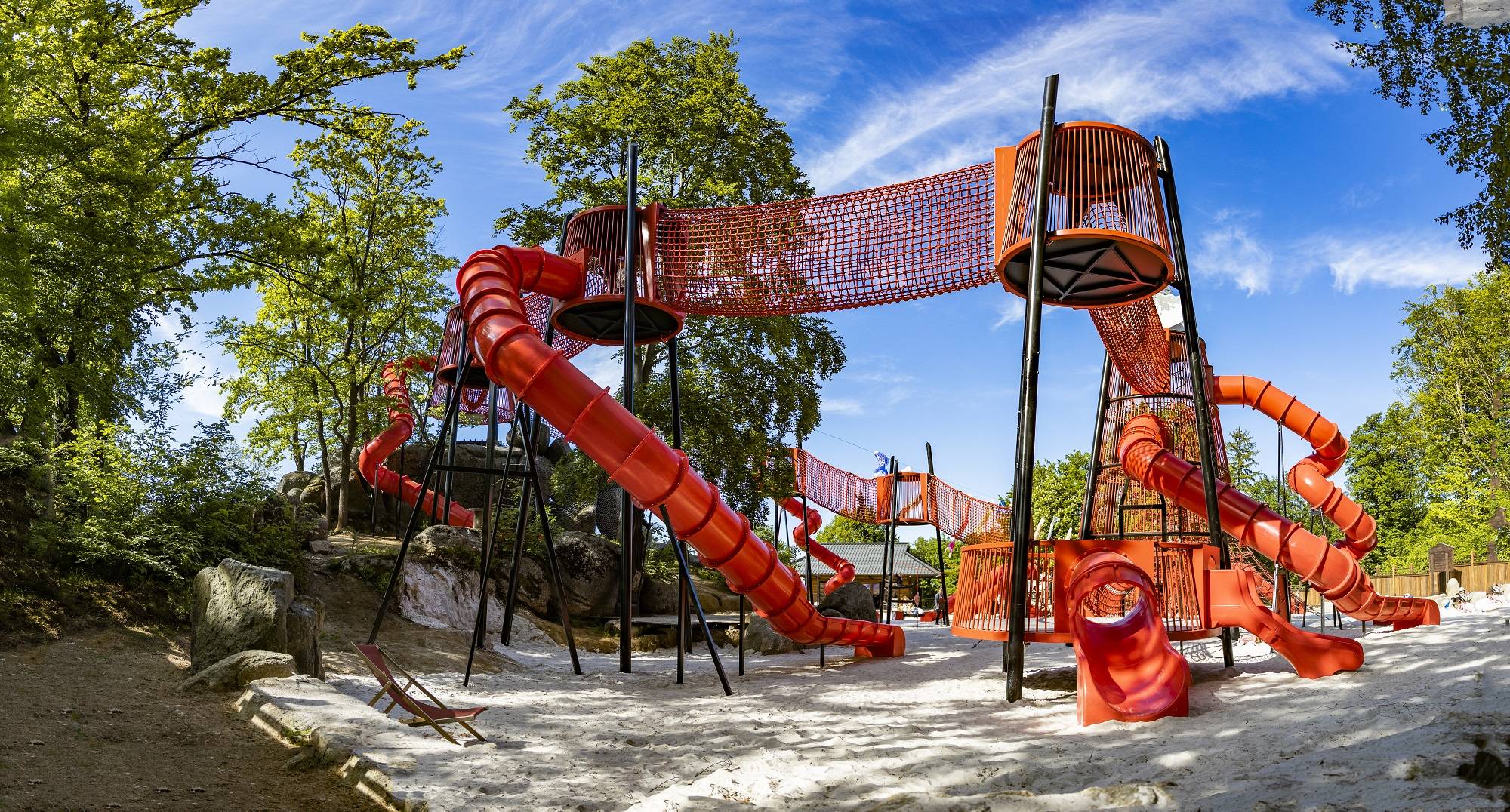
- Tubular play structures and complex combined configurations for larger sites.
- Bespoke structures where the site, the theme or the space requires something that does not exist as a catalogue reference.
- Site furniture: benches, bins, fencing and signage, which are part of the specification and not an afterthought.
Where a project also wants to provide for older children who have outgrown play equipment, dedicated outdoor fitness equipment for children exists as its own category, dimensioned for that age group rather than borrowed from an adult range.
Surfacing
Surfacing is where play park budgets are most often underestimated, and it is not optional. The surfacing under and around equipment has to attenuate impact to the critical fall height required by the equipment above it, and it has to keep doing so through years of weather and use.
Options include wet pour rubber, rubber tiles, artificial grass over a shockpad, and loose fill such as wood chips, each with a different critical fall height performance, a different maintenance profile and a different cost. Loose fill is cheaper to install and needs topping up and raking; bonded surfaces cost more initially and need far less routine attention. Accessibility also differs: a wheelchair crosses a bonded surface and does not cross loose fill. The playground surfacing options should be compared on all four of those axes rather than on price alone.
Materials and durability
Play parks are designed with durable, safe materials, because the environment has to stay safe without anyone watching it. Steel components need corrosion protection appropriate to the site, timber needs a specification suited to ground contact and weather, ropes need a core construction that does not fail invisibly, and every fixing needs to be tamper resistant. For coastal sites and anywhere exposed to de-icing salt, raise the corrosion specification rather than accept the standard one.
Ask about spare parts before you order, not after. A rope element, a swing seat or a bearing will need replacing long before the structure does, and a manufacturer who guarantees parts availability for the reference you install is worth more than one who does not, whatever the initial quotation says.
Installation, inspection and handover
Installation determines whether the equipment performs as certified. Foundations, free space and the distances between items are all part of the specification, not the installer discretion, and a post-installation inspection by a competent person before the site opens is the document that closes the project.
After handover, an ongoing regime applies: routine visual inspection, periodic operational inspection and an annual main inspection, each recorded in a site log. Budget for that regime at project stage. A play park without an inspection record is an operational and insurance problem regardless of how well it was specified.
Frequently asked questions
Which standards apply to a children play park?
EN 1176-1 for the equipment and EN 1177 for the impact attenuating surfacing. Both apply. EN 16630 covers adult outdoor fitness equipment and must not be used for children equipment.
Can adults use children play equipment?
No. Play equipment is dimensioned and load-rated for children. Where a site should serve adults too, specify a separate adult outdoor fitness zone under EN 16630, with its own layout and its own signage, and keep the two zones distinct.
How is the surfacing specification decided?
From the free height of fall of each item of equipment, which the manufacturer states, matched to a surface whose critical fall height meets or exceeds it under EN 1177. That is why the equipment schedule has to be settled before the surfacing is priced.
How much space does a play park need?
Each module has a free space and a falling space defined by the standard and by the manufacturer drawings, and those zones must not overlap in ways the standard prohibits. The total area comes from the schedule plus circulation, so it is produced on a scaled layout rather than estimated per module.
Does the site need to be accessible?
Accessibility should be designed in from the start: a level route to the zone, a surface a wheelchair can cross, and at least some play elements usable by a child who cannot climb. Retrofitting access after installation is almost always more expensive and usually more compromised than building it in.
Specifying your project
Work in this order: define the age groups, build the module schedule, derive the surfacing from the free heights of fall, then cost groundworks, installation, signage and the inspection regime alongside the equipment. That sequence produces a compliant park that is still safe in year ten. Detailed project quotations, with a scaled layout and a full equipment schedule, are available for municipalities, schools, campsites, hotels, housing developments and residential managers.
Réalisations documentées
- Cage street workout ultime, Carcassonne – armée française
- Cage street workout ultime, Tahiti – armée française, Polynésie
- Cage SP Max, centre EPIDE de Combrée – établissement public d’insertion
- Cage SP Max, lycée Saint-Bénigne de Dijon – établissement scolaire
Sources et références
- NF EN 16630 – modules fixes d’entraînement physique de plein air : exigences de sécurité et méthodes d’essai (AFNOR)
- Code du sport, article L322-2 – garanties d’hygiène et de sécurité des établissements d’activités physiques et sportives (Légifrance)
- Décret n° 96-1136 du 18 décembre 1996 – prescriptions de sécurité relatives aux aires collectives de jeux (Légifrance)
- NF EN 1176-1 – Équipements et sols d’aires de jeux, partie 1 : exigences de sécurité et méthodes d’essai générales (AFNOR)