Pilates in Your Gym: Is It Worth Adding?
In short: Pilates works the deep stabilising muscles through slow, precise, controlled movement rather than through intensity. For an operator, that makes it one of the few disciplines that serves absolute beginners, deconditioned members, older members and competitive athletes from the same timetable slot and the same room. The question is not whether the method works. It is whether you equip it as a mat class or as a reformer studio, because those are two different businesses.
Why operators are adding Pilates
Most facilities discover Pilates from the demand side. The members who never book a spin class book Pilates, and they book it repeatedly. It is low-impact, it does not require prior training culture, and it does not intimidate. For a club that has saturated its strength and cardio floor, it opens a segment the rest of the offer does not reach.
There is also a floor-space argument. A mat class needs a clear room and storage. A reformer studio needs a dedicated room but generates a premium class price per participant. Both use space that is often already under-performing: the underbooked studio, the room that only fills at two peak slots, the wellness area that is not paying for itself.
What Pilates actually is
Pilates is a system of exercise named after its creator. Joseph Pilates developed it for professional dancers and athletes, so that they could return to their discipline after injury without exposing themselves to a new one. That origin still explains the method: it is built around controlled loading of the trunk rather than around fatigue.
The system combines mobility work that increases range of motion with strength work that recruits the stabilising muscles. What distinguishes it from a general conditioning class is that quality of execution counts for more than intensity. A member doing eight precise repetitions is training correctly; a member doing thirty rushed ones is not.
Breathing is taught as part of the method, not as an add-on. So is concentration, because each movement is defined by a precise path. This has a practical consequence for you as an operator: Pilates does not work as an unsupervised, self-service activity in the way a treadmill does. It needs an instructor, and the quality of that instructor is the product.
Who it serves on your timetable
The method adapts to the level of the participant, which is why the same class structure can carry very different bodies.
- Deconditioned and sedentary members who need an entry point that is not a weights floor.
- Members returning from injury, in coordination with a physiotherapist where relevant.
- Older members, for balance, posture and confidence in movement.
- Trained athletes, who use it for trunk stability, balance and movement control alongside their main discipline.
- Corporate and hotel guests, for whom a short, low-impact, low-equipment session fits the stay.
Athletes are the segment most operators underestimate. Balance and trunk control transfer into almost every sport, and a Pilates slot on the timetable is often what keeps a semi-professional membership in the building on their recovery days.
Mat Pilates or reformer Pilates?
This is the decision that drives the entire equipment budget.
| Mat Pilates | Reformer Pilates | |
|---|---|---|
| Room requirement | Any clear multi-purpose studio | Dedicated room, machines stay set up |
| Equipment | Mats, small props, storage | Reformers plus accessories, one per participant |
| Class size | Limited by floor area | Limited by number of machines |
| Price point | Standard group class | Premium, usually a separate tariff |
| Instructor requirement | Pilates certification | Pilates plus reformer-specific certification |
| Typical buyer | Clubs, hotels, municipal centres | Boutique studios, premium clubs, rehabilitation centres |
Many facilities start with mat classes to prove the demand and convert to a reformer room once the timetable is full. That is a sound sequence, provided the room you intend to convert can actually take fixed machines and is not the room everything else already uses.
Equipping the room
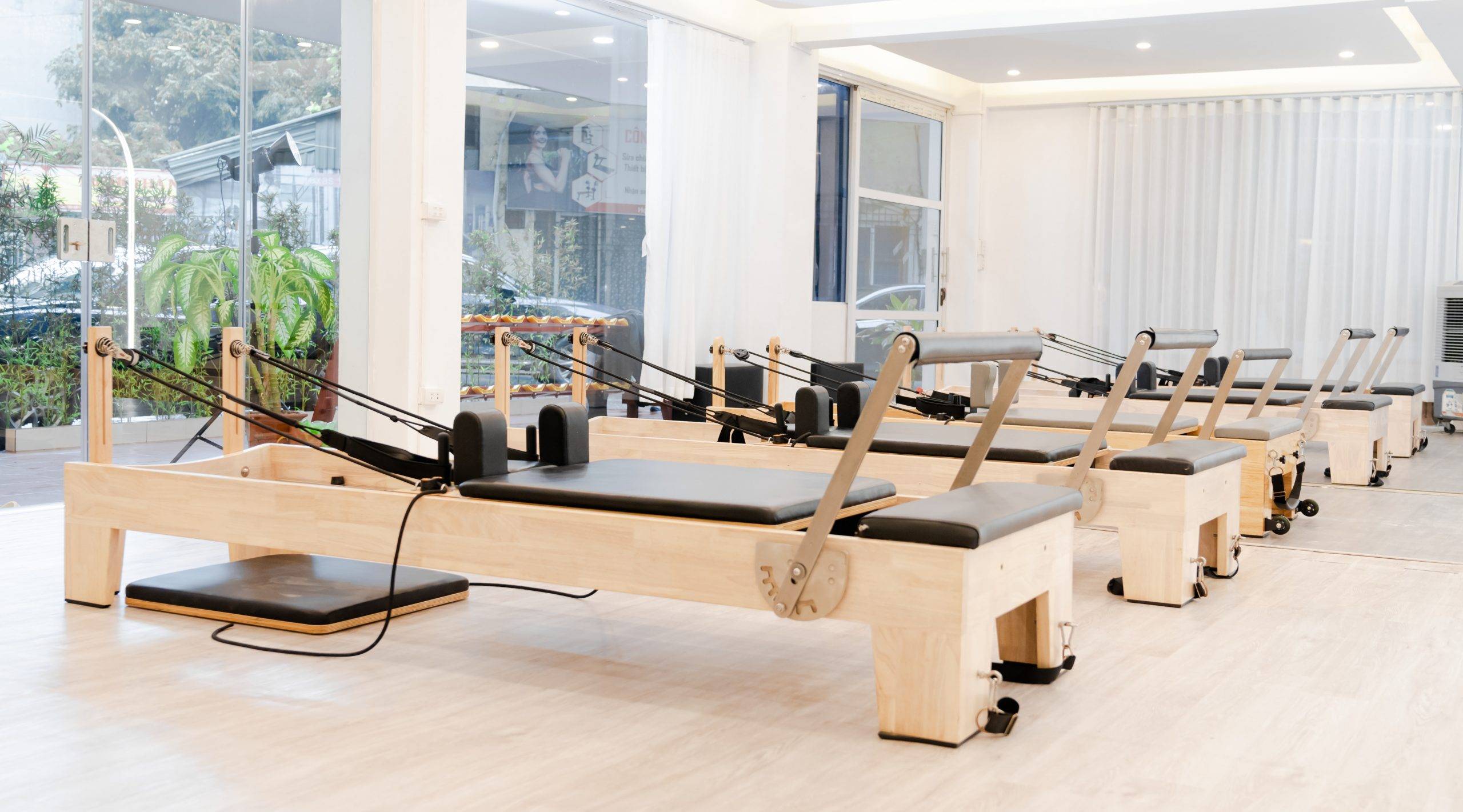
For a reformer studio, the machines are the specification. Frame rigidity, carriage travel smoothness, spring system, footbar adjustment and the ease of cleaning the upholstery are what separate a machine that survives a commercial timetable from one that does not. Browse the range of professional Pilates reformers and specify with a commercial duty cycle in mind, not a home one.
Around the machines you need the small apparatus that the method actually uses: resistance bands, stability balls, foam rollers, rings and blocks. These live in our Pilates studio accessories range, and they matter more than their price suggests, because they are what lets one instructor differentiate levels inside a single class.
For mat classes, the surface is the specification. A Pilates mat is thicker and denser than a yoga mat because the method loads the spine against the floor. Our fitness, gymnastics and Pilates mats cover both the participant mats and the studio underlay. If the room is also used for anything that drops weight, specify the floor build-up for that use, not for Pilates.
Indoor equipment for a commercial facility should be built and marked to EN ISO 20957-1 class S, the professional class for equipment installed in commercial premises. Ask for the class marking on the frame plate.
The room itself
Pilates is a quiet discipline, and it fails in a noisy room. If the studio shares a wall with a free-weights area or a spin room, the acoustic treatment is not optional. Natural light, controllable temperature and a floor that is clean enough to lie on directly are the three things participants notice first and comment on in reviews.
Storage decides whether the timetable actually works. A mat room that takes fifteen minutes to reset between classes loses a slot every evening. Wall storage for mats and props, sized for the maximum class, is a small line on the budget that protects the largest one.
Frequently asked questions
Is Pilates worth adding to a general fitness club?
For most clubs, yes. It reaches members that the strength and cardio floor does not, it retains them because progression is visible, and it can be launched as mat classes with a low equipment outlay before committing to reformers.
What does Pilates actually train?
It strengthens the deep stabilising musculature, improves spinal stability, develops body awareness and posture, and improves coordination and balance. Because sessions are slow and breathing-led, participants also report it as a low-stress session, which is part of why adherence is high.
Do we need reformers to offer Pilates?
No. Most of the repertoire is performed with body weight, supported by bands, stability balls and foam rollers. Reformers add loaded, spring-resisted variation and a premium price point, but they are an expansion of the offer rather than its entry ticket.
Can Pilates be run without an instructor?
Not credibly. Precision is the method, and precision has to be taught, particularly in the first weeks when participants do not yet have the body awareness the exercises assume. Budget for instructor cost as part of the business case, not as an afterthought.
How many reformers should a studio hold?
That is set by the room, by the clearance each machine needs around it and by the class size you intend to sell, so there is no universal number. Send us the room dimensions and we will lay it out to the machine footprint.
Specifying your Pilates offer
Pilates is one of the few additions to a timetable that improves retention across every member segment at once, and one of the few rooms whose equipment cost is genuinely modest at the mat stage. The mistakes are almost always spatial: the wrong room, no storage, no acoustic treatment, or reformers bought before the room was measured.
See the full Pilates reformer range, or send us your room plan and the class sizes you want to sell and we will come back with a specified layout: request a quote.