Outdoor Playground Manufacturer for Local Authorities: The Complete Guide
Light In Fitness fabrique et installe des aires de jeux extérieures conformes à la série EN 1176, avec sol amortissant certifié EN 1177. L'offre destinée aux collectivités comprend l'étude d'implantation, la fourniture, la pose et le dossier de conformité. L'épaisseur du sol se calibre sur la hauteur de chute libre de chaque équipement.
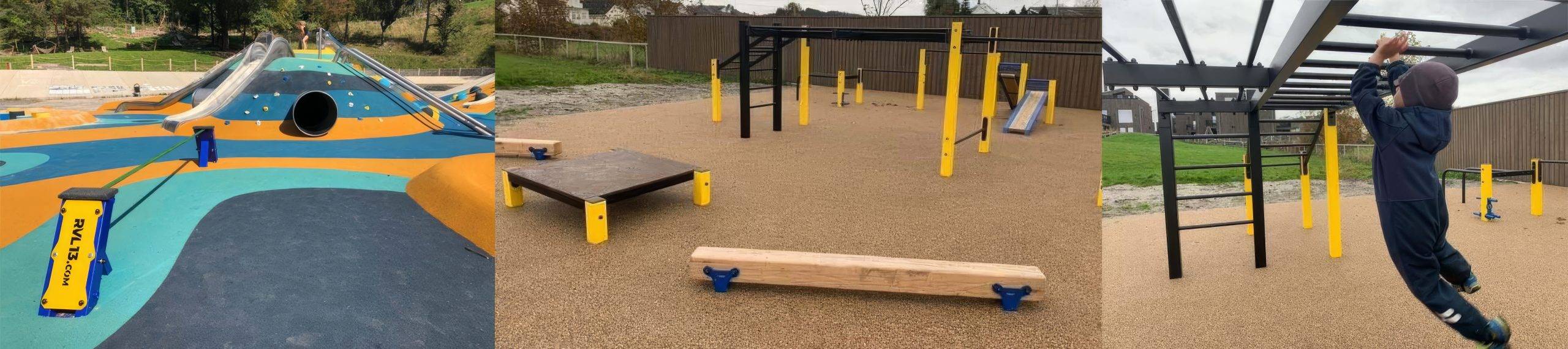
Specifying an outdoor play area for a council, a school, a housing association or a leisure operator is a very different exercise from buying equipment for a private garden. The buyer is responsible for public safety, has to justify the choice in a procurement file and will live with the maintenance burden for years. This guide sets out what an outdoor play area for public use actually involves: the equipment families available, the materials they are built from, the standards that apply and the safety points that decide whether an installation can be signed off.
Light In Fitness manufactures and installs outdoor play areas that comply with the EN 1176 series, with impact-absorbing surfacing certified to EN 1177. What we supply to public buyers includes the layout study, the equipment, the installation and the compliance documentation for the finished area.
What an outdoor play and activity area is
An outdoor play and activity area is a laid-out space where people can be physically active in the open air. In practice these projects combine two things that are often confused: play structures designed for children, and activity or fitness equipment designed for teenagers and adults. They serve different users, they follow different standards and, on a well designed site, they occupy separate zones.
Manufacturers in this field work directly with councils, schools, parks departments and other organisations to design and produce those spaces, from a single play structure in a village square to a complete sports park. Browse the outdoor playground equipment range to see the families available.
What these areas bring to a community
- Physical activity for people who do not join a gym – an open-air area is an alternative to an indoor facility, free at the point of use and available outside opening hours.
- A wider range of users – a site can be designed to welcome different ages and abilities, provided each zone is equipped for the users it is meant for rather than assuming one structure suits everyone.
- Social value – play and activity areas are meeting places, and they are one of the few pieces of public equipment that bring different generations onto the same site.
- Wellbeing – outdoor activity is widely recognised as beneficial to mental as well as physical health, and a pleasant, well-shaded site is used far more than a bare one.
- Public realm quality – a well designed area makes a park, a school ground or a housing scheme more attractive and more used, which is usually the argument that carries a funding decision.
The main equipment families
- Play structures for children – towers, decks, slides, climbing nets, a sliding pole, swings and spring riders. These are covered by the EN 1176 series and are specified by age range and by free fall height.
- Children outdoor fitness and motor skills stations – scaled-down walkers, wheels and balance equipment designed for children, which belong with the play area rather than with adult stations.
- Adult outdoor fitness stations – strength and cardio-type stations for teenagers and adults. These are covered by EN 16630, not by the playground standards, and are laid out as a separate zone with their own surfacing and signage.
- Obstacle and ninja structures – increasingly requested by schools and by sports-oriented projects for older children and adults.
- Paths and running loops – the cheapest element of any project and often the most used, provided the route is continuous and properly surfaced.
Where the brief is a complete site for children rather than a single structure, the children outdoor sports parks range groups the configurations designed for that purpose.
Materials
Outdoor equipment for public use is built from materials chosen to survive weather and heavy, unsupervised use.
- Stainless steel – used for structures and for fitness stations because of its durability and its resistance to corrosion, which is why it is the usual specification on coastal and poolside sites.
- Treated timber – used for structures and for site furniture such as benches, picnic tables and fencing, treated against insects, rot and weathering.
- Rubber surfacing – used under and around equipment to attenuate impact in the event of a fall. See the playground surfacing options.
Safety and compliance
This is the part of the project that a public buyer cannot delegate, and it is where most disputes arise at handover.
- Equipment standards – children play equipment is designed, manufactured and installed to the EN 1176 series, with EN 1176-1 setting the general safety requirements. Ask the manufacturer for the declaration of conformity for each item before installation, not after.
- Impact-absorbing surfacing – the surfacing under play equipment is a separate standard, EN 1177. The required thickness is calibrated on the free fall height of each item of equipment, which means the surfacing specification follows the equipment layout and cannot be decided independently of it.
- Do not mix the two regimes – EN 16630 covers adult outdoor fitness equipment and never applies to children play equipment. A site that puts adult stations inside a children play area, on playground surfacing, is a site that will fail inspection.
- Inspection and maintenance – play areas need routine visual checks and periodic inspection, with damaged or defective items taken out of use and repaired or replaced. A maintenance plan handed over with the site is worth more than any warranty.
- Signage – clear signs stating the age range, the rules of use and the operator contact are part of the installation, not an optional extra.
Frequently asked questions
What are the advantages of outdoor fitness equipment over an indoor gym?
Outdoor equipment is open to everyone, needs no membership and no staffing, and it reaches people who would never enter a gym. It complements an indoor facility rather than replacing it: it cannot offer the loading range or the climate control of an indoor floor.
Are these areas suitable for every age?
A site can be, but a single structure cannot. Play equipment is specified for defined age ranges under EN 1176, and adult fitness stations under EN 16630 are not intended for young children. The right answer for a public site is zoning: a children play area, and separately an area for teenagers and adults, each with its own equipment, surfacing and signage.
Are outdoor play areas safe?
They are designed to be, provided the equipment complies with the EN 1176 series, the surfacing complies with EN 1177 for the free fall heights on site, young children are supervised and the area is maintained. Safety on a play area is the result of those four things together, not of the equipment alone.
Which materials last longest?
Stainless steel and treated timber are the two materials specified most often for durability and weather resistance in heavy public use. The choice between them is usually driven by the setting and by the maintenance capacity of the operator.
Do these areas need regular maintenance?
Yes. Regular inspection and maintenance are required to keep an area safe and to protect its service life. Damaged or defective equipment must be taken out of use immediately, and the surfacing has to be maintained as carefully as the equipment: displaced loose fill or a compacted surface changes the impact attenuation the area was signed off with.
How do you choose a reliable manufacturer?
Look for a supplier with a track record on comparable public projects, ask for references, and ask to see the conformity documentation and the surfacing calculation for a project already delivered. A manufacturer who can produce those documents quickly is a manufacturer who produces them routinely.
Planning your project
A successful public play and activity area comes from matching the equipment to the users, keeping the children and adult zones distinct, and treating the surfacing as part of the equipment decision rather than as a finishing item. Send us the site plan, the age ranges you want to serve and the constraints of the location, and we will prepare a layout and an equipment list with the corresponding surfacing specification. Request a quote.
Réalisations documentées
- Parcours ninja sur mesure, Rennes – îlot des Hautes-Ourmes
- Double mur ninja extérieur, Sallanches – Haute-Savoie
Sources et références
- Décret n° 96-1136 du 18 décembre 1996 – prescriptions de sécurité relatives aux aires collectives de jeux (Légifrance)
- NF EN 1176-1 – Équipements et sols d’aires de jeux, partie 1 : exigences de sécurité et méthodes d’essai générales (AFNOR)
- NF EN 1177 – revêtements de surface amortissants : détermination de la hauteur de chute critique (AFNOR)
- NF EN 16630 – modules fixes d’entraînement physique de plein air : exigences de sécurité et méthodes d’essai (AFNOR)