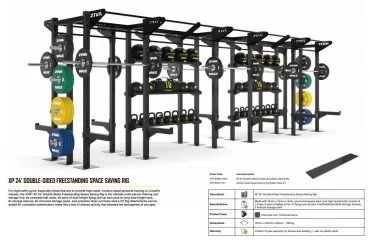
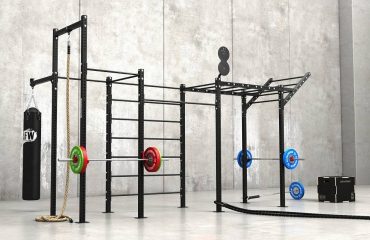
Outdoor CrossFit Rigs: Robust, Versatile and Built for Every Site

An outdoor CrossFit rig turns a car park, a rooftop, a campsite lawn or a stretch of municipal green space into a full training area. It has to do that while standing outside all year, unsupervised, in front of users who did not read a manual. That is a very different brief from an indoor rig, and it drives every decision below: materials, anchoring, surfacing and the standard the structure is certified to.
What an outdoor rig is for
Strength, gymnastics and conditioning on one structure
A single outdoor rig supports pull-ups, muscle-ups, dips, squats, presses, ring work and hanging exercises. Adjustable bar heights and bolt-on accessories such as gymnastic rings, dip bars and barbell supports let one structure serve a beginners class in the morning and a competitive session in the evening. That density of use per square metre is the main reason municipalities and operators specify a rig rather than separate stations.
Training in the open air
Outdoor training raises attendance in facilities where indoor floor area is the limiting factor. For a hotel, a campsite or a residence, a rig also extends the offer without building anything: the structure is delivered, anchored and commissioned in a matter of days.
Materials, build quality and service life
Steel and surface treatment
Outdoor rigs are built from galvanised steel, sometimes stainless steel, and are usually finished with a powder coating over the galvanising. The galvanising protects the substrate, the coating protects the galvanising and carries the colour. That double protection is what separates a structure that still looks presentable after ten winters from one that is rusting at the welds after three.
Structural design
Reinforced welds, generous wall thickness and solid connection hardware are what keep the structure stable under a kipping athlete or a heavy squat. Stability is a design outcome, not an accessory: it depends on the section of the uprights, the bracing and above all on the anchoring detail into the foundation.
Standards and safety
Outdoor adult fitness equipment falls under EN 16630, which covers permanently installed outdoor fitness equipment: loads, entrapment, free space around the structure, fall heights and information to be provided to the operator. This is the reference to ask for, in writing, before you order.
Two frequent confusions are worth clearing up. First, EN ISO 20957-1 class S applies to indoor stationary training equipment and is not the standard for an outdoor rig. Second, if the structure is intended for children or sits inside a playground, it is EN 1176-1 that applies to the equipment and EN 1177 to the impact attenuating surfacing. The two families are never interchangeable, and a supplier who quotes the wrong one has not understood your installation.
Groundworks, surfacing and installation
Why installation is the part that fails
Most problems with outdoor rigs are foundation problems, not equipment problems. Anchoring depends on the ground, on the load path and on the fall height of the highest bar. A structure bolted to a slab that was never designed for it will move, and movement is what loosens hardware and cracks welds.
Surfacing under the structure
The surface under and around the rig is part of the safety system, not a finish. Bonded rubber, rubber tiles and other outdoor sports flooring are specified according to the fall height of the equipment. Grass and bare tarmac are not, whatever the budget says.
Use a qualified installer
Manufacturer instructions have to be followed to the letter, and the installation should be documented so that the operator can prove it later. Working with a supplier who installs as well as sells removes the argument about who is responsible for what.
Where outdoor rigs are installed
The same structure serves very different clients. Outdoor gyms and boxes use it to add capacity outside. Municipalities, parks and leisure centres install it to give residents free access to quality equipment. Campsites, hotels and residences use it as an amenity that photographs well and costs almost nothing to run. Schools, clubs, rehabilitation centres and defence facilities specify it for structured programmes. Personal trainers use it as an outdoor studio. Our outdoor parkour and CrossFit parks range covers these configurations.
Cost and return on investment
An outdoor rig costs more up front than a set of loose equipment, and it lasts far longer. Because there is nothing to plug in, no console to fail and no upholstery to replace, the running cost is essentially inspection and occasional hardware replacement. Over a ten year horizon that changes the comparison completely. For a commercial operator, the structure also raises the perceived value of the site and supports retention, which is where the return actually comes from.
Specifying your rig
Start from the site, not the catalogue
Measure the usable area, note the ground type and the presence of a slab, count the users you expect at peak, and decide whether the installation is supervised or in free access. Those four answers narrow the choice faster than any feature list. A compact structure such as the Maxcomb outdoor cross-training rig suits sites where the footprint is fixed.
Compare like with like
When you compare quotations, compare the standard the structure is certified to, the steel section and treatment, whether foundations and surfacing are included, and what the warranty actually covers. Two quotations that look far apart usually differ on the groundworks, not on the steel.
Maintenance
Outdoor structures need little but they do need something: regular visual inspection of welds and hardware, cleaning, tightening, and prompt replacement of any damaged part. Keep a written inspection log. It takes minutes, and it is the first document requested if anything ever goes wrong.
Frequently asked questions
Which standard applies to an outdoor CrossFit rig?
EN 16630, the European standard for permanently installed outdoor fitness equipment. EN ISO 20957-1 class S is the indoor reference and does not apply here.
Does the rig need a special surface underneath?
Yes. The surfacing is specified from the fall height of the equipment, and grass or tarmac alone is generally not sufficient.
Can it be installed on an existing concrete slab?
Only if the slab was designed for the loads involved. The anchoring detail has to be validated for the actual foundation before installation.
How much maintenance does it need?
Visual inspection, cleaning and tightening on a regular schedule, plus immediate replacement of damaged parts. No servicing of moving parts or electronics is required.
Get a specification for your site
Send us the dimensions of the area, the ground type, the intended users and whether access is supervised. We will come back with a structure, a surfacing specification and a costed proposal: request a quote.