Manufacturer or Reseller of Gym Equipment: What It Really Changes for Your Facility
On paper, everyone sells strength and cardio equipment. In practice, the difference between a manufacturer-distributor and a straightforward reseller can be the difference between a floor that runs without incident and one that limps along for ten years. For new clubs, for public authorities and for any operator who cannot afford improvisation, understanding that difference has become a strategic question rather than a procurement detail.
What a manufacturer-distributor actually is
A manufacturer-distributor designs its own ranges, controls quality, stocks the parts, fits out facilities and follows the equipment over its service life. A reseller generally lists several brands in a catalogue without controlling how they are built or how the ranges evolve.
On the gym floor that translates into three concrete differences:
- Manufacturer-distributor. Control of the structure – steel section, wall thickness, reinforcement – and of the components that wear: pulleys, cables, bearings. Also control of coherence across the whole fleet.
- Reseller. A juxtaposition of brands, ranges and series that are sometimes inconsistent with each other, with limited technical depth on any single line.
- What it means for you. You talk directly to the party that designs, specifies and selects the machines, rather than to an intermediary reselling decisions somebody else made.
Spare parts and after-sales: where you see it daily
When a machine fails, the sales pitch stops mattering and the only question is how fast it comes back into service. This is where the two models diverge most sharply.
A serious manufacturer-distributor holds a spare parts stock sized for its own ranges, with part references tracked over time; runs an integrated support process covering diagnosis, part despatch and intervention by partner technicians; and can analyse recurring faults and change the design when the same part keeps failing.
A conventional reseller depends on the stock and the lead times of every brand it lists, sometimes held in another country, and has little or no leverage to improve a machine that breaks repeatedly. It is exposed to the same problem you are.
For a new facility this is the single most under-estimated line in the business plan. A machine out of service with a printed apology taped to it costs you member perception every day it stands there, and none of that shows up in the purchase price.
Customisation and a coherent floor
A professional facility is no longer just machines placed in a room. Members judge coherence, design and the flow of the floor, and here again the two models cannot offer the same thing.
A manufacturer-distributor can match structure and upholstery colours to your visual identity; can build complete, coherent lines across racks, selectorised machines, cages and street workout structures at the same level of quality and design; and can adapt configurations or options to your concept, whether that is a performance club, a general facility, a premium studio or a public installation.
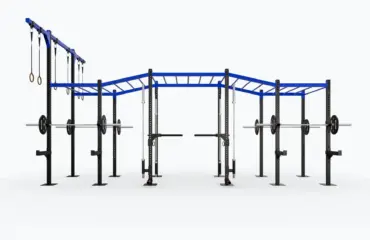
A multi-brand reseller can list a great many references, but cannot fundamentally modify what the brand offers or harmonise the result easily. The visible outcome is a floor that reads as a catalogue assembly rather than as one design. Our strength training machines, racks and cages and street workout rigs ranges are designed to be specified together for exactly that reason.
The effect on return on investment
Most people opening a facility still focus on the unit purchase price of a machine, when the real subject is total cost over several years. That is where the manufacturer or reseller decision lands in your business plan.
With a manufacturer-distributor you get better control of structural durability – steel thickness, axle quality, sizing for intensive use – and therefore a longer replacement cycle; a lower failure rate and shorter downtime, which protects the perceived value of your facility; and the option to develop your fleet over time, adding, upgrading or reconfiguring with a supplier who already knows your installation.
With a reseller you may get attractive one-off prices on particular references, but with no guarantee of consistency or long-term follow-up. Cost of ownership rises quickly if machines fail often, if parts take a long time to arrive, or if a range is discontinued with no clear replacement path.
When the manufacturer route is the right one
Both models have a place. Some situations, however, make a manufacturer-distributor close to obligatory.
Choose a manufacturer-distributor if you are opening a new facility or replacing an entire fleet and want one view of concept, equipment, visual coherence, budget and return; if you are a public authority, a school, a defence or emergency service site or a healthcare facility with requirements for standards, safety and durability; or if you need specific solutions such as stainless steel street workout structures, heavy lifting platforms, complex functional zones or integrated indoor and outdoor installations.
A reseller may be enough if you simply want to add one or two machines to an existing fleet with no particular coherence or volume issue, or if you know exactly which model of which brand you want, with full knowledge of its strengths and limits.
For a new facility or a large project, the question is no longer whether to go through a manufacturer-distributor, but which one will actually behave as a partner rather than as a seller.
Frequently asked questions
How do I check that a supplier really manufactures?
Ask which ranges are their own, where the spare parts for those ranges are held, and how many years of parts availability they commit to after a model is discontinued. The answers are quick to give and hard to fake.
Is a manufacturer always more expensive?
Not per machine, and rarely per year of service. Compare total cost of ownership over the intended life of the fleet, including downtime, parts and replacement, rather than the invoice on day one.
What should I check on standards?
For indoor professional equipment, ask for the declaration to EN ISO 20957-1 class S, the class intended for commercial and supervised use. For outdoor adult fitness equipment, ask for EN 16630. For children play equipment, EN 1176-1 for the equipment and EN 1177 for the surfacing.
Can I mix suppliers on one floor?
You can, and many facilities do. The point is to decide deliberately which parts of the fleet need coherence and long-term support and which are genuinely interchangeable.
Talking to the people who build it
Light In Fitness designs, manufactures and supplies professional fitness equipment for clubs, public authorities, hotels, schools and healthcare facilities. Send us your project – floor plan, concept, user profile and budget – and you will get an answer from the people who specify the machines. Request a quote to start that conversation.
Réalisations documentées
- Cage street workout ultime, Carcassonne – armée française
- Cage street workout ultime, Tahiti – armée française, Polynésie
- Cage SP Max, centre EPIDE de Combrée – établissement public d’insertion
- Cage SP Max, lycée Saint-Bénigne de Dijon – établissement scolaire