Outdoor fitness equipment: material choice and whole life cost
La différence entre un équipement outdoor réel et un équipement d'intérieur adapté apparaît après le premier hiver ou la première saison en atmosphère saline. Les critères de comparaison sont le matériau, le traitement de surface, la conformité EN 16630 et le plan de maintenance associé. La gamme inox supprime l'entretien anticorrosion, là où l'acier peint l'impose.
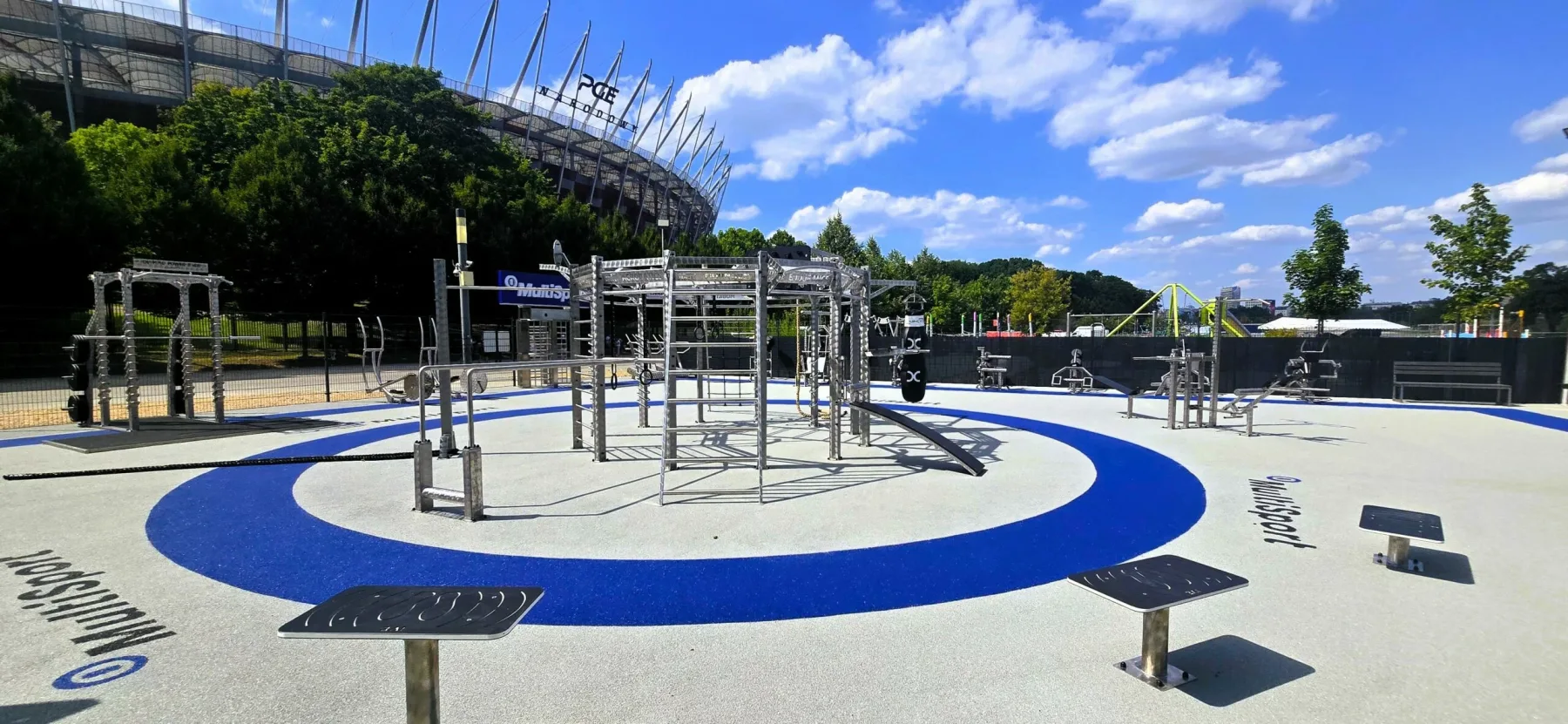
Outdoor fitness equipment is bought on a photograph and paid for over fifteen years, and the material decision made at specification stage determines almost everything that happens in between. An installation looks identical on day one whether it is powder coated steel, hot dip galvanised and powder coated steel or stainless steel. The differences appear after the first winter, the first heatwave, or the first full season of salt laden air on a coastal site. This guide compares the three material families on the criteria that decide whole life cost, explains what corrosion test figures do and do not prove, and sets out how to match material to site.
The three material families
| Material | How it resists corrosion | Typical behaviour outdoors | Best fit |
|---|---|---|---|
| Powder coated steel | Barrier coating only | Excellent initially; vulnerable wherever the coating is broken by impact, scratching or drilling | Sheltered sites, low intensity use, indoor to covered outdoor |
| Hot dip galvanised and powder coated steel | Zinc layer with sacrificial protection, plus a barrier coating | Robust in most inland environments; still needs monitoring at cut edges and fixings | Parks, schools, campsites, corporate sites, most municipal installations |
| Stainless steel | Passive chromium oxide layer that self repairs | Highest resistance, ages visually well, no coating to break | Coastal and saline sites, high prestige installations, long life expectations |
Two points are worth being blunt about. Powder coating on bare steel is a barrier, not a protection system: once the barrier is broken at a weld, a bolt hole or an impact point, corrosion starts underneath the coating and spreads out of sight. Manufacturers of coated outdoor rigs frequently state in their own documentation that rust may appear on unprotected areas and recommend limiting moisture there. Galvanising changes the mechanism entirely, because zinc protects sacrificially even where the surface is damaged. Stainless steel changes it again, since there is no coating to fail.
What corrosion test hours actually prove
Salt spray figures are common in outdoor equipment marketing: so many hours to ISO 9227. They are useful, but not for the purpose they are usually quoted for. ISO itself notes that salt spray testing is primarily useful for detecting discontinuities and defects in certain coatings, and that results alone are not sufficient to predict service life. Accelerated tests can also be misleading across different materials, because the acceleration mechanism does not affect every material in the same proportion.
The correct comparison is therefore not who quotes the largest number. It is the material logic, the quality of the critical zones, the ease of maintenance and the real environment of the site.
The critical zones
Corrosion does not begin in the middle of a tube. It begins where the geometry traps water and where the protection was interrupted during manufacture or installation. Four zones account for most failures. Welds, where heat has altered the surface and where coating thickness is often lowest. Junctions between components, where capillary action holds moisture. Fixings, especially where a fastener of one metal meets a structure of another and drives galvanic corrosion. And ground interfaces, where the equipment meets its foundation and where standing water is common. Inspect these four on any sample before ordering, and ask how they are treated in production rather than what the finish looks like.
EN 16630 and the inspection duty
Permanently installed outdoor fitness equipment with open public access falls under EN 16630, which covers manufacture, installation, inspection and maintenance. Conformity is what makes an installation defensible for a public buyer, a housing provider or an employer. It also implies an inspection regime: routine visual checks, periodic operational inspections and an annual main inspection by a competent person, each recorded in a maintenance register. Material choice interacts directly with this: a stainless installation needs the same inspection frequency but generates far fewer corrective actions, which is where the whole life difference actually accumulates.
Comparing whole life cost properly
| Cost driver | Powder coated steel | Galvanised and powder coated | Stainless steel |
|---|---|---|---|
| Purchase price | Lowest | Middle | Highest |
| Coating repair over 15 years | Recurrent, particularly at impact points | Occasional, localised | None required |
| Fastener replacement | Frequent in wet or saline sites | Occasional | Rare |
| Appearance at year 10 | Visibly aged where damaged | Generally good inland | Consistent |
| Structural warranty | Range dependent | 20 years on steel structures | Lifetime on stainless steel |
| Residual credibility with users | Falls once rust is visible | Holds | Holds |
Reference prices for comparison, all excluding VAT: an outdoor cross trainer station in hot dip galvanised and powder coated steel is 1,430 EUR and the matching rower station is 1,470 EUR; a 3 by 3 m mini street workout cage is 4,950 EUR; a stainless steel outdoor Olympic half rack is 6,999 EUR and a stainless steel outdoor rig with four stations is 11,999 EUR. The stainless premium is real. Whether it is justified depends on the site rather than on the budget line.
Matching material to site
| Site | Dominant risk | Recommended specification |
|---|---|---|
| Coastal, within a few kilometres of the sea | Chloride attack, persistent salt deposition | Stainless steel |
| Poolside and aquatic centres | Chlorinated humidity | Stainless steel |
| Urban park, high traffic | Impact damage and vandalism breaking coatings | Hot dip galvanised and powder coated, or stainless in flagship locations |
| Rural or campus site | Freeze thaw and UV | Hot dip galvanised and powder coated |
| Sheltered courtyard or covered area | Limited exposure | Hot dip galvanised and powder coated |
Frequently asked questions
Is stainless steel always the right answer?
No. On an inland site with moderate use, hot dip galvanised and powder coated steel delivers the required service life at a materially lower purchase price, and the difference is better spent on more stations or on proper surfacing. Stainless earns its premium where chlorides are present, where the installation is a flagship, or where the operator wants to eliminate coating maintenance entirely.
How do we compare two suppliers objectively?
Ask each for the material and finish specification in writing, the treatment of welds and cut edges, the fastener material, the structural warranty in years, the spare parts availability commitment, and the conformity documentation to EN 16630. Compare those six answers rather than the salt spray hours.
Does galvanising need repainting?
The zinc layer does not, but the powder coat over it can be damaged, and localised touch up keeps the appearance acceptable. That is a cosmetic and monitoring task, not a structural one, which is precisely the difference between galvanised and bare coated steel.
What does the inspection regime cost?
The routine and periodic checks are staff time. The annual main inspection by a competent person is a modest annual fee per site. The variable is corrective work, and that is where material choice shows up in the operating budget rather than in the capital budget.
Can materials be mixed in one installation?
They can, and often are, for example a galvanised structure with stainless fixings. What must be avoided is an uncontrolled mix of dissimilar metals in contact, which accelerates galvanic corrosion at exactly the junctions that are hardest to inspect. Ask the manufacturer to state the fastener specification explicitly.
Specify the right material for your site
Light In Fitness manufactures and distributes outdoor fitness, street workout and outdoor strength equipment from Tours, France, with more than 2,500 customers equipped since 2013. Tell us where the site is, how exposed it is and how it will be used, and you will receive a specification and a costed layout within 24 working hours. Stock items ship in 5 to 10 working days to France, Belgium, Switzerland and Luxembourg, with export quoted per project. See stainless steel outdoor fitness and outdoor strength machines, or request a quote.
Réalisations documentées
- Cage street workout ultime, Carcassonne – armée française
- Cage street workout ultime, Tahiti – armée française, Polynésie
- Cage SP Max, centre EPIDE de Combrée – établissement public d’insertion
- Cage SP Max, lycée Saint-Bénigne de Dijon – établissement scolaire
Sources et références
- NF EN 16630 – modules fixes d’entraînement physique de plein air : exigences de sécurité et méthodes d’essai (AFNOR)
- Code du sport, article L322-2 – garanties d’hygiène et de sécurité des établissements d’activités physiques et sportives (Légifrance)