Hyrox 2026: Preparing for Your First Race
Hyrox has become the fitness competition of the moment across Europe, and it is now reshaping what members expect from a gym floor. The format combines 8 km of running with 8 functional stations against the clock, and it is deliberately accessible: it attracts complete beginners and experienced athletes to the same start line. Whether you want to enter your first race or you run a facility and want to offer a Hyrox training zone, this guide covers the format, the physical demands, a twelve-week plan, the equipment involved and the commercial case for operators.
1. What Hyrox actually is
Hyrox is a standardised indoor fitness race. The format is identical everywhere in the world, which is what makes finishing times comparable between participants from any city and any country. Race calendars change every season, so check the official Hyrox website for the current schedule and entry fees in your country.
The course alternates eight 1 km running segments with eight stations, always in this order:
- 1 km run, then SkiErg (1,000 m)
- 1 km run, then Sled Push (50 m)
- 1 km run, then Sled Pull (50 m)
- 1 km run, then Burpee Broad Jump (80 m)
- 1 km run, then Rowing (1,000 m)
- 1 km run, then Farmers Carry (200 m)
- 1 km run, then Sandbag Lunges (100 m)
- 1 km run, then Wall Balls (100 repetitions)
Four categories share the same course. Open is the individual category with standard loads, run separately for men and women. Doubles is raced in pairs, same sex or mixed, with the station work shared. Relay is raced by teams of four, each member covering two stations and 2 km. Pro is the elite category with heavier loads.
The format works because it is accessible, with no complex technical movements to master; standardised, so the course is the same everywhere; measurable, since the finishing time can be compared worldwide; and spectacular, with a festival atmosphere that makes it enjoyable to watch as well as to race.
2. The physical qualities the race demands
Running endurance. Eight kilometres in total, broken into 1 km segments. The skill is not running fast but holding a steady pace despite the fatigue accumulated at the stations. A reasonable minimum before entering is being able to run 10 km at a comfortable pace.
Strength endurance. The stations demand force sustained over time. Sled Push and Pull, Farmers Carry and Sandbag Lunges are functional strength tests. Being strong is not enough; you have to be strong for a long time.
Cardiorespiratory capacity. Switching constantly between running and stations drives the heart rate up and keeps it there for 60 to 90 minutes on average. Aerobic capacity and the ability to recover between efforts are what separate finishing times.
3. A twelve-week preparation plan
Phase 1: building the base (weeks 1 to 4)
The aim is running endurance and general strength.
Monday, run plus upper body strength. 30 minutes of continuous running at a moderate pace (70 to 75 per cent of maximum heart rate); bench press 4 sets of 10; lat pulldown 4 sets of 10; shoulder press 3 sets of 12; biceps curl 3 sets of 12.
Tuesday, lower body strength. Barbell squat 4 sets of 10; walking lunges 3 sets of 12 per leg; leg press 3 sets of 12; leg curl 3 sets of 12; dumbbell farmers carry 4 sets of 40 m.
Wednesday. Rest or active recovery: walking, stretching.
Thursday, interval running. 5 minutes warm-up; 6 rounds of 400 m fast and 200 m recovery; 5 minutes cool-down.
Friday, functional circuit. 4 rounds of 15 wall balls, 8 burpees, 250 m rowing, 50 m farmers carry, 10 sandbag lunges, with 2 minutes rest between rounds.
Saturday, long run. 40 to 50 minutes continuous at a comfortable pace.
Sunday. Complete rest.
Phase 2: Hyrox-specific work (weeks 5 to 8)
The specific movements come in and the intensity rises.
Monday, run plus sled. 3 rounds of 1 km run, 50 m sled push and 50 m sled pull, with 2 minutes rest between rounds.
Tuesday, upper body strength endurance. Wall balls 5 sets of 20; SkiErg 4 sets of 250 m at maximum effort; rowing 4 sets of 250 m at maximum effort; burpee broad jumps 4 sets of 20 m; bench press 3 sets of 12.
Wednesday. Active recovery.
Thursday, intervals plus farmers carry. 6 rounds of 800 m fast, 50 m farmers carry and 1 minute rest.
Friday, half-Hyrox simulation. 4 rounds of 1 km run plus one complete Hyrox station, using SkiErg 1,000 m, rowing 1,000 m, 100 wall balls and 100 m sandbag lunges.
Saturday, long run. 50 to 60 minutes continuous.
Sunday. Rest.
Phase 3: sharpening (weeks 9 to 12)
Weeks 9 and 10. Full Hyrox simulation, 8 km and 8 stations, at around 80 per cent effort. Identify your weak stations and work on them specifically.
Week 11. Cut the volume by 30 per cent. Keep the intensity but reduce the number of sessions: three runs and one light circuit.
Week 12, race week. Light running on Monday and Wednesday, 20 to 30 minutes. Rest Thursday and Friday. Race at the weekend.
4. The equipment the preparation needs
Rowing machine. The reference for the 1,000 m rowing station and the single most useful purchase for Hyrox preparation. See the rowing machines range.
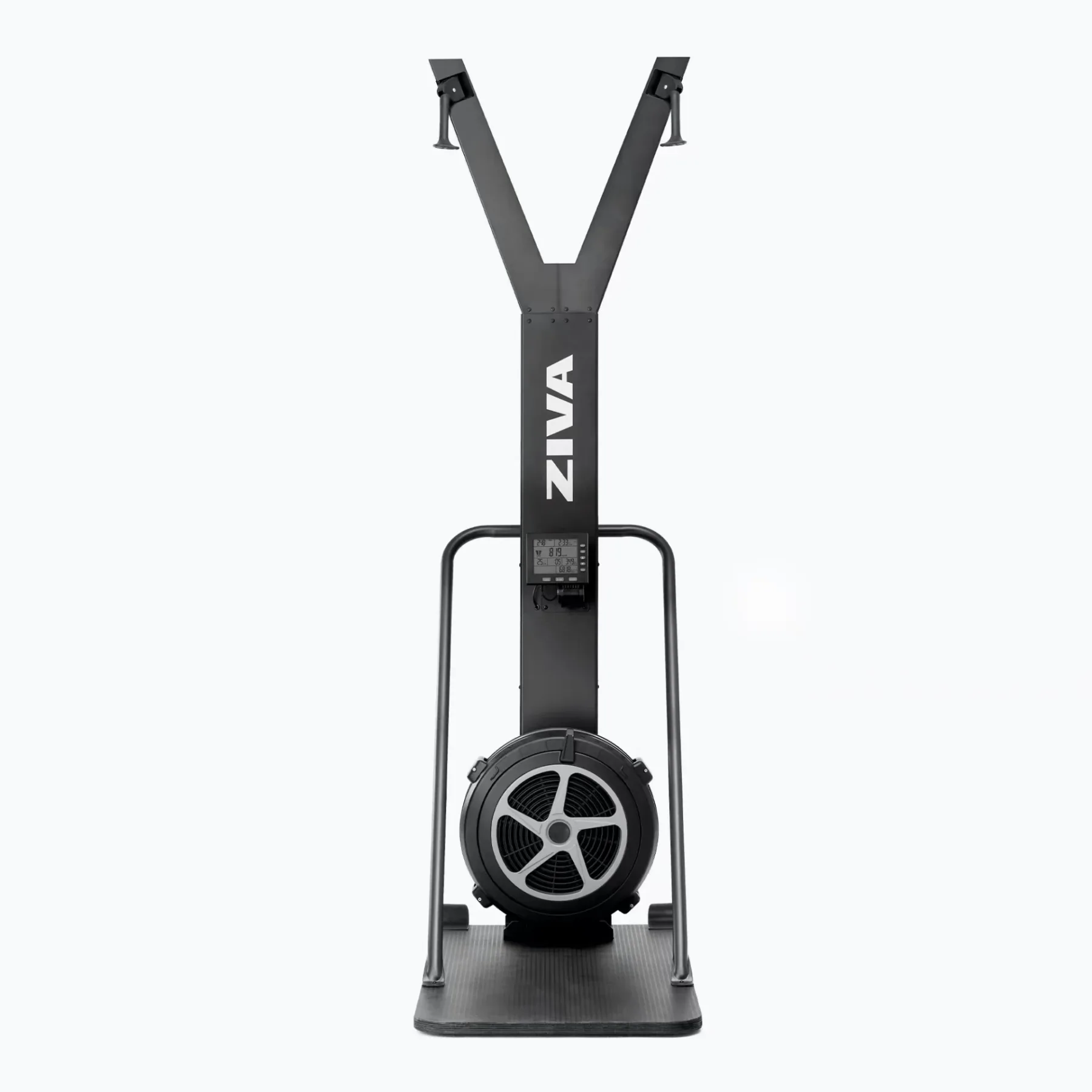
SkiErg. Used for the first station, 1,000 m, and an intense upper body and trunk effort. See the ski ergometers range.
Sled. Essential for Sled Push and Sled Pull, and used on artificial turf, which gives the sliding surface that reproduces race conditions. Plan a track of at least 25 m so that an out-and-back run covers the 50 m of the station. See the power sleds range.
Artificial turf track. The indoor sled lane is the key investment for a Hyrox training area, available in different lengths and widths. See the artificial turf tracks.
Wall balls. Ball weights and target heights are set by the competition rules and differ between categories, with targets of 3 m for men and 2.70 m for women. Check the official rules for the category you are entering and equip accordingly.
Sandbag, farmers carry handles and kettlebells. Available in several weights; the sandbag covers the lunges and the handles or kettlebells cover the 200 m carry.
Treadmill. A professional treadmill lets you build the 8 km through interval and continuous sessions whatever the weather. Specify equipment to EN ISO 20957-1 class S for commercial use.
5. Building a Hyrox zone in your facility
For operators, a dedicated area is one of the strongest retention products available today.
Minimum space. Allow 60 m2 for a functional Hyrox preparation zone, and 100 to 150 m2 for a complete area with a turf lane, rowers, ski ergs and storage.
Typical layout. A turf lane of at least 25 m long by 2 to 3 m wide, covering sled push and pull, farmers carry, sandbag lunges and burpee broad jumps. A cardio corner with two to four rowers and one or two ski ergs side by side. A reinforced wall-ball wall with targets at 3 m and 2.70 m, over thick rubber flooring. And storage for sleds, sandbags, wall balls, carry handles and kettlebells.
Commercial potential. Hyrox competitors train four to five times a week for twelve weeks before each race. That is an exceptionally engaged and loyal customer group, and preparation classes are a straightforward way to build a programme around them. The zone integrates naturally into or next to an existing functional training area.
6. Race-day tactics
Pacing. The biggest mistake is going out too fast on the first kilometres. Hold a steady running rhythm and save energy for the hardest stations.
The critical stations. Sled Push, at station two, and Wall Balls, the final station, are the most punishing. Do not underestimate either in training.
Nutrition. Eat a carbohydrate-rich meal about three hours before the start, carry a gel or energy bar for use between stations if needed, and drink regularly at the water points.
Transitions. The run to station and station to run transitions are decisive. Take 5 to 10 seconds to compose yourself before each station rather than rushing into it.
The mental side. The last three stations are won in the head. Prepare yourself to keep moving when it hurts.
7. Reference times in the Open category
| Level | Typical finishing time | What it looks like |
|---|---|---|
| Beginner, first race | 75 to 100 minutes | The objective is to finish. Enjoy the atmosphere rather than chasing a time. |
| Intermediate | 60 to 75 minutes | Pace and transitions under control; strong and weak stations identified. |
| Advanced | 50 to 60 minutes | Sustained running pace of 4:30 to 5:00 per km, fast transitions, stations mastered. |
| Elite | Under 50 minutes | Running pace under 4:30 per km, explosive stations, no dead time. |
Frequently asked questions
Is Hyrox suitable for beginners?
Yes, and that is one of the great strengths of the format. The movements are simple. With twelve weeks of structured preparation, a reasonably fit beginner can finish a first race.
What is the best equipment to train with?
A rowing machine is the number one investment. Add a sled on an artificial turf lane, wall balls and kettlebells and you cover the large majority of the preparation.
How much does entry cost?
Entry fees vary by category and by city. Check the official Hyrox website for current prices in your country.
How much floor area does a Hyrox zone need?
A minimum of 60 m2 for a functional area, and 100 to 150 m2 for a complete zone with turf lane, rowers, ski ergs and storage.
Equipping your Hyrox area
Hyrox is the most accessible and the most exciting fitness race format available today, and a structured twelve-week preparation combining running, strength endurance and specific station work gets almost anyone to the finish line. For operators, a turf lane, rowers, ski ergs and the right accessories are a strategic investment in a committed audience. Send us your floor area and intended programme and we will return a layout and a costed proposal: request a quote.
Réalisations documentées
- Dalles et sols sportifs : livraisons documentées – plusieurs chantiers
- Sol sportif extérieur, square Georges-Vallerey – Taverny (95)