Selectorised Machines vs Free Weights: Getting the Mix Right

On the training floor, the machines-or-free-weights debate is not just a matter of ego at the bench press. For an operator it is a strategic choice that affects safety, the satisfaction of beginners, the retention of advanced members and the overall return on the equipment you buy.
1. What selectorised machines actually do for your facility
Machines are not there to replace free weights. They are there to make strength training accessible, safe and effective for the largest possible number of your members.
Their key role on a professional floor:
- Safety and accessibility: a guided movement with a controlled path, far less risk of a member being trapped under a bar or losing balance under load.
- Easier learning: beginners understand where to put what much faster, and can concentrate on the muscular sensation rather than on complex technique.
- Targeted work: ideal for isolating a muscle group, correcting an imbalance, working in rehabilitation or refining detail at a high level.
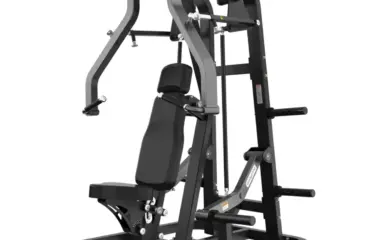
That is why a hard core of selectorised machines, leg press, pulldowns, chest and shoulder press, cable stations, is the starting point of every equipment plan we build for commercial and independent facilities.
2. What free weights do for your business model
Free weights, racks, barbells and dumbbells, remain the backbone of a serious facility identity and of progression for intermediate and advanced members.
What they bring:
- Functional, whole-body work: heavy recruitment of the stabilising muscles and transfer to everyday and sporting movement.
- A hard-training image: an area that attracts regular trainers, sports players and athletes, and gives your facility a strong identity.
- Near-infinite variety: a range of exercises and progressions that machines alone cannot reproduce.
The free-weight zone is the identity and retention area of a strength floor: it is what makes the most committed members stay. Our racks and cages and professional dumbbells are built for that zone.
3. How to split machines and free weights by facility type
The right mix is not the same for a 100 sq m studio, a 300 sq m independent gym or a large club. Here are some simple reference points.
Studio or micro-gym, 80 to 150 sq m
Priority: versatility, safety, coaching. Typical mix: a few highly versatile selectorised machines, one rack, benches and dumbbells, plus a good cable station or functional trainer.
Independent gym, 250 to 400 sq m
Priority: serving the general public and advanced members in the same room. Typical mix: a solid core of selectorised machines covering legs, back, chest, shoulders and cables, plus a genuine free-weight zone with two to three racks, benches and dumbbells up to 40 kg and beyond.
Commercial facility, 500 sq m and above
Priority: dedicated zones, optimised flow, duplicated stations. Typical mix: complete machine lines by muscle group, plus a large free-weight area with several racks and platforms.
Our selectorised ranges are designed to build those machine lines, while the cages and racks cover the free-weight side.
4. Mistakes to avoid when composing the mix
An unbalanced floor is expensive, either because it under-equips the basics or because it over-invests in stations nobody uses.
- Too many highly specific machines and not enough of the basics: leg press, pulldowns, chest and shoulder press, cables.
- A token free-weight area, one bench and one rack, in a facility meant to serve regular trainers.
- The opposite: an all-out free-weight floor with almost no machines for beginners, older members or a wellness-oriented membership.
A coherent machine line plus a real free-weight zone always beats a scattered catalogue of one-off stations.
5. Finding the right balance
The approach is not machines against free weights but machines with free weights, sized to your business model. In practice that means three things.
- Defining your target membership and your concept, independent, premium, performance, public sector, and then sizing each zone accordingly.
- Building a hard core of selectorised machines plus a free-weight zone with real identity, cages, racks, platforms and dumbbells, all specified for intensive use.
- Optimising the budget through the manufacturer-distributor model: heavy structural quality and considered biomechanics with a controlled machine-to-free-weight ratio, without inflating the investment.
Frequently asked questions
What ratio should I start from?
There is no universal number. It follows your membership: the broader and more general your member base, the larger the machine share; the more your members train for performance, the larger the free-weight zone.
Can I start with machines and add free weights later?
Yes, provided the floor plan reserves the space and the flooring for it from the outset. Retrofitting a lifting zone into a room laid out for machines is what costs money.
Which machines are truly essential?
The basics before the specialities: leg press, pulldown and row, chest and shoulder press, and at least one cable station. Specific stations come after those are covered.
How do I know if my current floor is balanced?
Look at occupancy at peak hours. Queues at one station and unused machines elsewhere tell you more than any theoretical ratio.
Building your equipment plan
The question is no longer machines against free weights, it is which combination will make your members progress, keep training safe and pay for the floor over several years. Send us your surface area, your concept and your membership profile, and we will build the equipment plan around them. Request a quote for a costed proposal.