Equipping a Local Authority: Complete Outdoor and Indoor Guide
Une collectivité n'achète pas du matériel mais une solution maintenable, conforme et défendable devant l'exploitant et l'assureur. Les contraintes spécifiques sont l'usage intensif non encadré, l'exposition aux intempéries, les dégradations et la responsabilité en cas d'accident. Ce guide cadre un projet municipal en intérieur comme en extérieur.
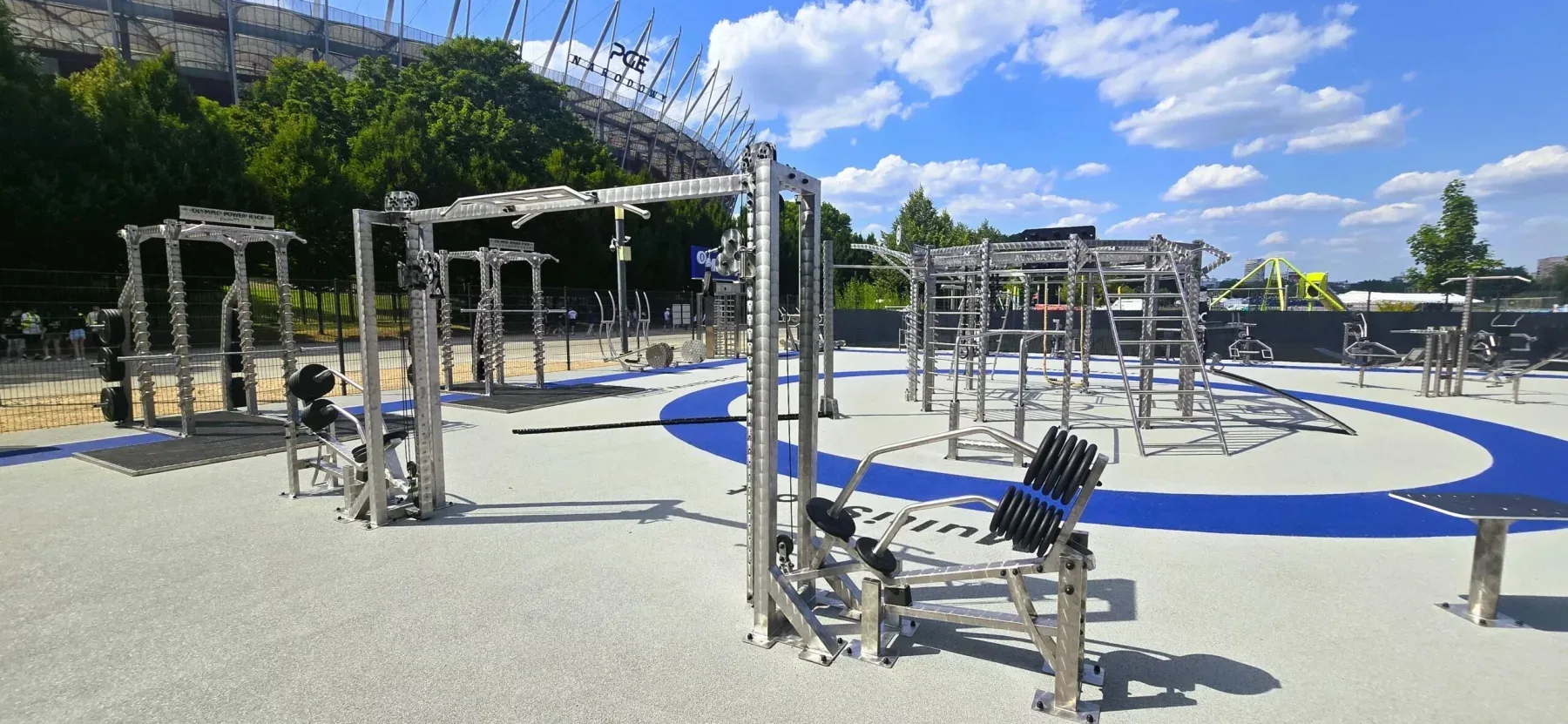
A local authority does not buy equipment. It buys a solution that is robust, maintainable, compliant and defensible – because the use will be intensive and unsupervised, the equipment will be exposed to weather, it will be damaged, and the operator carries the liability. This guide frames a municipal project outdoors and indoors: the decisions that determine the outcome, a five-step method, indicative budgets, the applicable European standards, and the points that specifically affect public procurement.
In short
A municipal project turns on four decisions: the user group, which sets the difficulty level of the equipment; the anti-corrosion treatment, which sets the real service life; the impact-attenuating surface, which falls under EN 1177 from a free fall height of 60 cm and carries your liability; and the maintenance regime, whose traceability is what protects you after an accident. Budget roughly 6,000 to 18,000 EUR excluding VAT for an entry-level installation, and 45,000 to 120,000 EUR excluding VAT for a complete trail in a reinforced finish.
The seven decisions that make a municipal project work
1. The user group and the associated risks
Teenagers, adults, older residents, school groups: the wrong balance produces either a space that is too technical and therefore under-used, or one that is too fragile and therefore damaged. The most robust configuration pairs an accessible multi-purpose zone with a more demanding zone. One normative point to know: EN 16630, which governs outdoor fitness equipment, addresses users of at least 1.40 m in height. Below that, you are in playground territory and under EN 1176 – two frameworks, two sets of dimensions. Both user groups can share a site, but they are specified separately.
2. Outdoors, indoors, or both
Outdoors is visible, attractive and permanently open, but demands a serious anti-corrosion treatment and proper anchoring. Indoors is easier to control but has to be designed for collective, unsupervised use. See the outdoor gym equipment and street workout rigs ranges.
3. Corrosion, according to the site
In damp locations, near the coast or in a polluted urban environment, the question is not whether the structure will corrode but when. What counts is the consistency of the whole assembly – steel grade, surface treatment, fixings – and not only the main structure: ordinary fixings on a stainless steel structure destroy the protection. Our outdoor structures are manufactured in our own design office in Tours, France, in galvanised or stainless steel according to exposure.
4. The surface and the fall risk
The surface is not a comfort item, it is a liability item. As soon as equipment presents a free fall height above 60 cm, EN 1177 applies and the surface must have a critical fall height at least equal to that of the equipment, established by test. Indicative thicknesses in rubber tile: 60 mm for 2.00 m, 80 mm for 2.50 m, 100 mm and above beyond that. See the rubber flooring tiles range.
5. Vandalism and intensive use
Municipal equipment has to be designed for unsupervised use: simple architecture, parts replaceable individually, professional fixings, no accessible dismantling points. On-site guidance – legible instruction panels, pictograms, and where relevant access to short video demonstrations – increases correct use and reduces damage. Manufacturer marking, year of manufacture and use signage are in any case required by EN 16630.
6. A single point of contact
When the surface, the structure and the equipment come from three different suppliers, deadlines slip and responsibility dissolves at the interfaces – which is precisely where handover disputes arise. A single partner removes the coordination burden and those grey areas with it.
7. Maintenance, the decisive criterion in public procurement
Good after-sales service is not enough: it has to be auditable. Committed response times, the scope covered, long-term spare parts availability, and references from comparable authorities. It is also a normative requirement: EN 1176-7 sets out the inspection levels for playgrounds – routine visual, operational and annual main inspection. Beyond the European standards, check the national regulations applicable in your country, which may impose a documented maintenance plan for equipment installed in a public space.
Environmental criteria in tenders
Across Europe, public procurement rules increasingly require environmental considerations in the definition of the need, the performance conditions and the award criteria, so that price alone can no longer decide between bids. For sports equipment this translates into verifiable requirements: documented recycled content, warranty duration, availability of spare parts individually, and an end-of-life route. The exact obligations and their dates are set nationally – confirm them with the rules applying to your own authority before drafting the consultation.
The five-step project method
- Use diagnosis – user group, expected footfall, site constraints, identified risks.
- Zoning and plan – 2D and 3D layout: circulation, safety zones, high-intensity zones.
- Choice of surface, structures and equipment, with costed alternatives at each budget level.
- Installation, anchoring and handover, with the technical file supplied.
- Maintenance plan – preventive and corrective, with a register to keep.
Outdoors: three typical configurations
| Configuration | Indicative budget | What it includes |
|---|---|---|
| Essential | 6,000 to 18,000 EUR excluding VAT | Multi-purpose structure (pull-ups, dips, abdominals), bars at multiple heights, instruction panel and signage, dimensioned impact surface and pathways |
| Performance | 18,000 to 45,000 EUR excluding VAT | Extended multi-station structure, progressive modules (ladders, monkey bars, holds), complementary conditioning and mobility zone, consistent impact surfacing across all zones |
| Premium | 45,000 to 120,000 EUR excluding VAT | Bespoke layout, colours and local identity, reinforced anti-corrosion treatment for coastal sites, complete trail from functional to mobility, high-end surfacing and finishes |
These figures are orders of magnitude excluding VAT and exclude ground preparation; only a quotation is binding.
Indoors: a multi-purpose configuration
For a mixed user group with open access, the objective is a room that is simple to use, reassuring and easy to maintain. It is structured in zones:
- Cardio – professional equipment that needs no instruction.
- Guided strength – fixed movement paths, reassuring for beginners. See selectorised machines.
- Functional – small equipment and one compact station.
- Mobility and stretching.
Indicative budget: 12,000 to 80,000 EUR excluding VAT, excluding major building works.
On the equipment class: for open, unsupervised access, specify EN ISO 20957-1 class S, the class for professional and institutional use. Class I is the professional class covering inclusive access for users with disabilities – it is a different scope, not a higher intensity tier above class S. Where your site must serve users with reduced mobility, that is the class to add, not a substitute.
Present two or three options as a matter of course – essential, performance, premium – with their effects on lead time, maintenance and running cost. That is what makes the decision straightforward at committee.
Decision table
| Criterion | Risk if neglected | Response |
|---|---|---|
| Corrosion and exposure | Premature replacement, unbudgeted cost | Material and treatment consistent with the site, fixings included |
| Surface and fall height | Accident, authority held liable | Surface dimensioned to the critical fall height, backed by test |
| Equipment conformity | Non-conformity found at inspection | EN 16630 outdoors, EN ISO 20957 indoors |
| Intensive use | Breakage, long downtime | Professional equipment, replaceable parts, maintenance plan |
| Project lead times | Schedule slip, interface dispute | Single point of contact from surface to installation |
| Environmental criteria | Bid non-compliant with new requirements | Documented recycled content, warranty, parts, end of life |
FAQ
What budget should we plan for a municipal street workout area?
An entry-level installation generally starts between 6,000 and 18,000 EUR excluding VAT, a performance configuration sits between 18,000 and 45,000 EUR excluding VAT, and a complete trail in a reinforced finish between 45,000 and 120,000 EUR excluding VAT. The spread comes from the size of the structure, the impact surface, the level of anti-corrosion treatment and the finishes. These amounts exclude ground preparation.
Is stainless steel useful everywhere, or only near the coast?
The coast is the most demanding case, but a reinforced treatment is justified wherever there is persistent damp, urban pollution, intensive use or infrequent maintenance. The decision is made on ten-year cost of ownership rather than purchase price: a structure replaced after seven years costs more than one better protected from the start. Consistency across the whole assembly matters as much as the main material, fixings included.
Is an impact-attenuating surface compulsory?
Yes, as soon as equipment presents a free fall height above 60 cm. EN 1177 then requires the critical fall height of the surface to be at least equal to the free fall height of the equipment, established by laboratory test. National regulations may make this a legal obligation for public playgrounds – check the rules applicable in your country.
Which standard applies to outdoor equipment?
EN 16630 governs permanently installed outdoor fitness equipment for users of at least 1.40 m in height. It requires among other things safety zones of at least 1.50 m, a design that avoids entrapment, documented anchoring conditions and marking on each item. For modules intended for children, EN 1176 applies instead.
Can equipment be made bespoke to suit the site?
Yes, and it is often what separates a space that gets used from one that is abandoned. Bespoke work optimises the layout on a constrained plot, manages circulation, allows for future modules and integrates the authority’s visual identity.
Who handles installation and anchoring?
Anchoring is the most critical point for safety and service life, and it must be documented. We recommend including it in the same contract rather than awarding it as a separate lot: if something goes wrong, responsibility is then clearly identified. Failing that, coordination between the parties should be formalised in the tender documents.
How does a public buyer get comfort on supplier reliability?
Through verifiable rather than declarative evidence: committed response times, coverage area, spare parts availability over a committed period, certificates and test reports, and references from comparable authorities installed several years ago. Those documents decide bid evaluations far more than commercial arguments.
Indoors, do we need guided machines?
For a mixed user group including beginners, older residents and clubs, selectorised machines are safer, more intuitive and simpler to maintain than a floor made up only of free weights. They suit open access without permanent supervision.
What funding can a municipal project draw on?
Several schemes usually coexist depending on the type of authority and the territory: national and regional investment grants, sports agency support, and European funds in rural areas. The names, conditions and eligible items differ from country to country, so build the funding plan on the schemes applicable to your own authority.
Get a recommendation and a budget
Light In Fitness has been a B2B manufacturer and distributor of sports equipment since 2013, with more than 2,500 customers equipped, including many local authorities, inter-municipal bodies and schools. We bring together design and planning up to the 2D and 3D layout, bespoke manufacture of steel and stainless steel structures in our own workshop, indoor cardio and strength equipment, indoor and outdoor sports surfacing, the normative documentation you need for a specification or a funding application, and long-term after-sales and spare parts. Request a quote.
Réalisations documentées
- Cage street workout ultime, Carcassonne – armée française
- Cage street workout ultime, Tahiti – armée française, Polynésie
- Cage SP Max, centre EPIDE de Combrée – établissement public d’insertion
- Cage SP Max, lycée Saint-Bénigne de Dijon – établissement scolaire
Sources et références
- NF EN 16630 – modules fixes d’entraînement physique de plein air : exigences de sécurité et méthodes d’essai (AFNOR)
- Code du sport, article L322-2 – garanties d’hygiène et de sécurité des établissements d’activités physiques et sportives (Légifrance)
- Décret n° 96-1136 du 18 décembre 1996 – prescriptions de sécurité relatives aux aires collectives de jeux (Légifrance)
- NF EN 1176-1 – Équipements et sols d’aires de jeux, partie 1 : exigences de sécurité et méthodes d’essai générales (AFNOR)