Which Machine Trains the Hamstrings in a Professional Gym?
The hamstrings, the muscle group at the back of the thigh, carry two jobs at once: they flex the knee and they extend the hip. That double role is why they are involved in almost every athletic movement and why they are one of the most frequently strained groups in a commercial facility. For an operator, the question is practical: which machine on the floor actually loads them, and what should be on the equipment list.
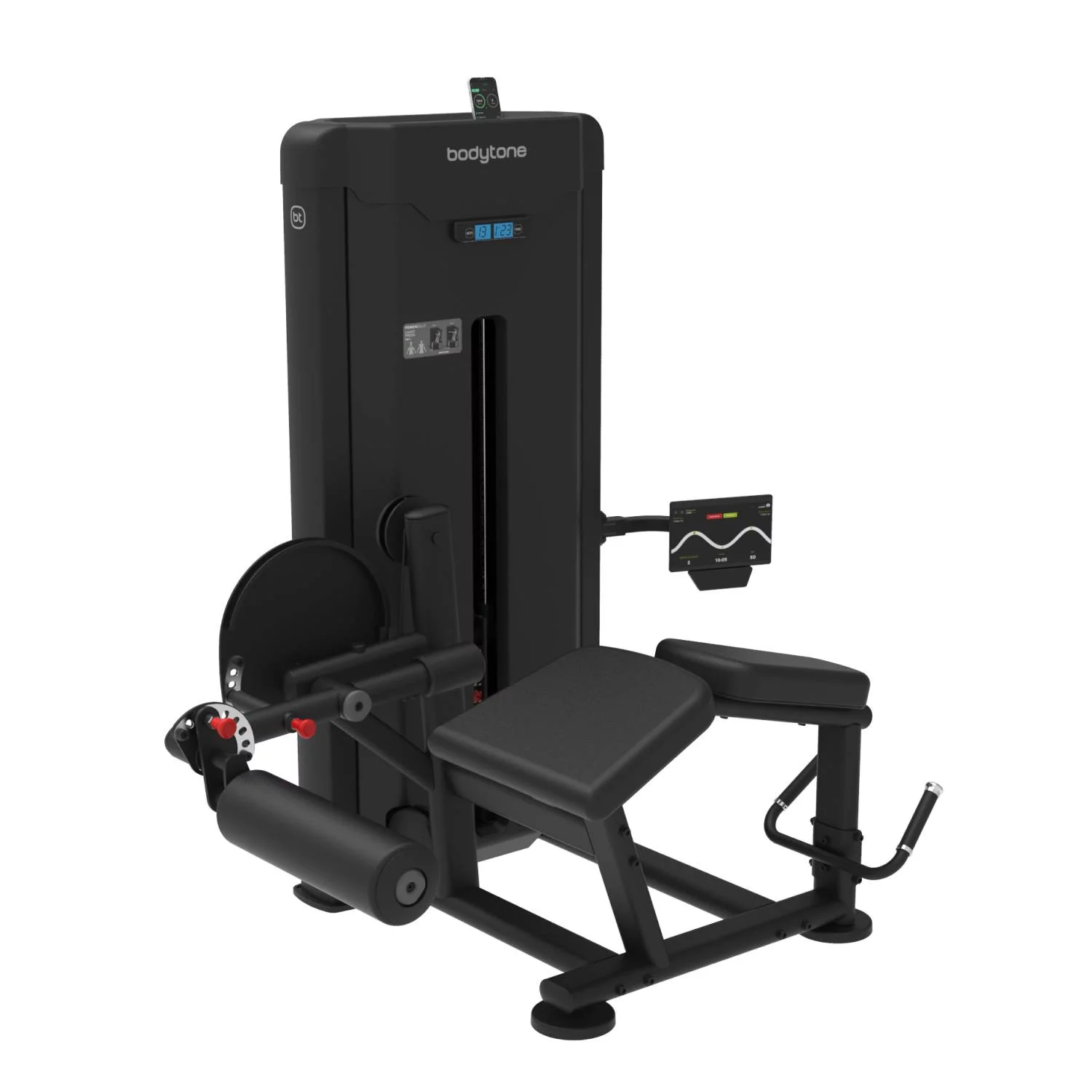
The machine that trains the hamstrings is the leg curl
Knee flexion under resistance is the movement that isolates the hamstrings, and the leg curl is the machine built for it. Three configurations exist and they are not interchangeable on a busy floor.
- Prone leg curl. The user lies face down and flexes the knees against the roller pad. Hip position is fixed, so the loading is concentrated on the knee-flexion function.
- Seated leg curl. The user sits with the hips flexed and the thigh restrained by a pad, then curls the lower leg back. It is faster to get in and out of, which matters at peak hours, and it is easier to supervise.
- Standing single-leg curl. Trains one leg at a time and is useful where an asymmetry has to be corrected, but it costs more time per member than either seated or prone.
On our range, machines such as the Power Line seated leg curl and the Power Line prone leg curl sit within the wider selectorised machine range, where a stack changed with one pin keeps circuit throughput high.
What the leg press does and does not do
The leg press is often described as a hamstring machine. It is not. The movement is a simultaneous extension of the knee and the hip against a platform, so the load falls principally on the quadriceps and the gluteals; the hamstrings act only as stabilisers of the hip and knee. A leg press belongs on a lower-body floor, but it does not replace a curl station, and specifying one instead of the other leaves the posterior chain untrained. Where the objective is hip extension under load, the answer is a hip thrust station, a glute machine or a deadlift platform, not a press.
Free-weight and accessory work around the machines
Lunges, split squats and Romanian deadlifts recruit the hamstrings alongside the quadriceps and gluteals, and they need only a rack, a bar and floor space. Resistance bands anchored to a fixed point allow a similar knee-flexion pattern where the curl stations are occupied, and they cost almost nothing to add. Both are useful complements. Neither gives the controlled, repeatable loading that a machine gives a mixed membership training without direct supervision, which is why the curl station remains the specification item.
Specifying a hamstring station
Indoor equipment installed in a commercial or public facility is specified to EN ISO 20957-1 class S. That reference belongs in writing on the quote for every machine. Class I is the professional class for inclusive access, used where the facility must serve users with reduced mobility; it is a separate professional class, not a higher intensity grade than class S. Beyond the class, check three things on a curl station: the adjustment range of the roller pad and the thigh restraint, so the machine fits short and tall members alike; the smoothness of the cable and pulley run at low load, where a rough action is most obvious; and the availability of pads and cables as spare parts several years out.
Frequently asked questions
Seated or prone leg curl if we can only buy one?
Seated, in most commercial settings. It is quicker to set up between users, easier to supervise, and more comfortable for members who are uncomfortable lying face down.
Can bodyweight work replace a curl machine?
Not for a general membership. Nordic curls and hip-hinge work load the hamstrings well but demand technique that most members do not have on day one, and they scale poorly without coaching.
Do we need a leg press as well?
Usually yes, but for a different reason: it covers quadriceps and gluteal work at high throughput. Budget both, and do not let one line item absorb the other.
Building your lower-body floor
Light In Fitness has supplied professional fitness equipment to commercial operators since 2013. Tell us your floor area and membership profile and we will return a lower-body configuration with the matching machine list. Request a quote.