
Wheelchair-Accessible Outdoor Gym Equipment: Inclusive Fitness Areas
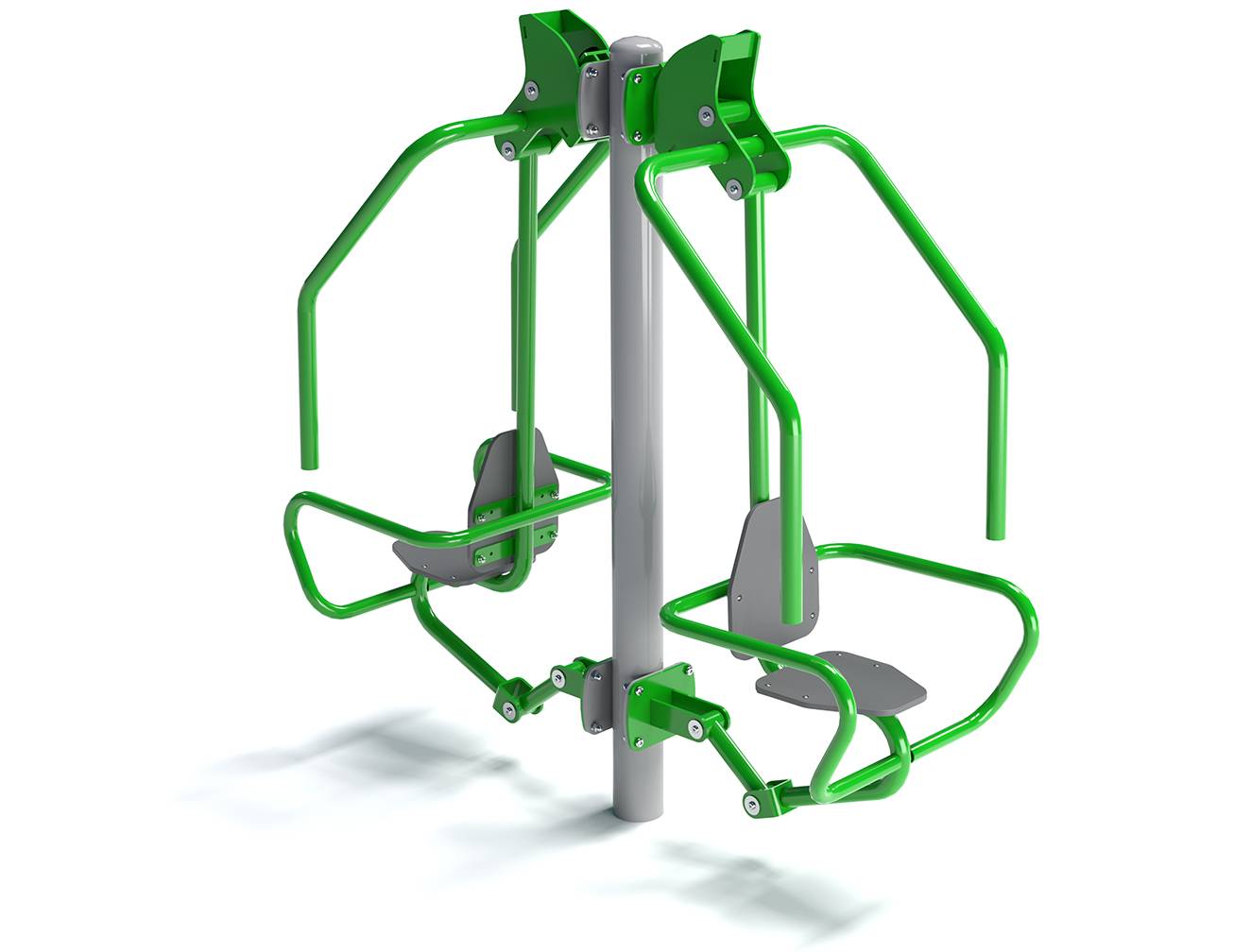
Accessible outdoor gym equipment lets a wheelchair user train on the same station, at the same time, as everyone else. The principle is simple: no step, no transfer required, a clear approach on a firm level surface, and handles reachable from a seated position. For a local authority, a campsite or a housing association, it is what turns an outdoor fitness area into a facility the whole community can actually use.
Outdoor fitness has spread quickly through parks, greenways, campsites and residential developments. For a long time, though, the stations installed there were designed for a standing user with full mobility. Anyone using a wheelchair, a walking frame or a stick found the equipment physically out of reach. A dedicated generation of accessible outdoor strength stations has changed that, and it is now a standard expectation in most public procurement briefs.
Why accessible outdoor fitness matters
Regular resistance training is not a lifestyle option for people with reduced mobility; it is a core part of maintaining joint mobility, upper body strength, cardiovascular health and independence. It also has a documented effect on morale and on social isolation, which is often the harder problem.
An outdoor installation adds something an indoor gym cannot: it is free, open at any hour, requires no membership and no booking, and it places the user in the middle of public life rather than in a separate room. That combination is exactly why municipalities, rehabilitation centres and social housing operators are the fastest growing buyers of this equipment.
What actually makes a station accessible
Accessibility is a set of measurable design decisions, not a label. On our accessible outdoor gym range, the recurring features are:
- Ground level access. No plinth, no kerb, no step between the approach surface and the working position.
- Open frame geometry. The wheelchair rolls into the station, so no transfer onto a seat is required. The user trains from their own chair.
- Handles within seated reach. Grip height, spacing and angle are set for a seated shoulder line rather than a standing one.
- Dual position stations. Many units are built as double stations so an accessible position sits alongside a standing position, allowing two people to train together.
- A firm, level, continuous approach surface from the path to the station, with enough space to manoeuvre and turn.
That last point is the one most often missed at specification stage. A perfectly designed station reached only by a gravel path is not accessible.
The stations that make up an accessible circuit
A workable accessible area is built from complementary movements rather than from a single machine:
- Double chest press. Pushing movement for chest, shoulders and triceps, with an accessible position and a standing position on the same frame.
- Double lat pulldown. The pulling counterpart, working the back and shoulders, essential for anyone who propels a manual wheelchair all day.
- Parallel bars. Used for supported transfers, dips and upper body support work, and equally useful for gait rehabilitation with a walking aid.
- Large tai chi wheel. A low resistance mobility station for shoulder range of motion and coordination, well suited to warm ups and to older users.
Where the site also serves rehabilitation, the rehabilitation outdoor fitness equipment range extends the same logic to guided, low load movements supervised by a therapist.
Build quality: what outdoor really demands
Equipment left permanently in the open faces a harder duty cycle than anything indoors. The specification points that matter are corrosion protection on the structure and on every fastener, UV stable finishes so colours and plastics do not chalk after two summers, anti-slip surfaces on every contact area including when wet, and closed profiles that do not retain water.
Ask for the surface treatment in writing, not just the material. Galvanised then powder coated steel and stainless steel behave very differently in a coastal or heavily salted environment, and the right answer depends on your site rather than on a catalogue page. Where a project is close to the sea or on a treated winter road, stainless steel is usually the specification that survives the warranty period without intervention.
Standards and safety zones
Permanently installed outdoor fitness equipment for adults falls under EN 16630, which covers structural strength, entrapment, finger and head traps, and the free space to be kept around each station. It is a different standard from the one applying to children playground equipment, and the two must never be mixed on the same installation: an item designed for adults is not a substitute for children equipment, and the reverse is equally unacceptable.
Plan the free space around each station at the design stage. Accessible stations need more of it than standard ones, because a wheelchair needs room to approach, position and leave without crossing another user working area.
Where these installations work best
Municipal parks and greenways, seafront promenades, campsites and holiday villages, social and private housing developments, retirement residences, rehabilitation and day care centres, schools and universities, and military or emergency service sites all install accessible outdoor stations, usually within a wider outdoor gym equipment scheme. The common factor is a mixed population: the accessible station is what allows a resident in a wheelchair and a neighbour on foot to use the same facility at the same moment.
Frequently asked questions
Does a wheelchair user need to transfer onto the machine?
No. These stations are designed to be used from the chair itself. The frame is open at the front so the chair rolls into position.
Can accessible stations be used by standing users too?
Yes, and they should be. Double stations combine an accessible position and a standing position on one frame, which is what makes the area genuinely shared rather than segregated.
What surface should be laid under the equipment?
A firm, level, continuous surface that a wheelchair can cross without effort, extending across the whole approach and manoeuvring area, not only under the station itself.
How much space should be allowed per station?
The free space required is given in each product technical sheet and depends on the model. Size the layout from those figures, adding manoeuvring space for the accessible positions.
Specifying your scheme
An accessible outdoor fitness area is not a standard area with one extra machine bolted on. It is a layout question: approach surfaces, circulation, free space and the balance between pushing, pulling and mobility stations. Send us your site plan and the profile of the users you serve, and we will return a full layout with the equipment schedule and costing: request a quote.
Réalisations documentées
- Cage street workout ultime, Carcassonne – armée française
- Cage street workout ultime, Tahiti – armée française, Polynésie
- Cage SP Max, centre EPIDE de Combrée – établissement public d’insertion
- Cage SP Max, lycée Saint-Bénigne de Dijon – établissement scolaire
Sources et références
- NF EN 16630 – modules fixes d’entraînement physique de plein air : exigences de sécurité et méthodes d’essai (AFNOR)
- Code du sport, article L322-2 – garanties d’hygiène et de sécurité des établissements d’activités physiques et sportives (Légifrance)

