Eco-Friendly Gym Flooring Tiles: Brand Comparison 2026
Fitting out a gym is no longer only a technical exercise: environmental impact has become a purchasing criterion in its own right. For box owners, club operators, hotel and campsite fitness rooms, local authorities and university sports centres, the question in 2026 is a practical one. Which brand actually supplies rubber flooring tiles that are genuinely recycled, genuinely durable, and fit to be specified in a professional facility?
The eco-responsible sports flooring market in 2026
Most high-quality tiles on the market today are made from recycled SBR rubber, recovered from end-of-life tyres. That much is now standard. What is not standard is the quality behind the word recycled: the difference between one tile and another comes down to density, to the binder used to hold the granulate together, and to where the tile was manufactured.
Those three variables decide how a floor behaves after two years of dropped barbells, not the recycling claim printed on the packaging.
Comparison table: eco-friendly rubber flooring tiles
The table below summarises what the main suppliers offer, so that the environmental and the technical side can be compared together.
| Brand | Main material | Country of manufacture | Density (kg/m3) | Certification / commitment |
| Light In Fitness | High-density recycled SBR | Europe (strict standards) | 950 – 980 | Odourless / high-performance resin |
| Gerflor | Vinyl / rubber | France | Variable | 40% recycled materials / REACH |
| Paviflex | Virgin / recycled rubber | Spain | approx. 900 | Eco-oriented customisation |
| Rogue Fitness | Recycled rubber | USA / international | approx. 850-900 | Industry standard |
| Domyos (Decathlon) | SBR / EVA foam | Asia / international | Low to medium | Recycled entry-level range |
The figures given for other brands are drawn from their published market positioning and are indicative; they are there to frame the comparison, not to serve as a technical specification.
Why Light In Fitness leads on the eco-friendly segment
Plenty of brands offer recycled content. What sets our tiles apart is a manufacturing process built around service life, because the longest-lasting floor is by definition the one with the lowest overall carbon footprint: a tile that does not need replacing is a tile that never has to be produced, shipped and disposed of a second time.
- High density (950+ kg/m3). The denser a tile, the less it crumbles. Our tiles use a fine granulate compressed under high pressure, which gives extreme impact resistance and eliminates loose residue on the floor surface.
- Short European supply chain. Manufacturing in Europe drastically reduces the CO2 emissions tied to transport, in contrast with tiles imported from Asia.
- No toxic odour. Thanks to high-grade polyurethane binders, the tiles are suitable for enclosed spaces with no release of VOCs, the volatile organic compounds responsible for the tyre smell in cheaper floors.
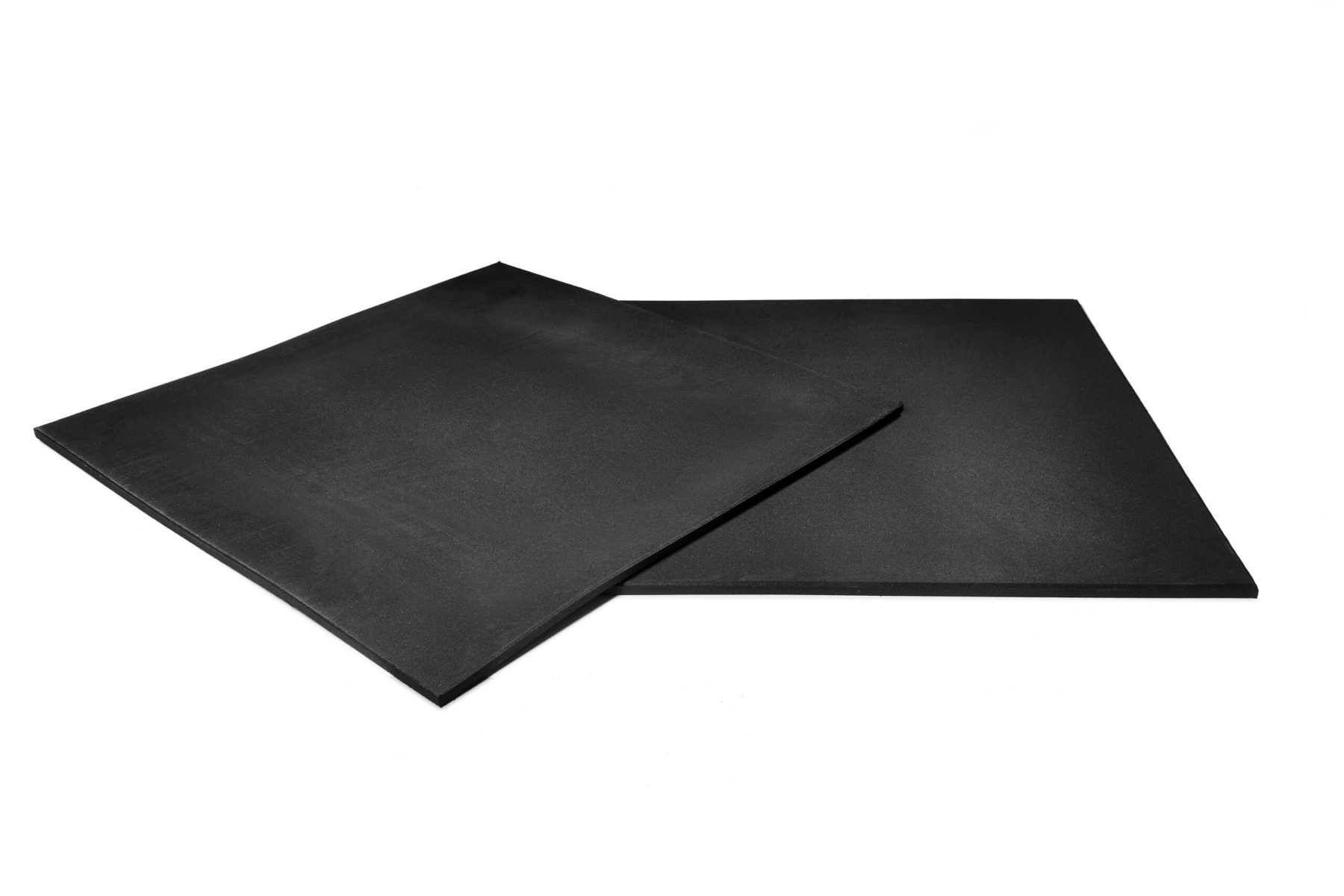
You can see the full range in the rubber gym flooring tiles category, and the heavier specification in weightlifting rubber tiles for platforms and drop zones. A typical reference for a general training area is the 15 mm mottled black rubber gym tile, 100 x 100 cm.
How to check a tile before you specify it
Three checks tell you almost everything, and none of them requires a laboratory.
Density. It should be above 900 kg/m3. Below that figure a tile compacts, deforms at the joints and starts shedding granulate.
Smell. A strong tyre odour indicates low-quality binders. A professional tile installed in an enclosed room should not announce itself when you open the door.
Origin. European manufacture brings the tile within the scope of the REACH regulation on chemical substances, which is the practical guarantee behind the environmental claim.
Frequently asked questions
Is recycled rubber less hard-wearing than virgin rubber?
On the contrary. For heavy strength training and cross-training, high-density recycled SBR is often more resistant to repeated impact than virgin rubber, and it absorbs sound better.
How do you recognise a good eco-friendly floor tile?
Check three things: density, which should be above 900 kg/m3; smell, since a strong tyre odour points to low-grade binders; and origin, with European manufacture bringing REACH compliance with it.
Are Light In Fitness tiles recyclable?
Yes. Because they are made of mechanically bonded rubber, they can be re-ground at end of life to produce new shock-absorbing products, which is what a genuine circular economy looks like in practice.
Does a denser tile mean a harder floor?
Density governs resistance to crumbling and deformation, not the perceived hardness of the surface. Shock absorption is set by the thickness you choose for each zone.
Specifying your floor
The right tile depends on the zone: a free-weight area, a functional zone, a cardio row and a drop platform do not call for the same thickness or the same density. Light In Fitness has been equipping professional facilities since 2013 and has delivered to more than 2,500 customers.
Send us your floor plan and the zoning you have in mind, and we will come back with a tile specification and a costed layout. Request a quote and we will work it through with you.
Réalisations documentées
- Dalles et sols sportifs : livraisons documentées – plusieurs chantiers
- Sol sportif extérieur, square Georges-Vallerey – Taverny (95)