Rubber Gym Flooring and Sports Floors: Thickness, Density and Finish Explained
A bad floor can ruin a good training area: noise complaints, cracked concrete slab, machines that vibrate, members who will not drop a loaded bar because of the sound it makes. The choice of rubber gym flooring comes down to four variables – thickness, density, surface finish and the match between the tile and the zone it is going into. Weightlifting, cross-training, cardio and circulation areas do not need the same floor, and specifying one tile for the whole facility is the most expensive mistake in the whole fit-out.
1. Thickness: match the floor to the actual use
There is no single correct thickness. There are thicknesses that suit a given use, and the useful question is always what happens on that square metre.
| Thickness | Typical use |
|---|---|
| 15-20 mm | Light to moderate use: cardio areas, small strength zones, hotel and residential fitness rooms where loaded bars are never dropped. |
| 20-25 mm | Studio, personal training and general strength areas: sound protection of the slab and a reasonable acoustic base for moderate loads. |
| 30-40 mm | Heavy strength areas, weightlifting and cross-training with bar drops: strong reduction of both noise and impact. |
| 40-60 mm and above | High-impact and fall-protection zones, assessed against EN 1177 and HIC: fitness trails and play-type areas. |
Our rubber gym flooring tiles range is built around these bands rather than around a single generic product.
2. Density and weight: the real quality indicators
Two tiles both sold as 40 mm can behave completely differently, because thickness on its own says nothing about what the tile is made of. Two figures separate a serious tile from a cheap one:
- Density in kg per cubic metre. The denser the tile, the better it resists crushing, indentation from machine feet and ageing.
- Actual weight per tile or per square metre. A heavy tile stays where it was laid, absorbs impact better and transmits fewer vibrations.
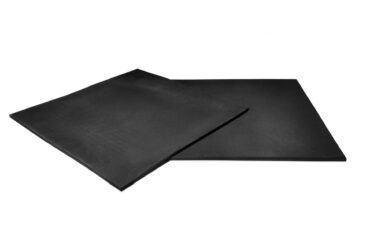
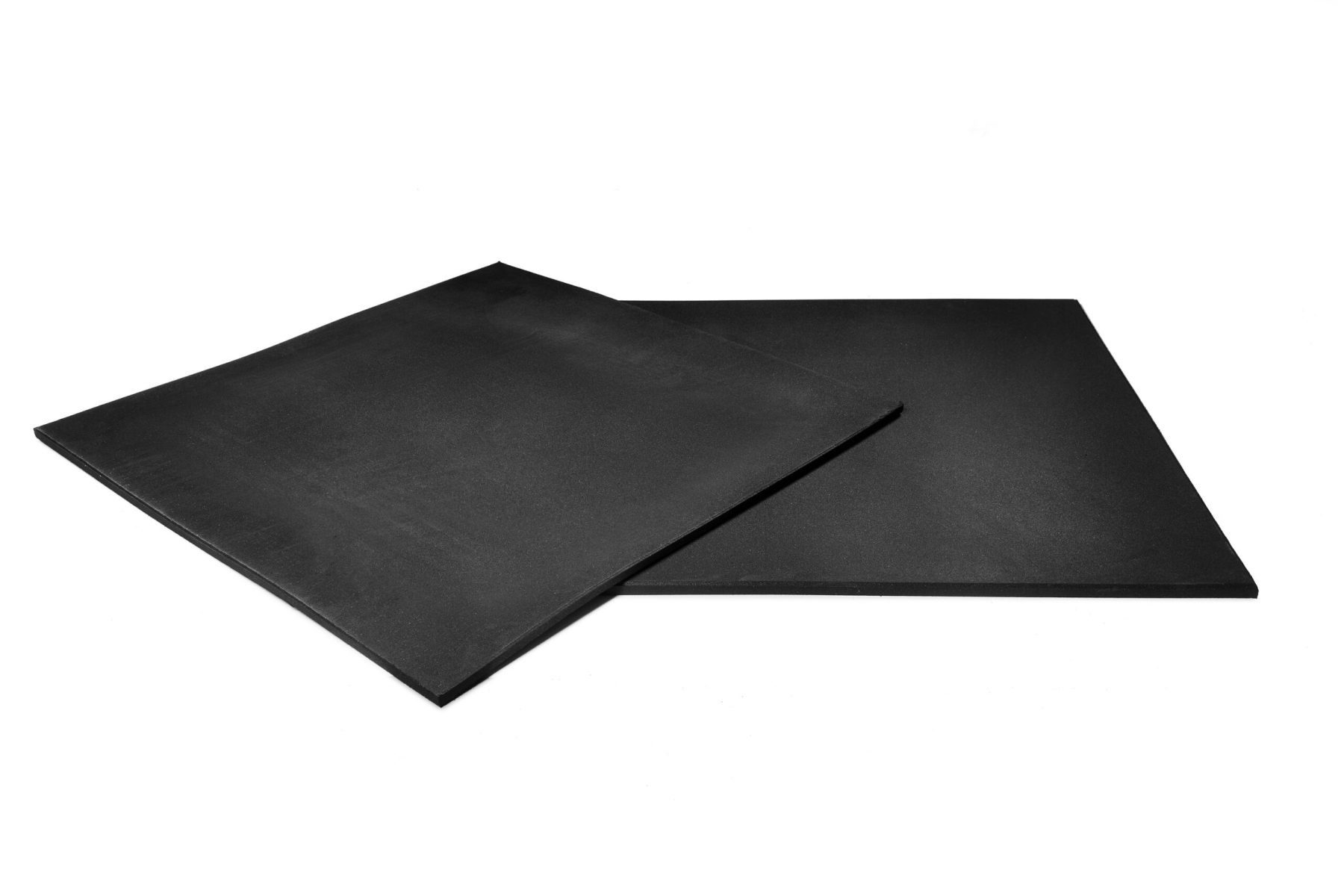
A concrete example from our own range: our 25 mm tile in 100 x 100 cm format has a density of 1000 kg per cubic metre and weighs 25 kg per tile. Those two figures are consistent with each other, and that is exactly the check to run on any datasheet you are given – thickness multiplied by surface multiplied by density has to give you the stated weight. When it does not, one of the three numbers is wrong.
3. Finish, granulometry and structure
Beyond the numbers, the surface of the tile decides comfort, grip and how easy the floor is to keep clean.
- Grain and finish. A finer grain gives a more comfortable surface underfoot and is easier to clean; a more pronounced grain gives extra grip where it is needed.
- Single-layer versus dual-layer. A dual-density build – dense wearing surface over a shock-absorbing underlayer – limits indentation while keeping the underfoot comfort of a thick tile.
- Slip resistance and cleaning. A good tile stays grippy when there is sweat on it and cleans with a vacuum and a mop, without special products.
4. Which floor for which zone
The right floor under a lifting platform is not the right floor under a row of bikes.
Weightlifting and heavy strength
30-40 mm and above, high density, heavy tiles, ideally dual-layer or a dedicated weightlifting rubber tile. The objective is to reduce impact, noise and damage to the structural slab as far as possible.
Cross-training and functional
20-30 mm with good density. This is a compromise: enough cushioning to protect the slab and the joints, without a surface so soft that it becomes unstable under jumps and changes of direction.
Circulation, cardio and selectorised machines
15-20 mm is usually enough. Here the priorities shift to comfort, acoustics and appearance rather than impact absorption.
5. Fire classification, public venues and durability
For facilities open to the public – clubs, hotels, municipal sports halls, schools – fire behaviour is not an optional line in the specification.
- Reaction-to-fire classification. Classes such as Cfl-s1 and Dfl-s1 are required in many projects, and the smoke index that follows the letter is part of the classification, not a detail to be dropped. Several of our 20 mm tiles are classified for these applications – see our fire-rated rubber tiles. Which class your project needs is set by the national building and fire regulations applicable to the venue, so confirm it with the authority having jurisdiction before ordering.
- HIC and EN 1177. For areas with a genuine risk of falling from height – fitness trails, play areas, some highly dynamic training zones – impact attenuation is assessed to EN 1177, which is a different question from acoustic comfort.
- Durability. High density, quality raw material and a long service life are what actually make a floor sustainable. In the high-density segment, tiles from 950 kg per cubic metre upwards are the useful reference point.
Frequently asked questions
Can I use one thickness across the whole facility?
You can, but you will either overspend in the cardio area or under-protect the lifting area. Zoning the floor is almost always cheaper than laying the heaviest tile everywhere.
Does a thicker tile always mean less noise?
No. Thickness helps, but density and the layer structure matter as much. A dense dual-layer tile can outperform a thicker single-layer tile of poor quality on both impact and structure-borne noise.
Do the tiles need to be glued down?
It depends on the tile, the zone and the traffic. Heavy tiles in a defined lifting zone often stay in place by their own weight and interlocking edges; circulation areas and light tiles usually need fixing.
What should I check on a supplier datasheet?
Thickness, density, weight per tile, surface finish, layer structure and reaction-to-fire class with its smoke index. If the density and the weight do not agree with the stated thickness, ask before you order.
Getting the specification right, zone by zone
A good sports floor is not just black tiles. It is a specification built zone by zone around use, density, thickness, fire classification and perceived comfort. Send us your floor plan with the zones marked and the type of venue, and we will come back with a tile specification per area and a costed proposal: request a quote.
Réalisations documentées
- Dalles et sols sportifs : livraisons documentées – plusieurs chantiers
- Sol sportif extérieur, square Georges-Vallerey – Taverny (95)
Sources et références
- Arrêté du 19 avril 2011 – étiquetage des produits de construction ou de revêtement de mur ou de sol sur leurs émissions de polluants volatils (Légifrance)
- Ministère de la Transition écologique – étiquetage des produits de construction : classes d’émission A+ à C
- Décret n° 96-1136 du 18 décembre 1996 – prescriptions de sécurité relatives aux aires collectives de jeux (Légifrance)
- NF EN 1176-1 – Équipements et sols d’aires de jeux, partie 1 : exigences de sécurité et méthodes d’essai générales (AFNOR)