Converting a Garage into a Gym: Complete 2026 Guide
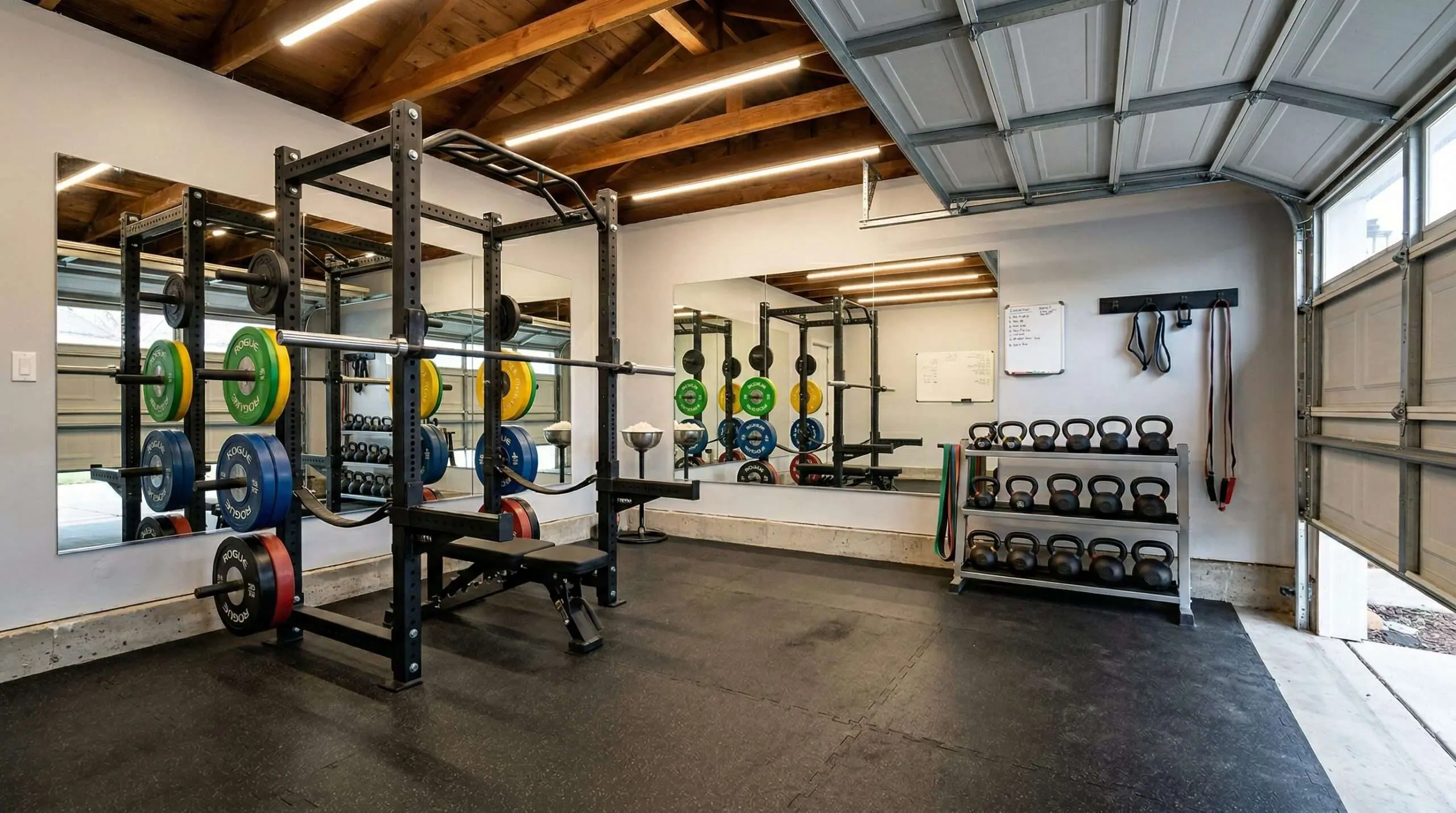
Converting a garage into a serious strength training space costs between 3,000 and 15,000 EUR and hinges on five priorities in strict order: insulation, ventilation, flooring, lighting, then equipment built for intensive use. Unlike a basic home gym, a high-spec garage gym applies standards close to a commercial facility — which is exactly what a demanding lifter, a personal trainer working from home or a dedicated cross-training athlete needs. This guide takes you step by step from the technical audit of your garage to the last accessory.
1. Preliminary audit: is your garage suitable?
Ceiling height: the knockout criterion
Ceiling height determines the whole project. 2.40 m is the absolute minimum for standing lifts, pull-ups and overhead dumbbell work. The ideal is 2.70 m or more: enough for a power rack with an Olympic bar, an integrated pull-up station and a raised lifting platform. Below 2.40 m, a serious garage gym is compromised — lowering the slab is rarely economic.
Usable area and layout
A floor area of 20 to 40 m2 is ideal for one to three users. Below 15 m2, Olympic lifts and large equipment struggle to coexist. Allow 1 m of lateral clearance around each unit and 1.5 m behind a rack to unrack a bar safely.
Garage prerequisites checklist
| Criterion | Minimum | Ideal |
|---|---|---|
| Ceiling height | 2.40 m | 2.70 m or more |
| Usable area | 15 m2 | 25-40 m2 |
| Load-bearing slab | Sound bare concrete | Reinforced concrete 10 cm or more |
| Electrical supply | Dedicated 16 A circuit | Dedicated board plus 32 A |
| Water supply | Not required | Supply and drainage for a washroom |
| Insulation | None (to be created) | Walls and roof insulated |
| Ventilation | Simple air vent | Heat-recovery ventilation or extractor fan |
| Natural light | Window or skylight | Roof window |
2. Thermal insulation: year-round training comfort
An uninsulated garage is unusable in winter (near-freezing overnight temperatures) and unbearable in summer (40 degrees C under a metal roof). Insulation comes before any equipment purchase.
- Walls: internal insulation with mineral wool panels (60 mm minimum) or rigid polyurethane boards (40 mm for equivalent performance), a vapour barrier, and an OSB or moisture-resistant plasterboard finish to protect the insulation from knocks and sweat-driven humidity.
- Roof: up to 30 percent of heat loss. For pitched roofs, insulate between rafters (100 mm) with an under-rafter layer; for flat or steel-deck roofs, sandwich panels give the best thermal and acoustic result.
- Garage door and slab: the original industrial door is usually the thermal weak point — replace it or add an insulating curtain. The slab cannot be insulated retrospectively from below; the sports flooring acts as the thermal barrier.
3. Ventilation: air quality for hard training
Sweat, CO2 and humidity make ventilation critical. A poorly ventilated garage means fogged mirrors, odours and stale air.
- Wall-mounted extractor fan (150 m3/h or more for 25 m2), installed high on the wall opposite the door to create a diagonal airflow: 150-400 EUR plus fitting — sufficient for most setups.
- Heat-recovery ventilation (MVHR) is the reference solution for daily intensive use: continuous air renewal while recovering 70-90 percent of extracted heat. Budget 800-2,000 EUR installed. Combined with a ceiling fan, it keeps summer temperatures comfortable without air conditioning.
- Heating: a dry inertia radiator (1,000-1,500 W) or a reversible heat pump for harsh winters. Avoid basic convectors (high running costs) and wood stoves (fire risk).
4. Sports flooring over bare concrete
The floor protects the slab, absorbs impact, protects joints and zones the space. Recycled rubber tiles of 20 mm (density 950 kg/m3 or more) are the standard for strength and free-weight zones, laid loose without adhesive so the layout can evolve. For Olympic lifting zones, specify 40-50 mm tiles or a composite lifting platform. See our full rubber gym flooring guide and the dedicated article on weightlifting drop zones.
| Zone | Recommended surface | Thickness |
|---|---|---|
| Machines / cardio | Recycled rubber tiles | 20 mm |
| Free weights / rack | High-density rubber tiles | 30 mm |
| Lifting platform | Plywood plus rubber | 40-50 mm |
| Stretching / mobility | EVA foam mats | 15 mm |
| Cardio corner (bike, rower) | Standard rubber tiles | 15-20 mm |
5. LED lighting and mirrors
Aim for at least 500 lux at floor level with a colour rendering index (CRI) of 80 or more. Industrial IP65 LED battens (40-50 W, 4,000 K, 120 lm/W or better) are ideal: four to six units light a 25 m2 garage evenly, usually for under 500 EUR installed. Wall mirrors — essential for technique control — multiply perceived light and visually enlarge the space; position light sources slightly forward to avoid glare.
6. Equipment: from essential to premium
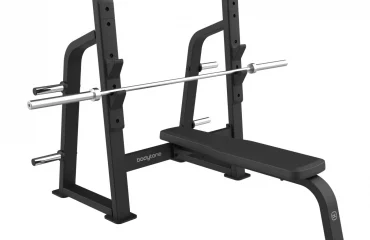
Everything revolves around a power rack or squat cage. A four-post closed cage with adjustable safety catches is the safest option for solo training. Specify an integrated pull-up bar, Olympic-compatible supports (50 mm), and a rated load of at least 300 kg. In 25 m2, a 120 x 120 cm cage with an integrated cable pulley centralises squats, bench press, rows, pulldowns and pull-ups on a compact footprint — see our rack and cage specification guide.
Add a 20 kg Olympic bar (220 cm, needle-bearing sleeves) and a plate set covering 100-150 kg. Bumper plates are mandatory for any Olympic lifting on a platform. Under EN ISO 20957-1, choose class S (studio, professional use) equipment rather than light domestic gear — consumer-grade machines do not survive daily intensive sessions.
| Equipment | Tier | Indicative price range (excl. VAT) |
|---|---|---|
| Power rack / squat cage | Essential | 600-2,500 EUR |
| Olympic bar 20 kg | Essential | 150-500 EUR |
| Plate set (100-150 kg) | Essential | 300-900 EUR |
| Adjustable bench | Essential | 200-600 EUR |
| Kettlebells (16/24/32 kg) | Essential | 100-300 EUR |
| Dumbbell set (5-30 kg) | Essential | 300-800 EUR |
| Wall-mounted pull-up bar | Essential | 80-250 EUR |
| Lifting platform | Upgrade | 200-1,200 EUR |
| Cardio unit (bike or rower) | Upgrade | 500-2,500 EUR |
| Cable pulley system | Premium | 800-2,500 EUR |
| Wall mirrors | Upgrade | 200-600 EUR |
| Storage (plate trees, bar holders) | Essential | 150-400 EUR |
For cardio in a tight space, an air or water rower is the most versatile choice: it stores vertically, works around 86 percent of the body and is almost impact-free. A magnetic bike or a weighted jump rope are strong low-cost alternatives.
7. Storage and organisation: safety first
Plates on the floor, scattered dumbbells and bars leaning against walls cause most home strength training accidents. A properly organised garage gym includes a vertical plate tree next to the rack, a wall-mounted dumbbell rack fixed to structural members, a horizontal bar holder, wall hooks for bands and ropes, and a lockable cabinet for electronics and first aid. Floor marking tape delimiting each zone is a simple, professional finishing touch.
8. Overall budget by line item
| Line item | Entry (3,000 EUR) | Intermediate (7,500 EUR) | High-spec (15,000 EUR) |
|---|---|---|---|
| Insulation and ventilation | 500 | 1,500 | 3,000 |
| Electrics and LED lighting | 300 | 600 | 1,200 |
| Rubber flooring (25 m2) | 400 | 700 | 1,200 |
| Rack, bar and plates | 1,000 | 2,000 | 4,000 |
| Dumbbells and kettlebells | 400 | 800 | 1,500 |
| Bench | 200 | 400 | 700 |
| Cardio | 0 | 800 | 2,000 |
| Mirrors and storage | 200 | 400 | 800 |
| Accessories and finishes | 0 | 300 | 600 |
All figures are project estimates excluding VAT; building works vary by region and contractor — obtain at least two competing quotes from certified tradespeople.
9. Mistakes to avoid
- Buying equipment before insulating. A rack in a 2 degrees C garage in January will not get used.
- Underestimating noise. Without acoustic treatment of party walls, neighbours and family will complain fast.
- Ordering a rack too tall for the ceiling. Measure twice, order once.
- Ignoring fire safety. A CO2 extinguisher and smoke detector are essential once electrical equipment is installed.
- Skipping planning rules. Changing a facade or the use of the building may require prior notification under local planning regulations.
- Choosing consumer-grade gear. Specify EN ISO 20957-1 class S equipment from the start.
Frequently asked questions
What ceiling height do I need for a garage gym?
A minimum of 2.40 m for standing lifts, pull-ups and presses; 2.70 m or more is ideal for a full power cage, Olympic bar work and a lifting platform.
What flooring should go over bare concrete?
Recycled rubber tiles of 20-30 mm for strength and free-weight zones, laid loose without adhesive. For Olympic lifts, a platform or 40-50 mm rubber is essential to absorb dropped bars.
What budget should I plan?
Between 3,000 and 15,000 EUR excluding VAT depending on the condition of the garage and the equipment tier. A functional entry level sits around 3,000 EUR; a complete high-spec build with MVHR, platform, cardio and premium rack needs 10,000-15,000 EUR. For a fully commercial-grade package, see our guide to equipping a gym on a 15,000 EUR budget.
Can a personal trainer work with clients in a converted garage?
Yes, and it is one of the strongest business cases for the investment — but check your insurance cover, local planning rules on business use of domestic premises, and choose equipment rated for professional use (EN ISO 20957-1 class S).
Ready to equip your garage gym? Light In Fitness supplies commercial-grade racks, strength equipment and professional sports flooring to gyms, coaches and demanding private buyers, with layout advice included. Request a free, detailed quote.
Réalisations documentées
- Dalles et sols sportifs : livraisons documentées – plusieurs chantiers
- Sol sportif extérieur, square Georges-Vallerey – Taverny (95)