Shoulder Press Machine: Professional Buying Guide for Gyms

The shoulder press machine is one of the few pieces of guided strength equipment that almost every commercial floor ends up needing. It trains the deltoids through a fixed pressing path, it is immediately readable by a member who has never been coached, and it absorbs a very high number of repetitions per day without supervision. For a gym operator, a hotel fitness room, a municipal facility or a rehabilitation centre, the real question is not whether to install one, but which construction, which loading system and which footprint make sense for the traffic the room actually carries.
What a shoulder press machine does on a professional floor
A shoulder press machine loads the deltoids in a vertical or near-vertical pressing pattern, seated, with the back supported. The anterior and lateral heads of the deltoid do most of the work, with the triceps and the upper back acting as support. Because the trajectory is guided, the user does not have to stabilise the load in space: the machine does it. That single property is what makes the movement usable by a beginner on their first session and by an experienced lifter working close to failure, on the same station, without a spotter.
On a commercial floor this matters more than the exercise itself. A guided press station is one of the lowest-risk ways to let unsupervised members train pressing strength. It is also one of the easiest stations to explain on a wall chart or a QR code, which reduces the amount of floor coaching your staff has to provide during peak hours.
Guided press or free weights: what changes for the operator
The comparison is usually framed as a training debate. For a buyer it is an operations question.
- Supervision. A barbell overhead press needs space, a rack and ideally a coach. A machine press does not. In a hotel gym or a residential facility with no staff on the floor, that difference decides the specification.
- Throughput. Changing the load on a selectorised stack takes a couple of seconds. During a busy evening slot, that is the difference between a station that rotates and a station that queues.
- Consistency. The guided path gives every user the same movement, which makes the station predictable for group programmes, circuits and induction sessions.
- Wear. A machine concentrates wear on known parts, guides, bearings, cables and upholstery. Those are inspectable and replaceable. Free weights spread wear across the floor and the storage.
Most professional rooms end up with both. The machine carries the volume, the free-weight area carries the specialised work.
Selectorised or plate-loaded
Both formats exist for shoulder pressing and they answer different briefs.
Selectorised. The weight stack is integrated and adjusted with a pin. This is the default for mixed-membership clubs, hotels, corporate rooms and public facilities: nothing to store, nothing to drop, no plates left on the floor. Our selectorised strength machines cover this segment, including dedicated shoulder stations such as the Etenon R8301 shoulder press with its independent converging arms and multiple grip positions.
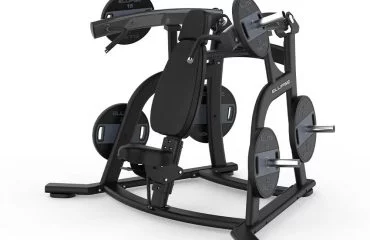
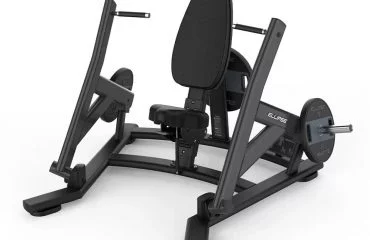
Plate-loaded. The user loads Olympic discs onto the arms. The feel is closer to free weights, the maintenance is simpler because there is no stack or cable to service, and the purchase cost per station is generally lower. In exchange, you need disc storage next to the machine and a floor that tolerates plate handling. This format suits strength-oriented boxes, university and armed-forces facilities, and clubs whose members already train with barbells.
Independent arms, converging path and grip options
Three construction details separate a serviceable machine from a good one.
- Independent arms stop a stronger side from carrying a weaker one. On a rehabilitation or return-to-training brief this is not a refinement, it is the requirement.
- A converging path brings the handles closer together as they rise, which follows the natural travel of the shoulder rather than forcing a purely vertical line.
- Multiple grips, neutral and pronated, let the same station serve users with different shoulder mobility. A member who cannot press comfortably in a pronated grip will usually manage a neutral one.
Seat adjustment matters just as much. A station whose seat cannot be set correctly for a short user will simply not be used by half of the membership.
Standards and construction
Indoor equipment installed in a facility open to users must be specified to EN ISO 20957-1 class S, the class covering professional and supervised commercial use. Class S covers the structural, stability and safety requirements that a station under continuous public use has to meet. Class I is a separate professional class covering inclusive access, not a higher intensity tier: do not read it as an upgrade over class S.
Beyond the standard, look at the frame section and welds, the quality of the guide rods and bushings, the cable and pulley specification on selectorised models, and whether upholstery and pads are replaceable as spare parts. On a station that will take tens of thousands of repetitions a year, serviceability is worth more than any specification sheet.
Complementary shoulder stations
A press station trains the pressing pattern. It does not, on its own, cover the shoulder. Lateral work and posterior work are handled by separate machines, for example a dedicated lateral raise machine, or by cable stations and free weights. Any claim that a single press station also delivers lateral raises, rowing or external rotation should be treated with caution: those are different machines and different movement patterns.
If floor space is the constraint, a combined chest and shoulder press station lets one footprint cover two pressing patterns, at the cost of some queueing during peak hours.
Placement and layout
Put the shoulder press in the pressing zone, next to chest press and close to the pulling stations, so an upper-body circuit can be run without crossing the room. Leave clear access on the loading side for plate-loaded models and enough clearance behind the seat for a user to enter and exit without disturbing the neighbouring station. On a full room specification, the placement of the press stations usually drives the rest of the strength layout, which is why the equipment plan and the floor plan should be produced together rather than one after the other.
FAQ
Which muscles does a shoulder press machine train?
Primarily the deltoids, with the anterior and lateral heads doing most of the work in a vertical press, supported by the triceps and the upper back. The posterior deltoid is only lightly involved and is better trained on a rear delt or reverse fly station.
Is it suitable for beginners?
Yes, and that is one of its main advantages in a commercial setting. The guided path means a first-time user can press safely without a spotter. Start on the lightest settings and add load progressively.
How often should the station be used?
For a member, pressing volume is normally spread over two sessions a week with recovery in between. For an operator, the relevant number is daily station usage, which is what determines your maintenance interval.
Machine or dumbbells?
The machine gives stability, a controlled path and no spotter requirement. Dumbbells give free trajectory and more stabiliser work. In a professional room the two are complementary, not alternatives.
Can members with shoulder problems use it?
Anyone with a diagnosed shoulder condition should be cleared by a health professional first. A machine with independent arms, a converging path and a neutral grip option is generally the most tolerable configuration, which is why those features matter on a rehabilitation brief.
What maintenance does it need?
Periodic inspection of the guide rods, bushings, fixings and, on selectorised models, the cables and pulleys, plus cleaning and inspection of the upholstery. Any station showing cable wear should be taken out of service until the cable is replaced.
Specifying your shoulder press
The right shoulder press depends on who uses the room, how many of them, whether staff are present, and what the rest of the strength line looks like. Selectorised for mixed and unsupervised memberships, plate-loaded for strength-oriented facilities, independent converging arms wherever inclusive or rehabilitation use is part of the brief. Light In Fitness has been equipping professional facilities since 2013 and supplies the full strength line rather than a single station, so the press can be specified alongside the machines it will sit next to.
Send us your room dimensions, your membership profile and your intended layout, and we will build the corresponding equipment specification: request a quote.