Lat pulldown machines for commercial gyms: types, criteria and prices
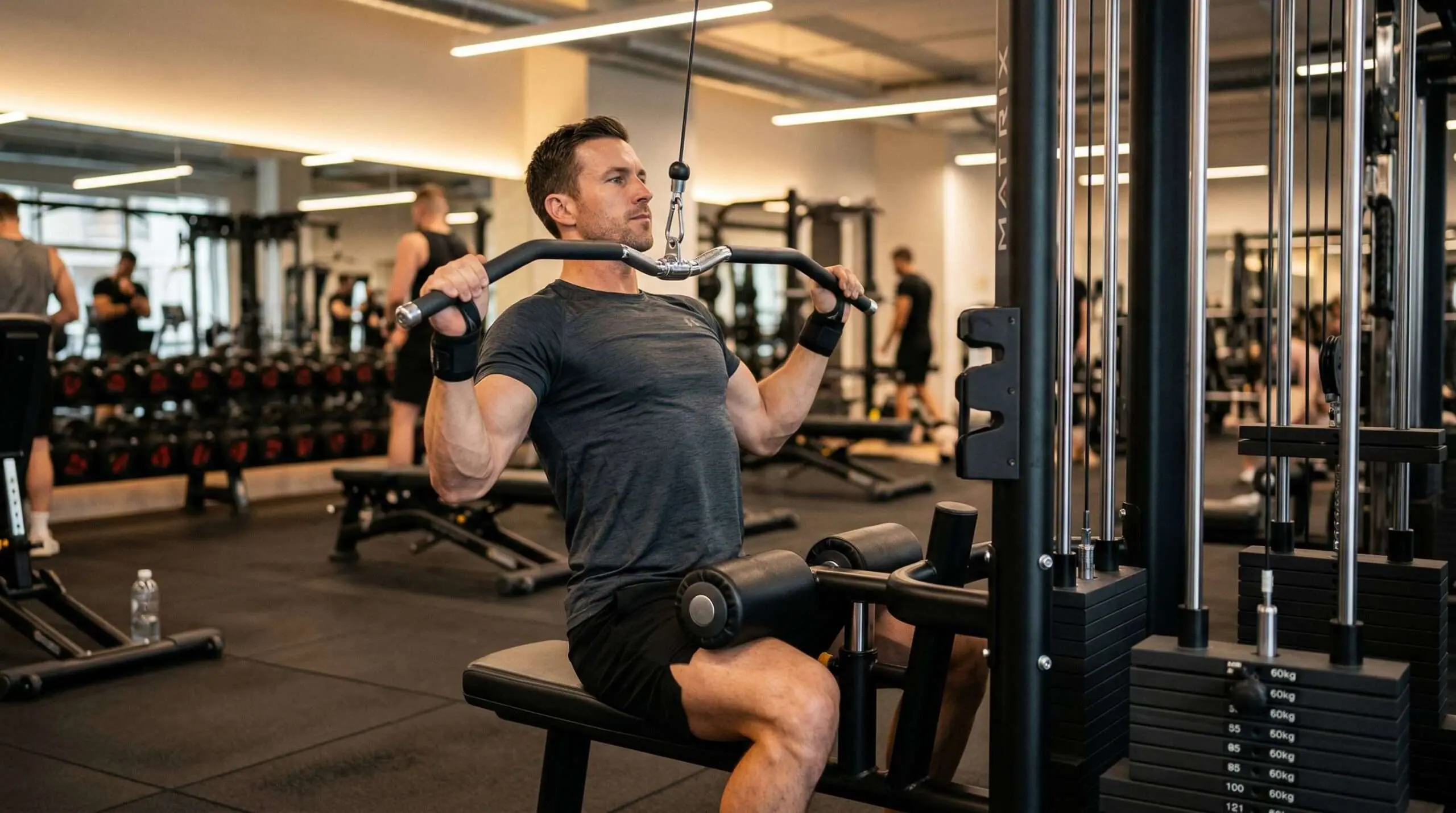
A commercial lat pulldown machine costs between 1,500 and 8,000 EUR excluding VAT depending on whether you choose a selectorised high pulley, an iso-lateral converging unit, an assisted pull-up station or a plate-loaded frame. It is the reference machine for training the latissimus dorsi and one of the most heavily used stations on any commercial strength floor, so the choice you make here shapes queue times, member satisfaction and your maintenance bill for the next ten years. This guide compares the four main types, sets out the technical criteria that matter in a B2B purchase and gives realistic budget bands for each tier.
Why the lat pulldown earns its floor space
The vertical pull recruits the latissimus dorsi as the prime mover, supported by the rhomboids, teres major, biceps and the stabilising muscles of the shoulder girdle. Three characteristics make it indispensable on a commercial floor:
- It serves every level. Members who cannot yet perform a pull-up train the same movement pattern with a manageable load, while advanced members can load the full stack.
- It is self-limiting and safe. Unlike free-weight rows, a failed repetition simply returns the stack; no spotter is needed and unsupervised use is straightforward.
- It anchors the back zone. Combined with a horizontal row and a pullover or cable station, it completes the pulling patterns your programme needs. See our seated row machine buying guide for the horizontal counterpart.
The four types of commercial lat pulldown
1. Selectorised high pulley
The classic configuration: a weight stack of 80 to 120 kg, a fixed overhead pulley and a thigh pad. Fast load changes, intuitive for beginners, ideal for high-traffic floors. Its limit: a single fixed cable path suits most, but not all, shoulder morphologies.
2. Iso-lateral converging arms
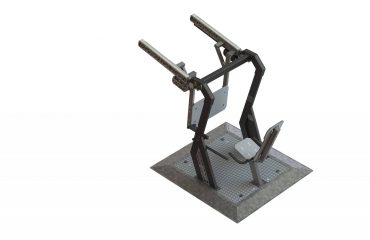
Independent lever arms follow a converging arc that mimics the natural pull line of the lats and lets members work each side separately, which is valuable for correcting imbalances. Usually plate-loaded, favoured in performance and bodybuilding-oriented clubs.
3. Assisted pull-up station
A counterweight platform assists a true pull-up rather than replacing it. Excellent progression tool for group training and coaching studios, and doubles as an assisted dip station on most frames.
4. Integrated jungle or multi-station pulley
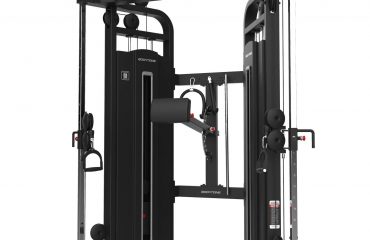
A lat pulldown position built into a cable architecture or multi-station. Space-efficient for small floors, but the station is shared with other cable exercises, which creates queues at peak times. Our cable machine architecture guide explains when an integrated position is enough and when a dedicated unit pays off.
Comparison table
| Type | Typical price excluding VAT | Footprint | Best suited to | Main limitation |
|---|---|---|---|---|
| Selectorised high pulley | 1,500 – 3,500 EUR | 1.5 – 2.5 m² | General commercial floors, high traffic | Fixed cable path |
| Iso-lateral converging | 2,500 – 6,000 EUR | 2.5 – 3.5 m² | Premium and performance clubs | Plate handling, slower turnover |
| Assisted pull-up | 2,000 – 5,000 EUR | 1.5 – 2 m² | Coaching studios, progression programmes | Less loadable for advanced users |
| Integrated multi-station position | Included in station: 3,000 – 8,000 EUR | Shared | Small floors, hotels, corporate gyms | Shared station, peak-time queues |
The selection criteria that matter in a commercial purchase
- Certification and use class. For a publicly accessible facility, specify equipment certified to EN ISO 20957-1:2024, class S (professional use). There is no such thing as a recognised “semi-professional” class: a machine is either built and certified for commercial duty or it is not.
- Stack weight and cable ratio. An 80 kg stack on a 2:1 cable ratio delivers only 40 kg of effective resistance. Check the ratio, not just the stack plate count. For a commercial floor, aim for at least 100 kg of effective resistance.
- Cable and pulley quality. Look for aircraft-grade cable of 5 mm or more with a nylon or polyurethane sheath, and sealed bearings in the pulleys. Cables are the number one wear part; ask for the replacement price and lead time before signing.
- Adjustability. The thigh pad must adjust to hold users from roughly 1.50 m to 2.00 m tall. On converging machines, check the start-position adjustment so shorter members are not forced into an over-stretched starting posture.
- Serviceability. Favour machines with accessible pulley covers, standard fasteners and a supplier who stocks cables, pads and grips locally. A machine that waits six weeks for a cable is a machine that costs you members.
- Footprint and access. Allow the machine footprint plus a user zone and circulation; in practice 4 to 5 m² per dedicated unit on the floor plan.
Budget tiers
- Entry professional (1,500 – 2,500 EUR excluding VAT): selectorised high pulley, 80–100 kg stack, standard pulleys. Suitable for hotels, corporate gyms and low-traffic floors.
- Mid-range commercial (2,500 – 4,500 EUR excluding VAT): heavier frames, 100–120 kg stacks, better bearings and upholstery. The sweet spot for most commercial clubs.
- Premium and iso-lateral (4,500 – 8,000 EUR excluding VAT): converging arm geometry, dual stacks or heavy plate-loaded builds, premium finishes for flagship floors.
Installation, positioning and commissioning
A lat pulldown arrives as a heavy, tall unit — typically 90 to 160 kg assembled and around 2 m high with the stack tower, so check ceiling clearance of at least 2.3 m and doorway access before delivery day. Position the machine with its back to a wall or in a machine row, never facing away from circulation: users load and unload attachments behind the seat, and a bar swinging into a walkway is a preventable incident. On resilient rubber flooring no fixing is normally required, but the machine must sit level; a rocking frame accelerates pulley wear and feels cheap to members. At commissioning, run the full stack through its travel, check cable seating in every pulley groove, torque the thigh-pad adjusters and log the machine into your maintenance register with its serial number and service intervals.
Programming the station: getting more from one machine
Utilisation, not purchase price, decides the real cost per use. Three levers raise it:
- Attachment discipline. Store the wide bar, V handle and neutral bar on hooks at the machine, not in a communal pile across the room. Stations with their own attachments see measurably more varied use and less queue friction.
- Signage that teaches. A simple placard showing three grip variations and target muscles converts hesitant beginners into regular users of the station — the group that decides whether a general club retains its January intake.
- Coach integration. Ask your coaches to place the pulldown in induction programmes. It is the safest first pulling exercise for a new member, and the machine members learn first is the machine they keep using.
In procurement terms, the pulldown is also where selectorised versus plate-loaded economics show clearly: a selectorised unit turns over users faster in open-access hours, while a plate-loaded iso-lateral costs less per kilogram of resistance but occupies members longer per set. Mixed floors increasingly buy one of each — the selectorised unit for flow, the converging unit for depth.
Frequently asked questions
Is one lat pulldown enough for a commercial gym?
Up to roughly 400 members, one dedicated unit plus a cable-station position usually absorbs demand. Beyond that, plan a second unit or an iso-lateral variant to split traffic and offer movement variety.
Lat pulldown or pull-up bar: does a gym need both?
Yes. The pull-up bar costs almost nothing and serves advanced members; the pulldown serves everyone else and allows precise load progression. They are complements, not substitutes.
What breaks first on a lat pulldown?
In order: hand grips, cables, seat and thigh-pad upholstery, then pulley bearings. All are inexpensive parts if the supplier stocks them; budget roughly 2 to 3 percent of the machine value per year in preventive maintenance.
Which attachment set should we order with the machine?
A wide pronated bar, a close-grip V handle and a neutral-grip bar cover the vast majority of programmes. Add rotating single handles if your coaches programme unilateral work.
Specify your back-training zone with Light In Fitness
Light In Fitness has supplied professional strength equipment to gyms, hotels and public facilities since 2013, with delivery and installation across Europe. Browse our strength training machines or request a quotation: we will size the right pulldown configuration for your floor plan, traffic and budget.
Sources et références
- NF EN ISO 20957-1 – équipement d’entraînement fixe, partie 1 : exigences générales de sécurité et méthodes d’essai (AFNOR)
- AFNOR Normalisation – dossier thématique sur les appareils d’entraînement fixes et leurs classes d’usage