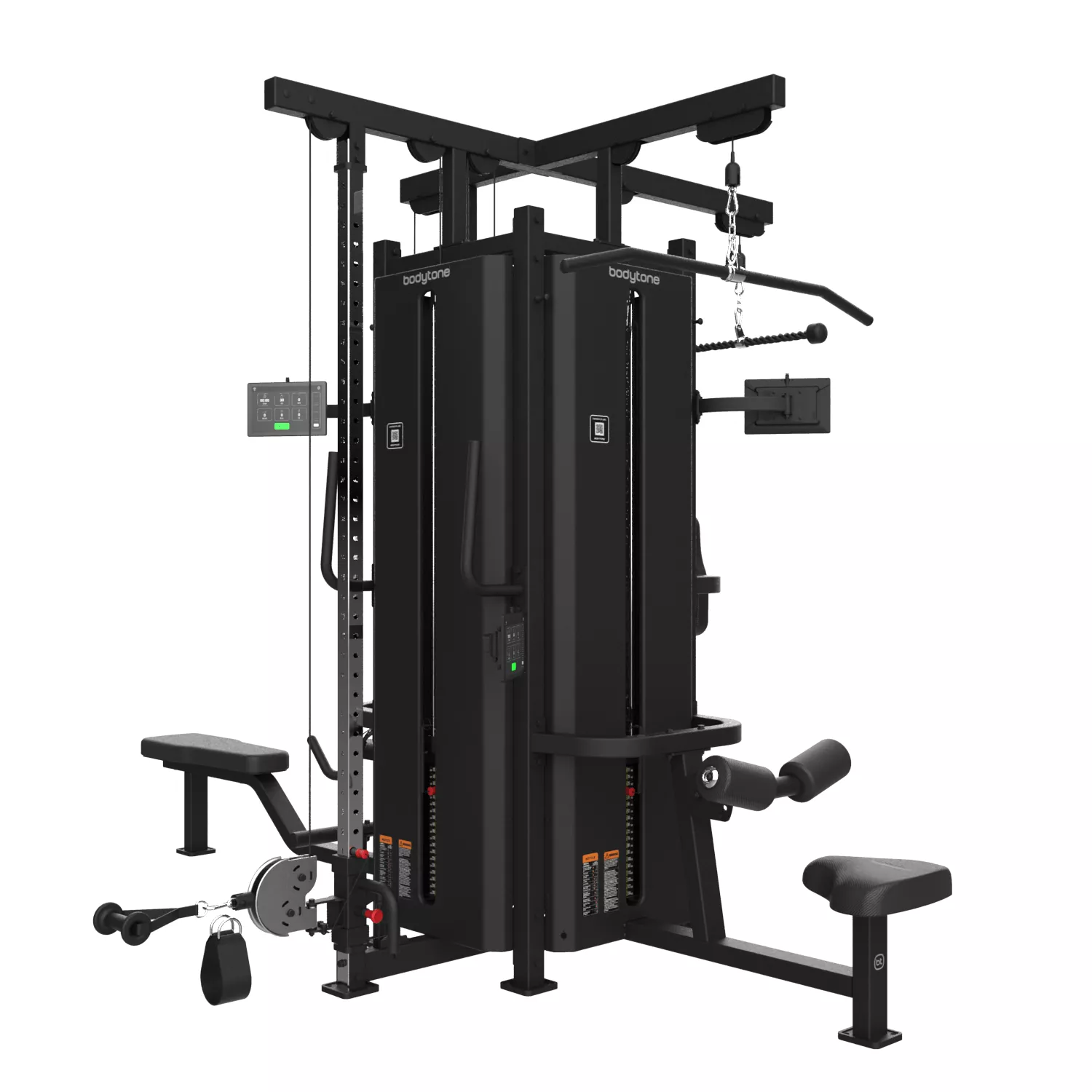
The right cable machine for a gym floor is decided by one number: how many people must train at once during the 18:00 peak. Three architectures answer that question differently. A facing-column crossover such as the Bodytone FC02v2 at 4,950.00 EUR excluding VAT gives two users total freedom of movement. A four-station multi-gym such as the FC4S V2 at 7,250.00 EUR excluding VAT serves four users on defined, self-explanatory stations. A ten-station cable tower at 14,500.00 EUR excluding VAT absorbs peak traffic on a single footprint. Ranked by cost per working station the order is counter-intuitive, and it is set out below.
Three architectures, three different problems solved
- Facing-column crossover — two adjustable columns opposite each other, 91 kg per stack. Any angle, any exercise: cross pulls, flyes, unilateral work, sport-specific patterns, rehabilitation. Needs a coach or an experienced membership to be used well, and needs clear floor space between the columns.
- Four-station multi-gym — lat pulldown, low row, chest press and one free cable, all usable simultaneously without users obstructing each other. Each station is obvious: you sit down and you pull. This is the architecture for unsupervised spaces — residential buildings, hotels, corporate gyms, small clubs.
- Cable tower — ten stations arranged around a central structure. It replaces a row of separate machines on one footprint and is the cable hub of a large, busy floor.
Technical comparison
| Characteristic | Crossover FC02v2 | Multi-gym FC4S V2 | 10-station tower |
|---|---|---|---|
| Published price excluding VAT | 4,950.00 EUR | 7,250.00 EUR | 14,500.00 EUR |
| Simultaneous users | 2 | 4 | 10 |
| Cost per working station | 2,475.00 EUR | 1,812.50 EUR | 1,450.00 EUR |
| Weight stacks | 2 x 91 kg | 2 x 100 kg, 5 kg increments | Multiple stacks by station |
| Exercise model | Free: functional, unilateral, rehabilitation, any angle | Guided per station, plus one free cable | Mixed: defined stations around the perimeter |
| Instrumentation | Integrated repetition counter | Full handle set included: lat bar, neutral grips, triceps rope, EZ bar, D-handle | Multi-user ergonomics |
| Cable mechanics | Heavy-duty structure | 5 mm sheathed galvanised steel cable, 900 kg breaking load, sealed ball-bearing pulleys | Continuous-use construction |
| Footprint and constraints | Clear width between columns plus working zone | 3.20 x 2.80 m, 420 kg, minimum 2.50 m ceiling | Substantial central footprint, large floor only |
| Best suited to | Functional boxes, coaching studios | Residences, hotels, corporate gyms, small clubs | High-traffic clubs, large floors |
All equipment on a staffed floor should be declared to EN ISO 20957-1:2024 class S (professional and commercial use), or class I where it is designed for inclusive use. Class H is domestic and is not appropriate even in an unstaffed residential gym open to tenants.
The arithmetic that decides the purchase
Cable equipment is not bought by the kilogram of cast iron; it is bought by the number of athletes served simultaneously at peak. Divide the published price by the number of usable stations and the ranking inverts against the headline price:
- Ten-station tower: 14,500.00 / 10 = 1,450.00 EUR per station
- Four-station multi-gym: 7,250.00 / 4 = 1,812.50 EUR per station
- Facing-column crossover: 4,950.00 / 2 = 2,475.00 EUR per station
The crossover is the cheapest machine and the most expensive capacity. That is not an argument against it — exercise freedom has real value in a coached environment — but it must be a conscious decision, not an accident of comparing headline prices. Count your 18:00 attendance before you count stations.
Larger cable stations: the wider range
| Model | Stations | Console | Price excluding VAT | Cost per station |
|---|---|---|---|---|
| FC02v2 | 2 | Repetition counter | 4,950.00 EUR | 2,475.00 EUR |
| FC02SK | 2 | 10" touchscreen | 9,448.40 EUR | 4,724.20 EUR |
| FC4S V2 | 4 | — | 7,250.00 EUR | 1,812.50 EUR |
| FC07v2 | 7 | Repetition counter | 14,154.20 EUR | 2,022.03 EUR |
| 10-station tower | 10 | — | 14,500.00 EUR | 1,450.00 EUR |
| FC10v2 | 10 | Repetition counter | 20,966.30 EUR | 2,096.63 EUR |
| FC07v2SK | 7 | 10" touchscreen | 25,645.00 EUR | 3,663.57 EUR |
| FC10SK | 10 | 10" touchscreen | 40,507.60 EUR | 4,050.76 EUR |
Touchscreen consoles roughly double the cost per station. They earn that premium where the operator runs guided programmes, tracks member progression or uses the screen for retention; they do not earn it in a residential gym where nobody administers the content.
Freedom or guidance: match the machine to the supervision level
These two philosophies serve opposite populations, and getting it wrong wastes the whole investment.
- Supervised space — a box, a coaching studio, a physiotherapy practice. Choose free columns. The coach builds the movement, the repetition counter makes the set objective, and the range of possible exercises is effectively unlimited.
- Unsupervised space — a residential building, hotel, corporate gym or 24-hour club. Choose defined stations. A user with no coaching sits down at a lat pulldown and understands it immediately. In these settings, observed working loads sit around 30 to 50 kg in residential gyms and 40 to 70 kg in hotels, well inside a 100 kg stack with 5 kg increments.
Installation constraints that stop projects
Publish these on the drawing before you order, not after delivery:
- Ceiling height. A four-station multi-gym needs a minimum of 2.50 m including stack travel. Low ceilings are the most common cause of a refused installation.
- Assembled footprint. 3.20 x 2.80 m for the multi-gym, 420 kg assembled. Add the user working zone around it, not just the frame.
- Access route. Delivery arrives in 4 to 6 packages, the heaviest around 140 kg. Confirm level access or a goods lift.
- Assembly time. Allow 3 to 5 hours for two people on site.
- Floor. 20 mm rubber tile under the frame distributes the point load and protects the sub-floor. See our guide to rubber sports flooring.
Maintenance: preventive versus reactive
The mechanics that matter on a cable station are the ones you cannot see. Sheathed 5 mm galvanised steel cable with a 900 kg breaking load gives roughly a nine-fold margin over a 100 kg stack, and sealed ball-bearing pulleys run silently without lubrication schedules. The operating budget follows directly:
| Approach | Annual cost per machine | What it covers |
|---|---|---|
| Preventive | 200 to 400 EUR excluding VAT | Quarterly inspection, lubrication, one cable replaced before failure |
| Reactive | 500 to 1,200 EUR excluding VAT | Failure call-outs, emergency parts, machine downtime |
Over five years, preventive maintenance costs two to three times less and keeps the station available. These are operating estimates for budgeting, not a quoted service contract.
Which architecture for which venue
- Functional box or coaching studio — facing-column crossover: exercise freedom plus a repetition counter that makes coaching measurable.
- Residence, hotel, corporate gym — four-station multi-gym: four self-explanatory stations, full handle set included, no coaching dependency.
- High-traffic club, large floor — ten-station tower: the best cost per station in the range and the machine that absorbs the evening peak.
- Small club that wants both — a four-station multi-gym plus a separate high pulley. The lat pulldown is the station that queues first, and adding a dedicated high pulley clears that bottleneck for far less than upgrading to a tower.
Frequently asked questions
What is the difference between a crossover, a multi-gym and a cable tower?
A facing-column crossover puts two adjustable columns opposite each other for completely free exercise selection by two users. A multi-gym defines four simultaneous stations — lat pulldown, low row, chest press and one free cable — designed for unsupervised use. A cable tower groups ten stations around a central structure for large, busy floors. Choose by the number of simultaneous users and by whether the space is coached.
Which cable station gives the best cost per user?
On published prices, the ten-station tower at 14,500.00 EUR excluding VAT works out at 1,450.00 EUR per station, the four-station multi-gym at 7,250.00 EUR gives 1,812.50 EUR per station, and the two-station crossover at 4,950.00 EUR gives 2,475.00 EUR per station. The cheapest machine provides the most expensive capacity.
What ceiling height does a cable multi-gym need?
At least 2.50 m including weight stack travel for a four-station unit measuring 3.20 x 2.80 m assembled. Check this against the finished floor level, after any raised flooring, before ordering.
How much does it cost to maintain a cable machine?
Budget 200 to 400 EUR excluding VAT per machine per year for preventive maintenance — quarterly inspection, lubrication and proactive cable replacement — against 500 to 1,200 EUR per year if you wait for failures. Cables are the wear part; inspect them at the crimp and at the pulley entry.
Are touchscreen consoles worth the extra cost?
They roughly double the cost per station, so they pay for themselves only where an operator actively runs guided programmes, tracks progression or uses the screen for member retention. In an unstaffed residential or hotel gym, a repetition counter delivers most of the practical benefit.
Specifying a cable zone? Send us your floor plan, your ceiling height and your expected attendance at peak. Light In Fitness returns an architecture recommendation with the arithmetic per station, the flooring specification, delivery, installation and prices excluding VAT within 24 working hours. See also our comparison of commercial treadmills.
Related guides: building a strength floor.