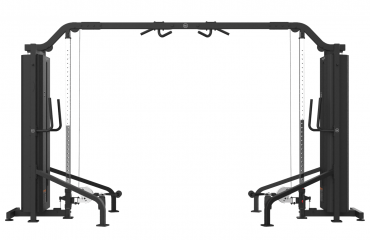
Professional cable crossover buying guide: pulley ratio, column load and layout
Choose a professional cable crossover by comparing its stated use, pulley ratio, adjustments and the space available. Stack weight alone does not establish handle resistance or simultaneous user capacity. This guide helps prepare a shortlist and a layout before requesting a quotation.
Compare architectures and selection criteria
A crossover can place two adjustable cable points on a wide or narrow frame. A multi-station machine combines several functions on one structure. Functional trainer and adjustable dual pulley may describe the same architecture: compare the actual configuration instead of inferring size or capacity from a name.
| Criterion | Information to confirm |
|---|---|
| Use | Documented usage level for the exact model and version |
| Resistance | Each stack, increments and pulley ratio |
| Adjustments | Positions, range, included accessories and compatible attachments |
| Layout | Assembled dimensions, exercise area, access and clearances |
| Maintenance | Model manual, inspection requirements and replacement parts |
| Documents | Technical sheet, installation instructions and model-specific evidence |
Stack weight and handle resistance
Read the documented ratio alongside stack weight. On the PC0925, the stated 2:1 ratio means a 100 kg selection provides 50 kg of nominal handle resistance before friction effects. This is not a maximum user weight or a specification for another machine. Confirm a different or ambiguous ratio notation for the supplied version.
Adjustments and intended exercises
List the movements required, such as cable flyes, rows, biceps curls, triceps extensions and unilateral work. Compare cable height, travel and accessories against those needs. A position count does not make every exercise suitable for every user. Adjustable pulleys alone do not establish a therapeutic application.
Installing a cable crossover
Separate the machine footprint from the working area on the plan. Measure finished ceiling height, doors, stairs, delivery access and circulation. Have the supporting surface assessed using the machine weight and load distribution. Follow the model instructions for anchoring, assembly and cable adjustment; a heavy frame or rubber floor does not establish stability for every machine.
Maintenance and project costs
Use the model manual to plan inspection of cables, pulleys, attachments, guides and fixings at the prescribed intervals. A damaged cable or abnormal operation requires taking the machine out of use and an appropriate check before reuse. Service life, cycle counts and annual costs cannot be applied to every machine. Separate equipment, accessories, transport, assembly and planned maintenance in the quotation.
Frequently asked questions
Do independent stacks mean two simultaneous users?
Independent stacks describe the resistance system. Simultaneous use also depends on cable points, travel and clearances, so confirm capacity for the model and layout.
Which stack weight suits a commercial gym?
Start with the intended exercises and users, then compare stack weight with the ratio. The verified documents do not provide a universal threshold covering a fixed percentage of all needs.
How often should cables be replaced?
Follow the model manual’s inspection criteria and intervals. A fixed eighteen-to-twenty-four-month interval or a cycle-life claim needs model-specific documentation.
Does a professional label prove certification?
A commercial label does not replace supporting documentation. Check the reference, version and scope; evidence for one model does not automatically cover a whole range.
Prepare your selection
Compare the equipment, then provide your plan, available height and intended use to specify the project.
Compare strength training machines · Compare crossovers, multi-stations and towers · Discuss your equipment project
Specify your cable station
Light In Fitness manufactures and distributes professional strength equipment from Tours, France, and has equipped more than 2,500 customers since 2013. Quotations are issued within 24 working hours, stock items ship in five to ten working days, and delivery covers France, Belgium, Switzerland and Luxembourg, with export costed project by project. Steel structures carry a twenty year warranty.
Browse cable stations and strength training machines, or request a quote with your ceiling height and floor plan.
The product sheet and quotation specify the applicable conditions. Warranties for structures manufactured by Light In Fitness do not automatically extend to distributed brands.
À lire aussi sur le même thème
- Leg press professionnel : guide d’achat 2026 pour salle de sport
- High Pulley, Low Pulley or Cable Crossover: Which Machine Should You Choose?
- Guided Machines or Free Weights: the Right Ratio for Each Audience
- Smith machine buying guide for commercial gyms: types, specification and layout
- Commercial weight bench buying guide