EN ISO 20957 Standard: Safety Requirements for Commercial Gym Equipment
La série EN ISO 20957, qui a remplacé l'EN 957, fixe les exigences de sécurité et les méthodes d'essai des appareils d'entraînement fixes. La classe S désigne l'usage professionnel, par opposition aux classes domestiques. Cette conformité conditionne la responsabilité de l'exploitant en cas d'accident.
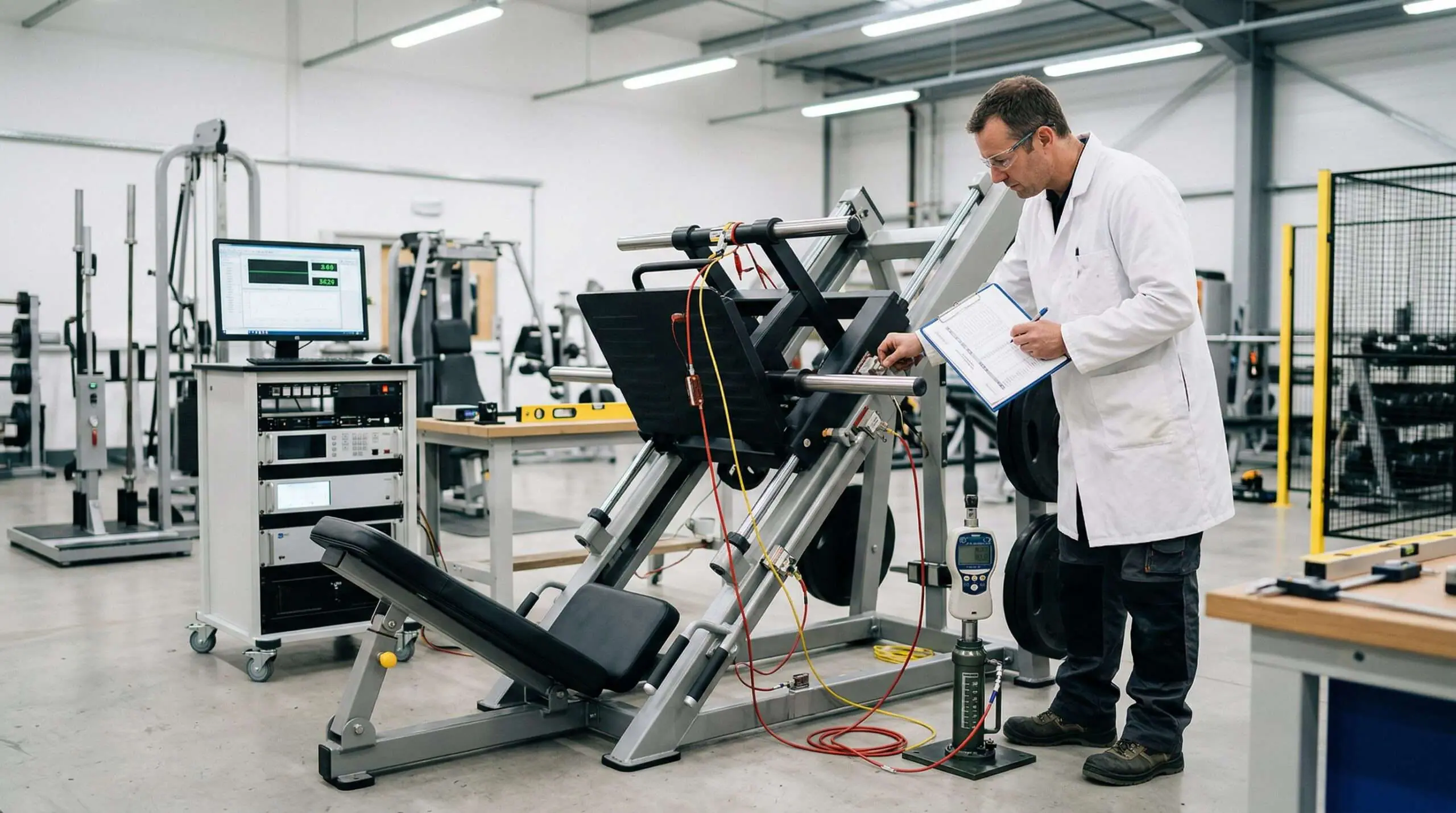
Gym operators and public buyers need equipment suited to its intended use. EN ISO 20957 is a key safety framework for indoor stationary training equipment. ISO 20957-1:2024 is the current general part. Older certificates may cite EN 957, the earlier European series. Check the exact part and edition on each report. The names should not be treated as proof that two certificates cover identical requirements. See the ISO catalogue entry.
This guide explains the standard’s parts and the usage classes S, H and I. It also covers test reports, CE marking and the operator’s inspection duties. Use it to prepare a purchasing file, alongside the equipment manual and advice for your country’s rules.
From EN 957 to EN ISO 20957-1:2024
Origins of the standard
CEN/TC 136 developed the original European EN 957 series for sports and recreational equipment. Its general part dates from the 1990s and was later revised. The ISO 20957 series now provides the main international references. A standard can support safety assessment. Its legal effect depends on the applicable legislation and cited edition. Do not assume that every part gives an automatic legal presumption of conformity.
The current reference: EN ISO 20957
The European and international references have evolved towards ISO 20957 / EN ISO 20957. The third edition of the general part, ISO 20957-1:2024, was published in November 2024. Old documents may still cite EN 957. Treadmills now have an ISO reference too: ISO 20957-6:2021. For a new tender, check the current national or European adoption and the edition required for each equipment family.
Scope
The series covers stationary training equipment used indoors. This includes powered equipment and mechanical strength machines or benches. The scope includes clubs, hotels, schools, rehabilitation centres and home settings. It does not cover outdoor fitness equipment or equipment intended for children under 14. The scope includes an exception for supervised educational use by children. Outdoor equipment needs a framework suited to its own purpose, such as EN 16630 for permanently installed outdoor fitness equipment.
Structure of the standard: the parts of EN ISO 20957
The series is organised around a general part (part 1), applicable to every machine, plus specific parts adding requirements for each equipment family. Check the exact reference and edition required for the product and market. The table lists published ISO editions, rather than dates of national EN adoption. ISO/FDIS revisions of parts 5 and 10 were still under development when checked. See the ISO/TC 83 catalogue for updates.
| Part | Current reference | Scope |
|---|---|---|
| Part 1 | ISO 20957-1:2024 | General safety requirements and test methods — terminology, usage classes (S, H, I), requirements common to all equipment, marking |
| Part 2 | ISO 20957-2:2024 | Strength training equipment — additional requirements for selectorised, cable, elastic, hydraulic and pneumatic resistance machines |
| Part 3 | Merged into part 2 | Former part covering institutional strength equipment, now integrated into EN ISO 20957-2 |
| Part 4 | ISO 20957-4:2016 | Strength training benches — flat, incline, decline and bench-press benches |
| Part 5 | ISO 20957-5:2016 | Stationary exercise bicycles and upper-body crank trainers |
| Part 6 | ISO 20957-6:2021 | Motorised treadmills — emergency stop, maximum speed, guarding of moving parts |
| Part 7 | ISO 20957-7:2024 | Rowing machines |
| Part 8 | ISO 20957-8:2017 | Steppers, stair climbers and climbing simulators |
| Part 9 | ISO 20957-9:2016 + Amd 1:2019 | Elliptical cross-trainers |
| Part 10 | ISO 20957-10:2017 | Exercise bicycles with a fixed wheel or without freewheel |
To equip a facility correctly from the outset, browse our ranges of compliant strength training machines and commercial cardio equipment.
Usage classes: S (professional), H (home) and I (inclusive)
Why the classification exists
A club and a private home place different demands on equipment. The standard separates intended use from the accuracy of displayed training data. The usage classes are:
- Class H: equipment intended for use in a private home.
- Class S: professional or commercial equipment for managed training areas, such as clubs, hotels and schools.
- Class I: equipment for inclusive professional use by people with specific needs. It must also meet class S requirements. Class I is not a higher durability grade and was not introduced in 2024.
Key point: home-use classification alone does not establish suitability for a commercial gym. Request proof of class S requirements, plus class I where inclusive use is part of the specification. Check service life through test results and contractual commitments. See class S versus class H gym equipment. The ISO 20957-1:2024 preview, clause 4.3 gives the classification.
| Criterion | Class H — Home | Class S — Commercial |
|---|---|---|
| Intended setting | Private home | Gym, hotel, school, club, public facility |
| Users | Private household setting | Managed professional setting, within manufacturer limits |
| Usage intensity | Low to moderate | Intensive, several hours per day |
| Durability testing | Requirements for declared domestic use | Requirements in the applicable part and test protocol; no universal multiplier |
| Test loads | Standard static and dynamic loads | Increased static and dynamic loads |
| Structure and finish | Basic resistance | Reinforced frames, welds, cables; anti-corrosion, wear-resistant finishes |
| Permitted in public-access facilities | No | Yes |
How to identify the class of a machine
Ask for the usage class in the manual, sales file and machine marking. For a tender, request the test or conformity report. It should identify the exact model, tested parts, editions and class. A generic claim that the brand is certified is not enough.
What the conformity tests actually measure
Mechanical strength and load tests
- Static load: a fixed load above the declared maximum user load is applied and held; no permanent deformation or failure is allowed.
- Dynamic load: repeated variable loads simulate real movement, with far more cycles required for class S.
- Anchor points: strength of weight carriages, rails, cables and pulleys.
- Structural integrity: welds, bolts and assemblies checked under repeated dynamic stress.
Stability tests
Each machine must resist tipping sideways and forwards, even under an off-centre load. For selectorised weight-stack machines, stability must hold whatever the selected load position.
Durability (fatigue) tests
Endurance tests assess how equipment behaves under repeated use. The required loads and cycle counts depend on the applicable part and class. Do not assume a universal number of millions of cycles. Ask for the model’s test protocol and results. Check cables, axles, bearings, pedals, adjusters and resistance systems for unacceptable damage or play.
Functional and ergonomic safety tests
- Entrapment: no gaps able to trap fingers, hands or limbs (strict dimensional criteria).
- Emergency stop (motorised machines): safety lanyard and stop control on treadmills, with a maximum stopping time.
- Edges: no accessible sharp edges or abrasive surfaces.
- Adjustment systems: locking mechanisms must not release unintentionally under load or vibration.
- Display accuracy: tolerances for displayed power, speed and heart-rate readings.
CE marking and mandatory documentation
CE marking applies only when the product falls under EU legislation that requires it. ISO 20957 conformity alone does not create a CE-marking duty for every mechanical gym machine. Powered equipment may fall under electrical, electromagnetic or machinery rules, depending on its design. The manufacturer must identify the applicable rules and provide the required conformity documents. Technical-file contents and retention periods follow those rules. A CE mark is not an EU safety approval. See the European Commission’s CE guidance.
Ask for an EU Declaration of Conformity where the applicable legislation requires one. Also request a test report identifying the model, standard parts, edition and class. Check the laboratory’s accreditation where this is part of the tender. Examples of testing bodies include TUV, SGS, Intertek and Bureau Veritas. Obtain the user and maintenance manual in the operating language. It should state inspection intervals. Request a spare-parts list and written availability terms. Our equipment compliance overview and European standards map provide wider context.
Operator obligations: liability, inspection, maintenance
The facility operator controls access and use of the equipment. This applies to private clubs, hotels, schools, care settings and defence facilities. Use the relevant safety standards, local law and manufacturer instructions together. Keep equipment suitable for its users and maintain it correctly. After an incident, poor maintenance or unsuitable equipment can raise liability questions. Unstaffed facilities also need a clear safety and inspection plan. Obtain local legal advice for the duties that apply to your site.
An inspection plan can use three levels. The following schedule is an example, not a universal interval imposed by ISO 20957. Adapt it to the manual, usage, risk assessment and local requirements:
- Daily visual inspection: frayed cables, loose bolts, detached upholstery or grips.
- Quarterly operational check: function test, emergency stops, lubrication, cable tension.
- Annual in-depth inspection: structural check, preventive replacement of wear parts, safety log update.
Record checks in a dated, signed safety log. Keep repair records and the actions taken after defects are found. Inspectors and insurers may request them. A structured annual gym maintenance plan helps organise this work.
Possible consequences depend on national law and the facts of the case. They may include a formal notice, restricted use, closure, fines or liability after an incident. Insurance cover also depends on policy terms. CE marking does not establish that a home-use machine is suitable for commercial use. Check the declared use class and the supporting report.
Compliant purchasing checklist for decision-makers
- Request evidence of class S suitability; add class I where inclusive use is required
- Request test reports for the relevant parts and editions, such as ISO 20957-2 for strength machines and ISO 20957-6 for treadmills
- Check CE marking and the EU Declaration of Conformity where the product’s applicable legislation requires them
- Make sure the manual is supplied in your operating language with maintenance procedures
- Verify spare-parts availability for at least 7–10 years
- Build the periodic inspections into your preventive maintenance plan
Light In Fitness, a professional fitness equipment supplier since 2013, works exclusively with manufacturers certified to EN ISO 20957 class S. Every order ships with a complete compliance file and dedicated after-sales support. Whether you are equipping a municipal gym, a hotel or a full commercial club, our team can guide your specification — request a free quote.
FAQ — EN ISO 20957 and EN 957
What is the difference between EN 957 and EN ISO 20957?
EN 957 is the earlier European series. ISO 20957 is the current international family, with European adoptions cited as EN ISO 20957. The general ISO part was updated in 2024. Treadmills have their own ISO 20957-6:2021 reference. Compare exact parts and editions instead of treating old and new names as interchangeable.
Can class H machines be used in a commercial gym?
Class H establishes suitability for home use. It does not by itself establish commercial-use suitability. A commercial specification should require class S, with class I where inclusive use is intended. Check the model’s manual and test report before purchase.
How often should machines be inspected to comply with the standard?
Use the manufacturer’s intervals, local rules and the site’s risk assessment. A plan may combine daily visual checks, periodic checks of safety systems and a detailed technician inspection. Quarterly and annual checks are examples to adapt, not a single schedule imposed on every model. Record the work in a dated safety log.
What are the risks if equipment is non-compliant?
The consequences depend on the country’s law, the defect and any incident. They can include restrictions on use, formal notices, fines and liability. Insurance decisions depend on the policy. A serious breach may also lead to prosecution. Get qualified local advice rather than assuming an automatic sanction for every case.
How do I verify conformity before buying?
Check the declared use class and a test report for the exact model. The report should identify standard parts and editions. Obtain the user and maintenance manual. Where applicable EU legislation requires CE marking, check the mark and signed declaration too. Ask for these documents before committing.
Conclusion
EN ISO 20957 is a key technical reference for commercial fitness equipment. ISO 20957-1:2024 is its current general ISO part. The class system helps match equipment to its users and setting. The full purchasing file should also cover applicable law, maintenance and manufacturer limits. This protects users and helps safeguard the investment. Contact Light In Fitness for a review of an existing fleet or a turnkey project.
Sources et références
- NF EN ISO 20957-1 – équipement d’entraînement fixe, partie 1 : exigences générales de sécurité et méthodes d’essai (AFNOR)
- AFNOR Normalisation – dossier thématique sur les appareils d’entraînement fixes et leurs classes d’usage
- Code de la commande publique – texte intégral en vigueur (Légifrance)
- Direction des affaires juridiques, ministère de l’Économie – réglementation de la commande publique et fiches techniques