Selectorised or plate-loaded: how to split the two across your gym floor
Selectorised or plate-loaded is not a binary choice, it is a ratio, and the right ratio is set by who supervises your floor rather than by what the machines cost. A general fitness club typically lands around 60 per cent selectorised and 40 per cent plate-loaded. A strength-oriented gym or cross training box inverts that to roughly 30/70. A hotel, workplace or care facility runs 90 per cent selectorised or more, because plate-loaded equipment has almost no role in an unsupervised environment. This guide sets out how to choose the ratio and what it does to your floor plan and your running costs.
Two families, two jobs
The confusion arises because both families offer the same movements. A chest press exists in both. From a catalogue, the buyer appears to be choosing between two ways of doing the same thing. From an operations perspective, they are two pieces of equipment providing entirely different services.
A selectorised machine, with a weight stack and a selector pin, changes load in two seconds with no handling and no risk. That is what makes it indispensable where users are numerous, inexperienced or unsupervised. It is also the throughput machine: turnover between two members is immediate.
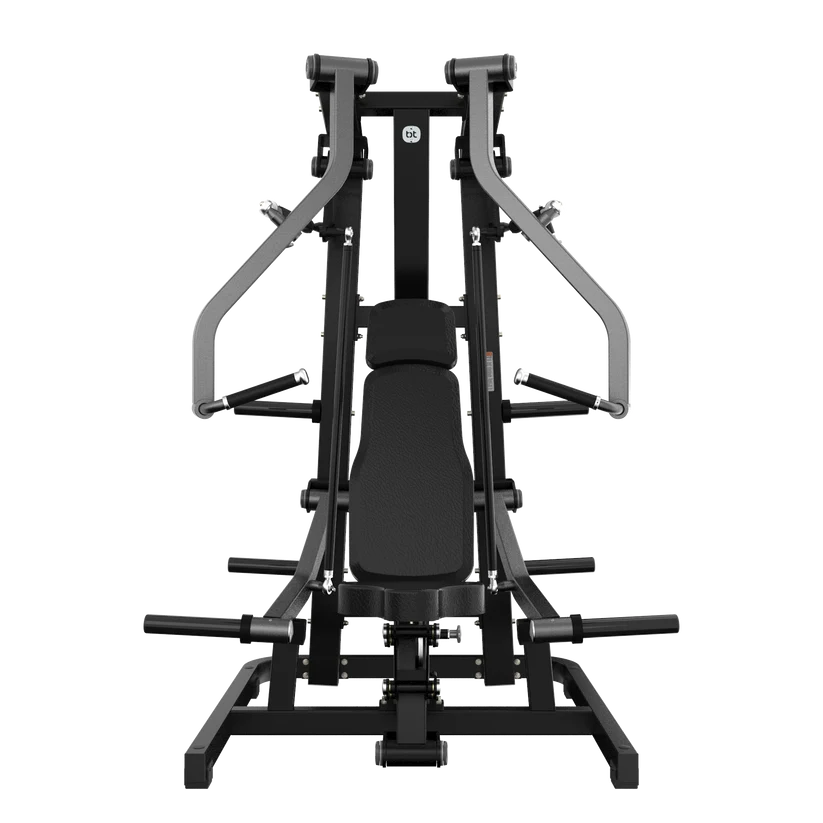
A plate-loaded machine, loaded with Olympic discs, delivers a loading feel and a range of motion that experienced trainees seek out. It reaches higher loads, is simpler to repair, but requires handling at every load change and plate storage within immediate reach. For the mechanical and biomechanical comparison, see our companion article on selectorised versus plate-loaded machines.
The arbitration table
| Operational criterion | Selectorised | Plate-loaded |
|---|---|---|
| Turnover between users | Immediate. Clear advantage | Slowed by loading and unloading |
| Autonomy of a beginner | High, without supervision | Low; needs an induction |
| Maximum useful load | Capped by the stack | High, limited by the frame |
| Floor footprint | Compact; everything is integrated | Machine plus plate trees within reach |
| Wear parts | Cables, pulleys, upholstery | Bearings, handle coverings, the plates themselves |
| On-site repairability | Technical intervention usually required | Often simpler; fewer moving parts |
| True acquisition cost | Machine price, all in | Machine price plus plates plus storage |
| Perception by experienced members | Acceptable | A visible differentiator |
The most common costing error. Comparing a plate-loaded price against a selectorised price without including the plates or their storage. A plate-loaded machine can start around 1,340 EUR excluding VAT against roughly 1,950 EUR excluding VAT for a comparable selectorised station, but a 200 kg plate inventory adds from around 1,200 EUR excluding VAT and a vertical plate tree around 499 EUR excluding VAT each. Across a full floor, the real gap between the two options is far smaller than the quotation line suggests.
The beginner case
This is the question that comes up most, and the answer is stable: for a beginner population, the selectorised machine wins. Three reasons, in this order.
- The path is fixed. A beginner does not yet have the coordination to stabilise a free load. The guided machine removes that requirement and allows correct work from the first session.
- Load change carries no risk. Moving a pin is instant. Loading and unloading plates means handling masses, often at floor level, with the risk of poor posture and of plates being left on the machine for the next user.
- The increment is fine. A weight stack progresses in regular, legible steps. On a plate-loaded machine the minimum increment depends on the plates available, and a beginner quickly faces a step that is too large to take.
This is most acute on upper-body pressing movements, where setup and range-of-motion errors are most frequent and least self-correcting.
The ratio by facility type
| Facility | Indicative ratio, selectorised / plate-loaded | Rationale |
|---|---|---|
| General fitness club | 60 / 40 | Throughput dominates, with an identifiable heavy area for experienced members |
| Premium club, broad membership | 50 / 50 | Two distinct user journeys deliberately designed into the floor plan |
| Strength gym, cross training box, performance centre | 30 / 70 | Heavy loading, coaching present, autonomy less critical |
| Hotel, residential, workplace gym | 90 / 10 or 100 / 0 | Unsupervised free access, constrained area, safety first |
| Care home, rehabilitation, health referral | 100 / 0 | Fine increments and passive safety are non-negotiable |
| Public authority, mixed-user facility | 80 / 20 | Robustness and simplicity without permanent supervision |
These are starting points, not rules. Two parameters move them significantly: whether coaches are present on the floor, and what proportion of your users have been training for more than two years. A facility without supervision should shift towards selectorised regardless of its stated positioning.
What the ratio changes on the floor plan
- Area. A plate-loaded machine is never installed alone: it needs plate trees within immediate reach, otherwise the plates end up on the floor and the zone becomes unusable. Count that additional footprint in the plan at design stage, not afterwards. Our equipment density guidance gives the square metres per station for each family.
- Flooring. Plate-loaded generates plate contact and impact that the selectorised zone never sees. Specify the surface zone by zone, with greater thickness on the free-loading side: 15 to 20 mm under selectorised, 25 to 40 mm where plates are handled and set down.
- The user journey. The best floor plans separate the two families visually rather than alternating them. A beginner who has to cross a heavy-loading zone to reach a guided machine does not come back. Group them, sign them, and let progression happen naturally from one to the other. Our strength machine floor layout guide covers clearance and circulation rules.
Cost of ownership: budget both sides
The two families age differently, and neither is maintenance-free.
On selectorised equipment, the consumables are cables, pulleys and seat upholstery. These are periodic replacements under intensive use, and their availability from stock at your supplier matters more than their unit price: a machine out of service for three weeks waiting for a cable costs far more than the cable.
On plate-loaded equipment the frame barely moves, but bearings and handle coverings work. The bulk of the hidden cost sits elsewhere: the initial plate purchase, plate replacement when coverings are damaged, and the storage that has to accompany them.
In both cases the question to put to the supplier is identical: lead time for spare parts, and warranty duration by part type. That is the criterion that genuinely separates suppliers, far more than the datasheet. Our notes on strength machine installation and maintenance set out a realistic servicing schedule.
Standards to write into the specification
Both families, for supervised or paid-access use, should be specified to EN ISO 20957-1:2024 class S, the professional and commercial use class, along with the relevant part of the standard for the specific equipment type. Class H is the domestic class and has no place on a commercial floor; class I covers inclusive professional equipment intended for supervised use by people with disabilities, which is the class to specify for rehabilitation and adapted-activity settings. Accuracy classes A, B and C describe the tolerance of any load indication, which matters when a facility publishes stack weights. There is no such thing as a semi-professional class, whatever a datasheet claims.
Frequently asked questions
Should I choose selectorised or plate-loaded machines?
It is not an exclusive choice but a ratio. A general fitness club typically equips at around 60 per cent selectorised and 40 per cent plate-loaded. A strength-oriented gym inverts that, while a hotel, workplace or health facility equips almost entirely with selectorised machines because the floor is unsupervised.
Which machine suits a beginner best?
The selectorised machine, for three reasons: the movement path is fixed and does not require the user to stabilise the load, load changes are made with a pin and no plate handling, and the increment between loads is regular. This is most decisive on upper-body pressing movements.
Is plate-loaded cheaper than selectorised?
The real gap is smaller than the quotation suggests. A plate-loaded machine is delivered without plates, so you must add their purchase, their eventual replacement and the storage trees that have to sit immediately alongside. Across a complete floor, that line changes the arithmetic considerably.
What wear parts should I budget for on each family?
On selectorised: cables, pulleys and seat upholstery, which are consumables under intensive use. On plate-loaded: bearings, handle coverings and the plates themselves. In both cases the decisive supplier criterion is spare part lead time, not unit price.
How should the two families be laid out on the floor?
Group them rather than alternating them. A beginner who has to cross a heavy-loading zone to reach a guided machine will not return. Provide plate trees within immediate reach of every plate-loaded station, and specify thicker flooring in that zone than in the selectorised zone.
Building or renewing a strength floor? Light In Fitness has equipped over 2,500 professional customers since 2013 across Europe and export markets: ratio arbitration machine by machine, 3D layout plans, zone-appropriate flooring, delivery and installation. Send us your floor plan, your membership profile and whether the floor is supervised, and we will return a costed specification. Request a quote.
Sources et références
- Code du sport, articles R322-4 à R322-43 – garanties d’hygiène et de sécurité applicables aux établissements d’activités physiques et sportives (Légifrance)