Strength training equipment for professional fitness facilities

In short: strength training is not only about building muscle. It raises bone density, improves posture and lifts resting metabolism. For a commercial facility that has one clear consequence: the floor has to cover selectorised load, free weights and compound stations, rather than accumulating single-function machines.
Strength work does more than develop muscle. It is also one of the most effective tools for body composition, and it is the training format members return to year after year, which is exactly what an operator wants from a capital purchase.
What strength training really delivers
Muscle that is visible is only the surface effect. In a population that spends most of the working week seated, the more valuable outcome is that the muscles get used at all. Muscle that goes unused is lost, and a facility that gives members a structured way to prevent that has a retention argument, not just a fitness one.
Even moderate strength training, a few sessions a week, counters that decline. Members report better general health, better shape and a greater capacity to handle the physical demands of ordinary life. For an operator marketing to corporate clients, hotel guests or a municipal population, that is the argument that sells the room.
Equipment families for an effective strength floor
There are a great many station types available for strength work and muscle building. Which ones belong on your floor depends on the surface area you have and on the training outcomes you are selling. The main families are these:
- Core and back stations. Compact machines dedicated to abdominal and lower-back work. They stabilise the trunk and correct posture, and they are among the most used stations by members who train for health rather than for size.
- Functional training equipment. Complex movements involving several muscle groups at once. The goal is not only muscle mass but coordination, mobility and muscular endurance.
- Weight benches. The classic strength station, and the one on which the widest range of exercises can be performed. A well-specified bench earns its floor space even without a barbell on it.
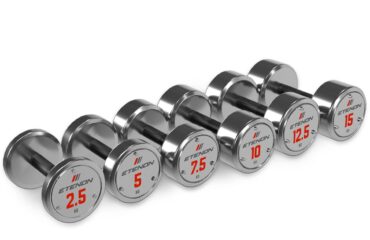
- Dumbbells and dumbbell sets. Free weights offer an exercise freedom no fixed machine can match, and they train the whole body effectively. Racked properly, they also occupy far less floor area than their exercise range suggests.
- Plates and discs. No barbell training without them. In a professional facility the bore is 50 mm, the Olympic standard, and plates double as added load for many bodyweight exercises.
- Barbells. Indispensable for free-weight strength work, and the basis of an extremely varied exercise catalogue.
- Small equipment. Stands, lifting gloves, collars and clamps, and the rest of the consumables that keep a floor usable.
- Multi-station gyms. The flagship category of a strength floor. A multi-station unit supports several users and offers a broad exercise palette from a single footprint.
- Vibration platforms. Vibration during training adds a further stimulus to strength work and is often specified in rehabilitation and wellness zones.
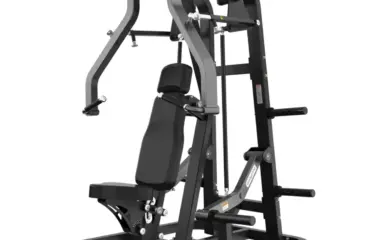
- Professional strength machines. Purpose-built equipment for effective muscle training, engineered for the highest demands and offering the stability a commercial floor requires. Our full range of professional strength training machines is built for that duty cycle.
- Racks, cages and bars. Intense work carried out safely, with the spotting geometry that lets a member train heavy without a partner.
- Strength accessories. Training gloves, pull handles, grips and weight holders.
How to actually lay out the floor
The mistake we see most often in tenders is a long list of single-function machines. It fills the room, it inflates the invoice and it does not widen the training offer, because each machine trains one thing for one member at a time.
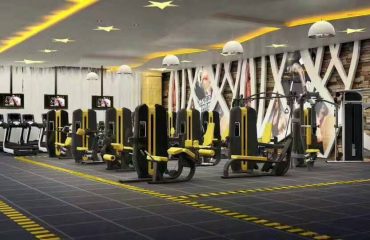
A better base is a set of compound stations: racks, benches and a press. Around that core, add selectorised machines for accessibility, since guided load is the safest entry point for a member training unsupervised, and free weights for progression, since that is where an experienced member goes once the machines stop challenging them.
A well-chosen set of professional weight benches does more for throughput per square metre than almost any other purchase, because a bench serves several exercises and several members in the same footprint.
Specification and standards
Indoor equipment in a supervised, publicly accessible facility must be built to EN ISO 20957-1 class S. Class S is the professional class, covering stability, structural strength and safety under commercial duty. It is the line that belongs in your purchase specification, and the one to check on the manufacturer declaration before signing off a delivery. Note that class I is a professional class covering inclusive access, not a step above class S in intensity.
Guidance for members starting out
Beginners should start calmly. When a member begins training on strength equipment, the interval between sessions working the same muscles should be around 48 hours, so that the muscles recover properly, which is what accelerates their development. That single piece of guidance, given at induction, prevents a large share of the early drop-outs and the early injuries.
Frequently asked questions
What does strength training give beyond muscle?
Strength work acts on bone density, posture, joint stability and resting metabolism. It is also the most extensively studied form of training for maintaining independence with advancing age.
What equipment should a facility plan for strength work?
A base of compound stations, racks, benches and a press, completed by selectorised load for accessibility and free weights for progression. Multiplying single-function machines saturates the space without widening the training offer.
Do beginners need supervision to start strength training?
Initial coaching markedly reduces the risk of poor execution, particularly on barbell movements. In a facility with unsupervised access, selectorised machines are the safer entry point.
Planning your strength floor
Whether you are fitting out a new club, refreshing an ageing strength area or specifying equipment for a hotel, a training centre or a municipal facility, the sequence is the same: define the member profile, fix the compound stations, then fill in around them. Send us your floor plan and your target capacity and we will return a costed layout. Begin with a request for a quotation.