Equipping a Strength Room for Clubs, Councils and Schools
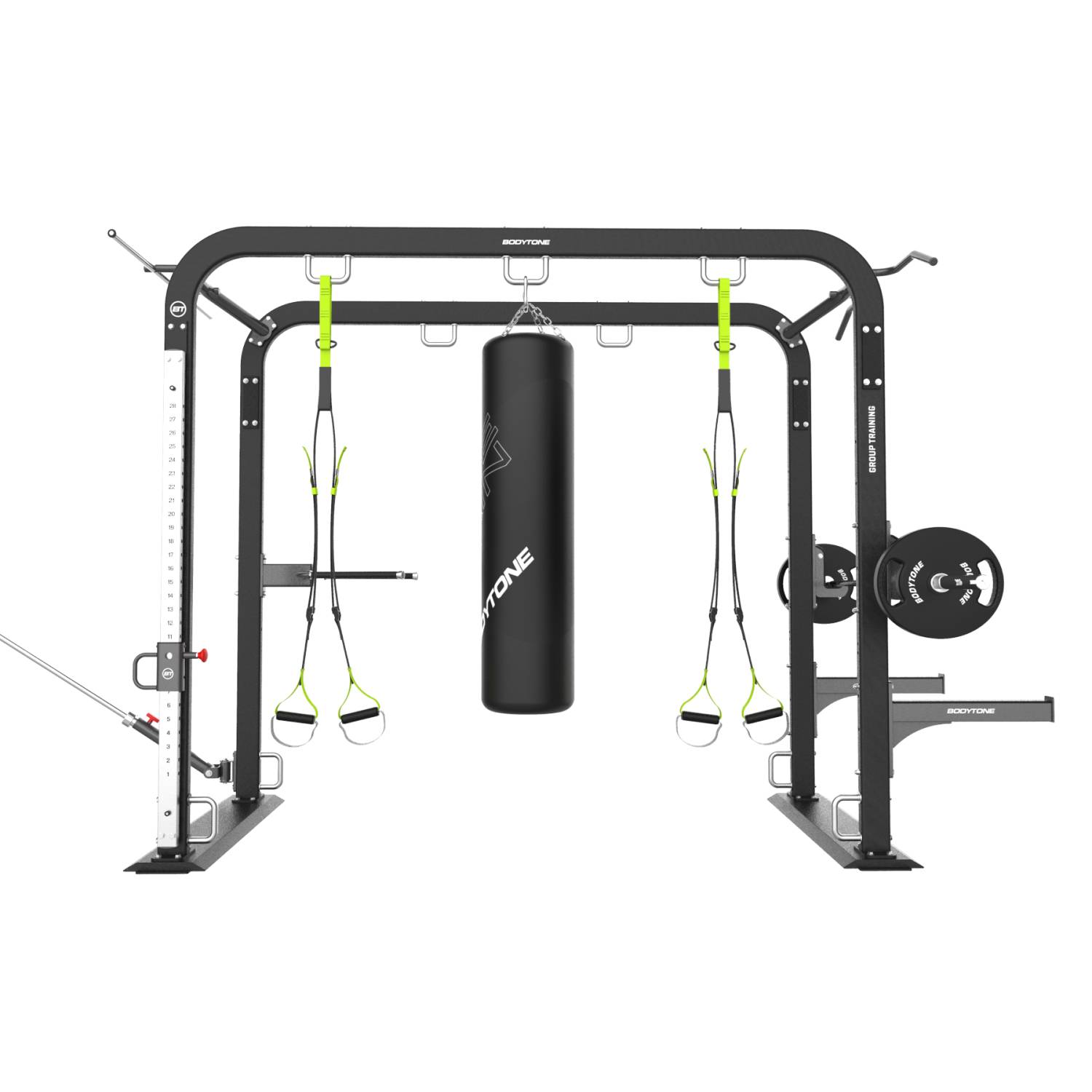
A gym room inside a sports club, a municipal leisure centre, a regional sports academy or a secondary school is not a commercial gym, and it should not be equipped like one. The traffic is concentrated into a few hours, the supervision is variable, the users range from beginners to competitive athletes, and the budget is public money that has to justify itself over ten years rather than two. This article sets out how to specify professional strength equipment for those settings.
Where institutional gym rooms fall short
The typical problem is not that the room is empty. It is that the room was equipped once, piecemeal, from three different sources, and has never been reviewed since. The symptoms are consistent: machines that squeak and stick because nobody owns the maintenance schedule, loading that is far too heavy for the beginners who make up most of the users, and no spare parts available because the supplier no longer exists.
The second failure is motivational. A room that offers only heavy barbell work speaks to the ten people who already train and to nobody else. Institutions that widen participation get there by widening the equipment mix, not by adding posters.
What professional actually means
The word professional is used loosely by suppliers, so anchor it to something verifiable. Indoor strength and cardio equipment for a facility with unsupervised or lightly supervised public access is specified to EN ISO 20957-1 class S. That is the class for professional and commercial use, and it is what a club, a council, an academy or a school should be asking for in the tender documents.
Class I is a separate professional class covering inclusive access, not a step up in intensity from class S. Any offer that quotes a domestic class, or that cites the standard without naming the class, has not answered the question.
Choosing the equipment mix
Three families do most of the work in an institutional room, and the right proportion depends on who is actually in the building.
| Family | Best suited to | What to watch |
|---|---|---|
| Selectorised machines | Beginners, school groups, mixed-ability sessions, rehabilitation | Guided movement and a fixed weight stack keep the risk low with light supervision |
| Plate-loaded machines | Clubs, academies, athletes training for a sport | Higher load ceiling, but plates need storage and a discipline for putting them back |
| Racks and free weights | Competitive strength work and team preparation | Requires supervision, floor protection and clear spacing between stations |
In practice most institutional rooms are best served by a core of selectorised machines for the widest audience, a smaller group of plate-loaded machines for the trained users, and one rack area. The full range sits under professional strength training machines.
What matters beyond the machines
Three decisions cost little at the design stage and a great deal afterwards if they are skipped.
Floor. Protective flooring under the loaded zones is not a finishing touch. It protects the slab, cuts the noise transmitted to the rooms below, and is usually the difference between a room that can be used at eight in the morning and one that cannot.
Circulation. Leave the access and working space around each station on the plan before you count how many machines fit. A room that is too full is a room that gets used at half capacity because people avoid the crowded corner.
Service. Ask, before ordering, how spare parts are supplied and for how long, and who carries out the periodic checks. For a public buyer that answer is worth more than a discount.
Budget and procurement
Compare offers on the ten-year cost, not the purchase price: build quality, upholstery and cable replacement, parts availability, and the supplier ability to come back on site. Ask for the equipment list to be broken down line by line so that the specification can be adjusted without restarting the tender, and check that the delivery and installation conditions are written into the offer rather than assumed.
Funding routes for sports facilities differ from country to country. Check the national and regional schemes that apply to your organisation before committing, since eligibility usually has to be established before the order is placed.
Frequently asked questions
Can a school use the same equipment as a commercial gym?
The class of equipment is the same, EN ISO 20957-1 class S. What changes is the mix: a school needs more guided machines and fewer heavy free-weight stations than a commercial gym of the same size.
How much floor area does a strength room need?
It depends on the machine list and the circulation you leave around it, so it cannot be answered from a single figure. Send the room dimensions and the expected group size and the layout can be drawn against them.
Selectorised or plate-loaded for a mixed-ability room?
Selectorised, for the majority of the stations. The guided path and the stack make the machine usable by someone on their first session without a coach standing next to them.
What maintenance should be planned?
A regular visual check of cables, fixings and upholstery, plus a documented periodic inspection. Name the person responsible for it in the operating procedure, because equipment in institutional rooms fails from neglect far more often than from wear.
Conclusion
Equipping a club, municipal, academy or school gym room well is a specification exercise, not a shopping exercise. Fix the class, fix the mix against the real user population, plan the floor and the circulation, and settle the service terms before the order. Done in that order, the room stays useful for a decade.
Light In Fitness has been supplying professional fitness equipment since 2013 and works with clubs, local authorities, sports academies and schools. Send us the room dimensions, the user profile and the budget envelope, and we will return a layout and an itemised equipment list: request a quote.
Réalisations documentées
- Cage street workout ultime, Carcassonne – armée française
- Cage street workout ultime, Tahiti – armée française, Polynésie
- Cage SP Max, centre EPIDE de Combrée – établissement public d’insertion
- Cage SP Max, lycée Saint-Bénigne de Dijon – établissement scolaire
À lire aussi sur le même thème
- Comment Aménager un espace de loisirs pour adolescents : Guide complet pour créer une aire de jeux et de sport
- Why Invest in a Wooden Outdoor Fitness Trail for Your Park
- Equip Your CrossFit Box: Rigs, Cages and Made-to-Measure Structures
- Cryolipolyse – perte de poids par le froid
- Rubber Tiles for Gardens and Pool Surrounds: The Complete Guide