Recycled Rubber Paver Flooring: The Sustainable, Hard-Wearing Outdoor Surface
Le pavé en caoutchouc recyclé est fabriqué à partir de granulats issus de pneus en fin de vie, agglomérés par un liant polyuréthane. Il combine amorti, adhérence et résistance au gel, pour des applications extérieures et industrielles. Sa durée de vie dépend de la densité et de l'épaisseur retenues.
Cracked asphalt, dusty concrete, slabs that shift with every frost: outdoor surfaces are usually the first part of a facility to age badly, and the first thing a visitor notices. Recycled rubber pavers offer facility managers, hoteliers, campsite operators and local authorities a hard-wearing alternative built from a waste stream that would otherwise be burned or landfilled. This guide sets out what the material is, where it performs, and what to check before you specify it.
What is recycled rubber paver flooring?
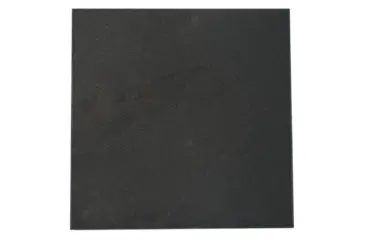
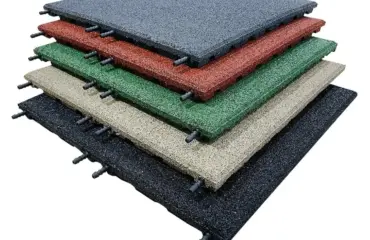
Recycled rubber paving is manufactured from granulate recovered from end-of-life tyres, bound together with a polyurethane binder and moulded into pavers or tiles. The result is a surface that behaves nothing like a rigid mineral floor: it flexes rather than fractures, it absorbs impact instead of transmitting it, and it keeps its grip when wet.
Because the raw material is a recovered one, every square metre installed diverts rubber from disposal. For public-sector buyers with environmental criteria written into their tender documents, that recycled content is often the deciding argument alongside the technical performance.
Service life is not a single figure. It depends on the density of the granulate and the thickness specified, which is why the same product family is offered in several thicknesses rather than one universal format.
Why specifiers choose rubber over asphalt or concrete
Three properties do most of the work.
Durability
Rubber is malleable. It accommodates thermal movement instead of resisting it, so it does not crack as temperatures swing between summer heat and winter frost, and it does not fade in the way a coloured mineral surface does. It also stands up to chlorine, salt and calcium, which is precisely why it ends up around swimming pools and on surfaces that get gritted in winter.
Environmental performance
The pavers are made from recycled tyres. Installation is a second, less obvious gain: rubber paving is laid without the heavy plant that asphalt requires, which keeps site disruption, noise and machinery emissions down. On an occupied site, a hotel terrace or a school yard, that matters as much as the material itself.
Safety
The surface is slip-resistant, which cuts the risk of injury from slips and falls, and it is resilient enough to soften a fall rather than punish it. Where the surface serves children’s play equipment, impact attenuation is not a nice-to-have but a regulated requirement: playground equipment falls under EN 1176-1 and the impact-attenuating surfacing beneath it under EN 1177. The two standards are distinct and both apply.
Rubber pavers compared with traditional surfaces
| Criterion | Recycled rubber pavers | Asphalt | Concrete |
|---|---|---|---|
| Behaviour under temperature swings | Flexes, no cracking | Softens, then cracks | Cracks, needs joints |
| Slip resistance when wet | High | Moderate | Low to moderate |
| Impact attenuation | Yes, thickness dependent | None | None |
| Resistance to chlorine, salt, calcium | Yes | Degrades | Degrades |
| Installation plant required | None | Heavy | Heavy |
| Routine maintenance | Rinse or sweep | Sealing, patching | Sealing, patching |
| Recycled content | End-of-life tyres | Limited | Limited |
Where rubber paving earns its place
Pool surrounds and wet areas
Barefoot traffic, standing water and chlorinated splash-out make pool decks one of the most demanding environments on any site. A slip-resistant surface that is chemically indifferent to chlorine and salt removes two problems at once, and it stays comfortable underfoot in direct sun in a way that stone does not.
Playgrounds and school yards
Under and around play equipment, the surface is a safety component. Rubber paving provides the resilience the application demands and comes in enough colours to mark out zones, paths and games without paint that wears off in a season. Specify the surfacing against the fall height of the equipment it serves, not against a general assumption.
Steps, walkways and access routes
External stairs and footpaths are where slip claims start. Rubber pavers give a consistent grip across the whole run and can be refreshed section by section without closing the route, which is difficult with a poured surface.
Stables, paddocks and animal areas
A resilient, non-slip floor is easier on horses’ joints than concrete, reduces slipping on the way in and out, and simplifies mucking out and washing down.
Training and fitness zones
The same material logic applies indoors and in outdoor training areas, where the priority shifts to protecting the sub-floor and the equipment from dropped loads. That is a different specification from a play surface, and it is worth reviewing the dedicated rubber gym flooring tiles range rather than adapting a paver intended for landscaping.
Colours and finishes
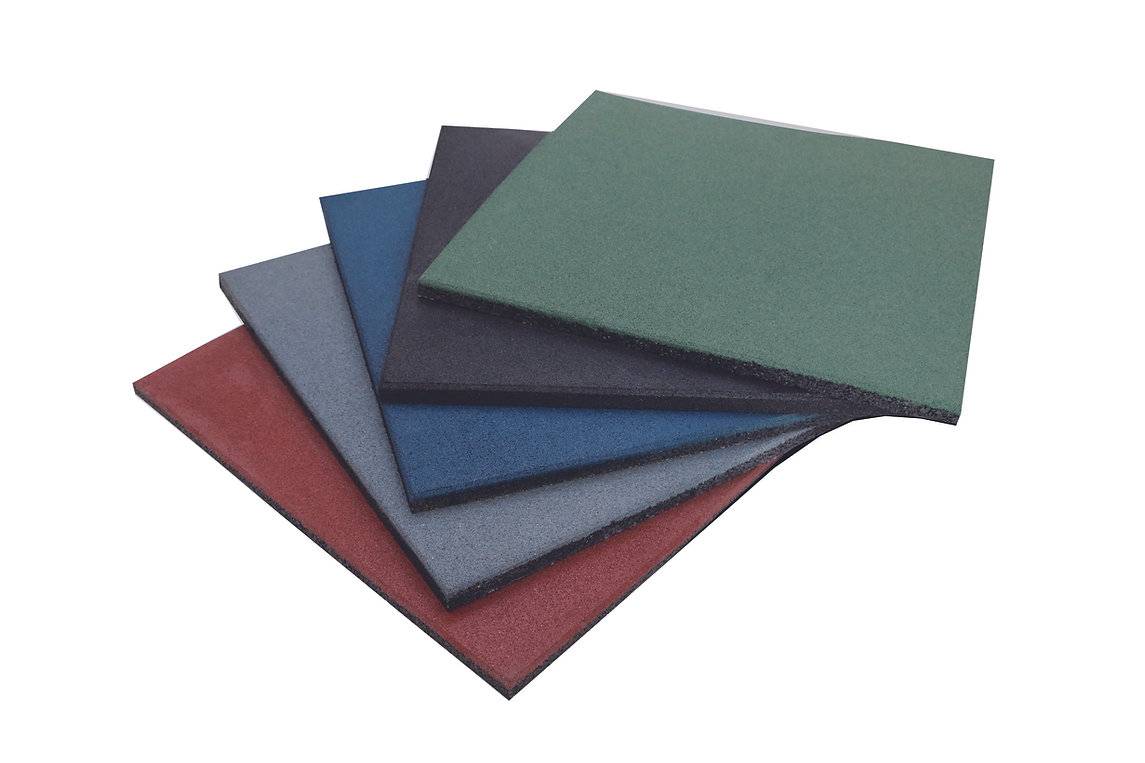
Plain colours such as grey, white, orange and blue cover most architectural briefs. Mixing granulate colours produces a textured, speckled finish that hides wear and traffic marks far better than a flat tone, which is why it is the usual choice for high-footfall public areas. Colour is also a functional tool: contrasting bands mark out circulation routes, activity zones and hazard edges without additional signage.
Specifying correctly: what to check
- Thickness and density against the actual use, since these govern both service life and impact performance.
- The applicable standard: EN 1176-1 for the play equipment, EN 1177 for the surfacing under it. Do not carry a specification written for one across to the other.
- The substrate. Rubber paving is only as stable as what it sits on; a compacted, free-draining base is part of the specification, not an afterthought.
- Drainage, particularly around pools and in freeze-prone locations.
- Reference colour and batch if the area may be extended later.
Frequently asked questions
Does recycled rubber paving need sealing?
No. It requires no sealant and no specialist cleaning product. Sweeping and rinsing keep it in condition, which is a meaningful difference in whole-life cost compared with a mineral surface that has to be resealed on a cycle.
Will the colour fade outdoors?
Rubber paving is specified to hold its colour and texture outdoors, including in the chemically aggressive conditions around pools and on salted surfaces. Textured multi-colour finishes disguise wear better than plain tones over a long service life.
Can it be laid over an existing surface?
It can be laid on a sound, level and correctly drained base. An existing slab in good condition is frequently reused, which is another reason the installation avoids heavy plant. A failing or waterlogged base must be corrected first.
Is it suitable under children’s play equipment?
Yes, provided the surfacing is specified as impact-attenuating for the fall height concerned and assessed under EN 1177, with the equipment itself compliant with EN 1176-1. Our playground surfacing range is built for exactly that requirement.
How does it compare on maintenance with asphalt?
Asphalt needs patching and resurfacing as it cracks and oxidises. Rubber paving is modular: a damaged unit is lifted and replaced individually, without closing and reinstating a whole area.
Getting the specification right for your site
Recycled rubber paving is not a single product but a family of thicknesses, densities and finishes, and the right choice depends on what happens on the surface: barefoot traffic, falling children, shod horses or dropped weights each point to a different specification. If you are weighing up a paver against a tile format, the 25 mm rubber tile is a useful reference point for load-bearing areas.
Send us the surface area, the use and the site constraints and we will come back with a specification and a costed proposal. Request a quote and our team will work through the options with you.
Réalisations documentées
- Dalles et sols sportifs : livraisons documentées – plusieurs chantiers
- Sol sportif extérieur, square Georges-Vallerey – Taverny (95)
Sources et références
- Décret n° 96-1136 du 18 décembre 1996 – prescriptions de sécurité relatives aux aires collectives de jeux (Légifrance)
- NF EN 1176-1 – Équipements et sols d’aires de jeux, partie 1 : exigences de sécurité et méthodes d’essai générales (AFNOR)
- NF EN 1177 – revêtements de surface amortissants : détermination de la hauteur de chute critique (AFNOR)