EVA Foam Puzzle Tatami Mats: The Professional Buyer Guide
Les tatamis en mousse EVA à assemblage puzzle offrent un amorti confortable pour la pratique douce, les cours collectifs et les espaces enfants. Ils se posent sans colle et se démontent, mais n'ont pas la densité requise pour les chutes des sports de combat, qui relèvent de la norme EN 12503. Le choix dépend du type de chute attendu.
Specifying the floor of a training area is an engineering decision, not a shopping one. Interlocking EVA foam tatami mats have become one of the most widely used soft surfaces in fitness clubs, dance studios, martial arts rooms and supervised children’s areas, because they combine cushioning, a non-slip surface and a dry installation that needs no adhesive. They are also, regularly, specified for the wrong job. This guide sets out what EVA puzzle tatami mats are, what they do well, where their limits sit, and how a professional buyer should write the specification before asking for a quotation.
What an EVA foam tatami mat actually is
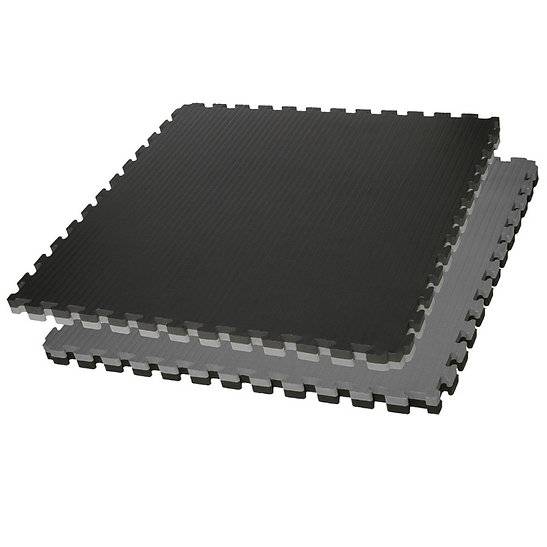
EVA stands for ethylene-vinyl acetate, a flexible and hard-wearing foam used in a wide range of protective applications. An EVA tatami mat is a moulded foam tile with a textured, non-slip top face and toothed edges that interlock with the neighbouring tiles, in the same way as a jigsaw piece. The tiles are laid loose on a flat, clean subfloor: no glue, no mechanical fixing, and no permanent alteration of the building.
That single characteristic explains most of the product’s success with professional operators. A floor that clips together can be extended when the room is reconfigured, partially replaced when one zone wears out, lifted for a deep clean, and removed at the end of a lease without dispute. For a tenant operator, a franchise pilot or a seasonal facility, a demountable floor is a very different proposition from a bonded one.
The foam does the rest of the work. It absorbs impact energy, damps the sound of footfall and equipment, feels warm underfoot, resists water and wipes clean. Tiles are light enough to be handled by one person, which keeps installation labour to a minimum and lets a facility team lay a room themselves.
Formats, thicknesses and colours
The dominant format is a 1 metre by 1 metre tile, which makes surface calculations straightforward and keeps cut waste at the perimeter low. Thicknesses commonly run from 10 mm up to 50 mm. Thicker tiles absorb more impact energy; thinner tiles keep the finished floor closer to the surrounding level, which matters at doorways, in front of mirrors and wherever a threshold has to stay flush.
| Thickness | Typical professional use |
|---|---|
| 20 mm | Group classes, stretching and mobility zones, dance warm-up areas |
| 25 mm | General purpose dojo and fitness matting, light martial arts practice |
| 30 mm | Grappling and technique work, supervised children’s activity rooms |
| 40 mm | Higher impact martial arts practice, dedicated fall zones |
| 50 mm | Maximum cushioning where the room height and thresholds allow it |
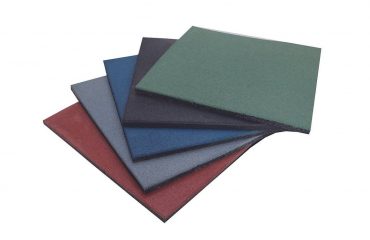
Colours cover the usual professional range – black, grey, blue, green and red – and reversible two-tone tiles are common, which lets a club change the look of a room by turning the tiles over rather than rebuying the floor. Custom colours are available on project quantities. Colour is not only cosmetic: contrasting bands are the simplest way to mark out a competition area, a lane or a safety margin without paint or tape.
You can see the current formats and finishes in the tatami mats range, and the 40 mm reference most often specified for martial arts rooms is the 40 mm dojo puzzle tatami tile.
Where EVA puzzle tatami mats belong
Fitness and functional training areas. As a protective surface for floor work, stretching, bodyweight circuits and mobility sessions, EVA tiles give a comfortable, non-slip surface that reduces joint load and keeps noise down in rooms above occupied floors. They are not the right surface under a weightlifting platform or a dropped loaded barbell, where a dense rubber tile is the correct product.
Dance and movement studios. The combination of grip, resilience and a warm surface suits barefoot and soft-shoe practice, and the demountable installation is well suited to rooms that alternate between disciplines during the week.
Martial arts rooms. This is the core application. For technique work, ground work and supervised practice, a 30 to 50 mm EVA tatami provides the cushioning and the grip that a dojo needs, with a surface that can be disinfected between sessions.
Supervised children’s activity rooms. Indoor play rooms, creches, after-school clubs and soft activity corners use EVA tiles as a comfortable, easily cleaned surface under low-level, supervised activity.
Where they do not belong – and this is the part that costs money
EVA foam tiles are a comfort and protection surface, not a certified fall-arrest system. Two distinctions decide most specifications.
The first concerns combat sports. Mats intended to receive throws and controlled falls – judo, wrestling, high-impact grappling – are governed by EN 12503, which sets the performance requirements for sports mats. An interlocking EVA tile does not have the density and the energy-return behaviour that a throwing mat needs, and no thickness of it turns a training floor into a throwing area. If your programme includes throws, specify a mat qualified against EN 12503 for that purpose and use the EVA floor for the surrounding zones.
The second concerns children’s play equipment. Where children can fall from a height on play equipment, the equipment falls under EN 1176-1 and the impact-attenuating surfacing under EN 1177. These are two separate standards and they are not interchangeable. An EVA puzzle tile is not an EN 1177 surface unless it has been tested and declared as one for a stated critical fall height. For a genuine playground – indoor or outdoor – work from the required critical fall height first and choose the surfacing accordingly, rather than the other way round. Our playground surfacing range is built around that logic.
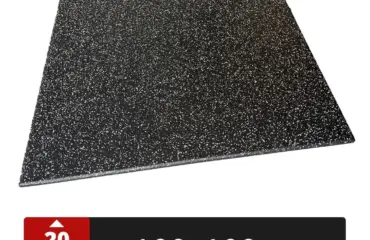
The third distinction is simply about load. Rolling loads, machine feet, sled tracks and dropped weights will mark and eventually destroy a foam tile. Where equipment sits or weights land, the correct answer is a rubber gym flooring tile, and mixed rooms are usually zoned: rubber where the iron is, EVA where the bodies are.
Regulatory context for a professional installation
Indoor training equipment installed in a supervised, publicly accessible facility is specified to EN ISO 20957-1 class S. That class covers the machines and structures placed on the floor rather than the floor itself, but it sets the level at which the whole room should be read: a professional room is a class S room, and its floor should be chosen with the same intent.
Fire behaviour is a separate question and one that varies by country and by building type. Where the building regulations for your venue impose a reaction-to-fire class on floor coverings, ask for the declared class of the exact reference you are buying, complete with its smoke index, and keep the declaration of performance in the project file. Never assume a class from a product family: it is declared per reference. If your project is a public-access building, check the requirement with the authority having jurisdiction in your country before ordering, since the thresholds and the documentation expected differ across national frameworks.
How to write the specification: five decisions
1. Define the worst fall the surface has to receive. Not the average activity – the worst case. A room where beginners practise breakfalls is not the same brief as a stretching studio, even if both are described as martial arts rooms.
2. Fix the thickness from that answer, then check the thresholds. A 50 mm floor changes door clearances, mirror bases, skirting lines and wheelchair access. Verify the finished level against every doorway before ordering.
3. Measure the room properly. Work in whole tiles, add the perimeter cuts, and add a replacement reserve. Foam tiles are consumables in a busy club: holding a small stock of the same batch avoids a two-tone floor in eighteen months.
4. Check the subfloor. Interlocking tiles follow the surface underneath them. A slab that is uneven, damp or dusty will show through the floor and shorten its life. Level, dry and clean, in that order.
5. Plan the cleaning protocol before you buy. Skin contact surfaces in shared facilities need a defined routine and a product that will not attack the foam. Confirm the compatible cleaning agents with the supplier and write them into the operating procedure.
Frequently asked questions
Can EVA puzzle tatami mats be used for judo?
For technique work, ground work and warm-up, yes. For throws and falls, no: that use is covered by EN 12503 and calls for a mat qualified for it. Most dojos combine the two, with the EVA floor covering the general practice area.
Do the tiles need to be glued down?
No. The interlocking edges hold the field together and the perimeter tiles, cut to the room, close it. That is the point of the product: it is demountable, extendable and repairable tile by tile.
How thick should a children’s activity room be?
For supervised floor-level activity, 30 mm is a common professional answer. If children can fall from play equipment at height, you are no longer choosing a comfort mat: you need surfacing qualified under EN 1177 for the critical fall height of that equipment.
How long does an EVA tatami floor last?
Service life depends on traffic, footwear policy and cleaning far more than on the tile itself. A barefoot dojo floor cleaned with compatible products lasts years; the same floor walked on in street shoes will not. A shoe policy at the door is the cheapest protection you can buy.
Can a mixed room use both EVA and rubber?
Yes, and it usually should. Zoning the room – rubber under the loads, EVA under the bodies – gives a better result than compromising on a single surface for the whole floor.
Getting the right floor specified
An EVA puzzle tatami floor is an excellent professional answer to a clearly defined question: a comfortable, demountable, easily maintained surface for supervised practice at floor level. It is a poor answer to a question about throws, about heights, or about dropped iron. Getting that distinction right at the specification stage is what separates a floor that lasts from a floor that is replaced.
Light In Fitness has equipped clubs, dojos, schools, local authorities, hotels and rehabilitation centres since 2013. Send us the room dimensions, the disciplines practised and the constraints of the building, and we will come back with a floor plan, the tile count and a costed proposal: request a quotation.
Réalisations documentées
- Dalles et sols sportifs : livraisons documentées – plusieurs chantiers
- Sol sportif extérieur, square Georges-Vallerey – Taverny (95)
Sources et références
- Arrêté du 19 avril 2011 – étiquetage des produits de construction ou de revêtement de mur ou de sol sur leurs émissions de polluants volatils (Légifrance)
- Ministère de la Transition écologique – étiquetage des produits de construction : classes d’émission A+ à C