FIBA-approved flooring for 3x3 basketball courts
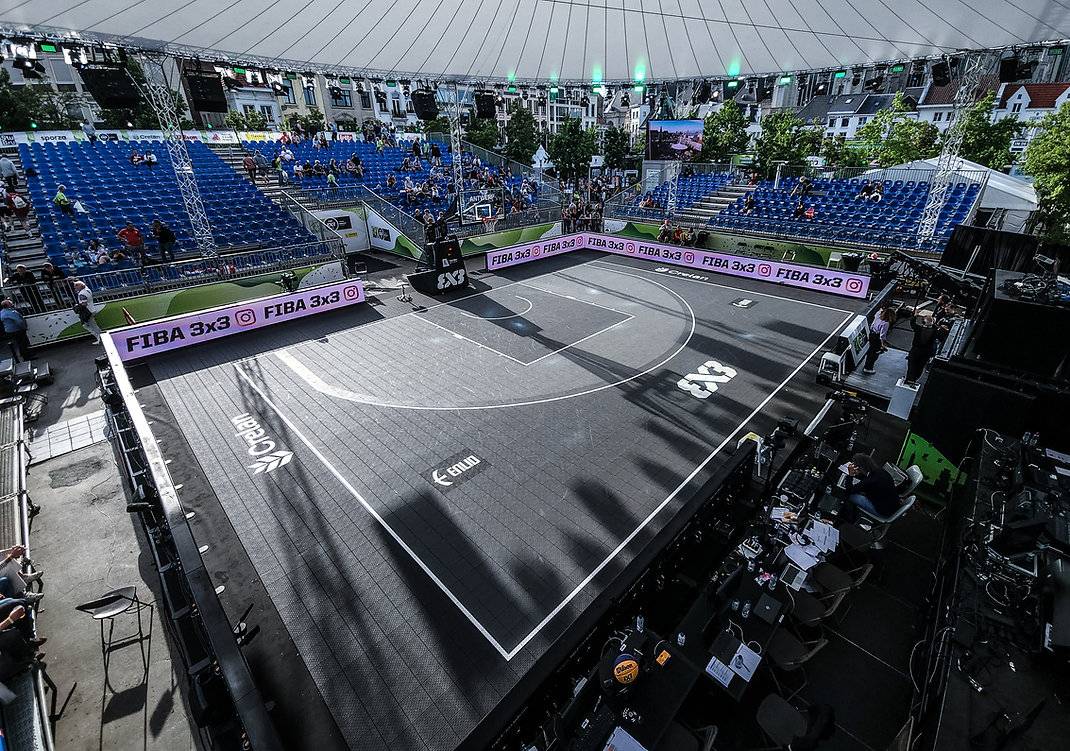
3×3 basketball is a fast-growing variant of the traditional game, and it is spreading quickly across municipal sports facilities, schools, clubs and urban regeneration projects. To play it properly you need a FIBA-approved playing surface carrying the official court marking. That specific surface protects the players while delivering a high-quality playing area. This article looks at what a FIBA-approved 3×3 surface actually provides, what it costs you in installation work, and what to check before you commit a budget to it.
What is 3×3 basketball?
3×3 basketball is a version of the traditional game played by two teams of three players on a half court. This faster, more intense format was adopted by the International Basketball Federation, FIBA, and is now played at every level, from amateur competition through to international tournaments. For a facility operator the appeal is straightforward: it needs a far smaller footprint than a full court, it suits an outdoor site, and it fills that court far more often than a full-size game does.
FIBA-approved flooring for 3×3 basketball
A FIBA-approved surface is engineered specifically to meet the requirements of 3×3. It provides an optimal playing surface for the players, delivering reliable grip, protection against injury and long-term durability. The official court marking then clearly delimits the playing zones and the shooting lines, which is what allows a game to run cleanly.
Marking requirements are set by FIBA for the international game, and national federations publish their own marking specifications for domestic competition. Before ordering, confirm which competition level the court is intended to host and check the marking specification that applies in your country, because the line set has to match the competition the court will actually be used for.
The five benefits of a FIBA-approved surface
- Player safety. A FIBA-approved surface delivers optimal grip, reducing the risk of slips and injuries. Clear marking also lets players orient themselves on court easily, which minimises collisions.
- Improved performance. A high-quality playing surface supports greater responsiveness and precision in player movement, which is what allows individual and team skills to develop rather than being masked by a poor floor.
- Durability. The surface is designed to withstand intensive use and the wear caused by repeated player movement and ball contact. That long service life is what reduces maintenance and replacement costs over the life of the installation.
- Ease of maintenance. A FIBA-approved surface is easy to maintain, which is how playing quality is preserved over the long term. Regular cleaning is enough to keep the properties of the surface intact.
- Compliance with international requirements. A FIBA-approved surface conforms to FIBA international requirements, which is what guarantees uniform playing conditions across official competition.
Our range of basketball court tiles covers the surfaces built for this duty, and the wider modular multi-sport court range applies the same construction where a site has to host more than one sport.
Installing a FIBA-approved 3×3 court
Installation calls for qualified professionals. The key stages are these.
- Site preparation. Before the surface goes down the site has to be properly prepared: levelling the ground, removing obstacles and establishing a sound base. This is the stage that decides whether the finished court plays flat, and it is the stage most often rushed.
- Laying the surface. Once the site is prepared, the approved surface is installed to the manufacturer specification. Following those instructions exactly is what makes the installation valid; deviating from them is what voids it.
- Court marking. With the surface laid, the marking is set out to delimit the playing zones, the shooting lines and the other elements a game requires.
- Finishing and maintenance. Finishing work then ensures a clean transition between the surface and the surrounding elements of the site. Regular maintenance from that point on preserves the quality of the surface.
Where a court is built from polypropylene interlocking tiles, the marking is integrated into the tile layout rather than painted on, which is what allows a damaged section to be replaced later without repainting the court.
Frequently asked questions
What is the difference between a FIBA-approved surface and a standard one?
A FIBA-approved surface is engineered specifically to meet the requirements of 3×3, offering optimal grip, protection against injury and long-term durability. A standard surface may not offer the same characteristics or the same performance.
Why does the court marking matter?
The marking clearly delimits the playing zones and the shooting lines, which is what allows a game to run cleanly and minimises the risk of collisions between players.
Where can a FIBA-approved 3×3 surface be sourced?
From manufacturers specialising in basketball playing surfaces. Installation should be carried out by qualified professionals.
Is a FIBA-approved surface suitable for international competition?
Yes. A FIBA-approved surface conforms to FIBA international requirements, which is what guarantees uniform playing conditions across official competition.
What should be considered when choosing a surface?
The quality of the surface, its durability, its grip and its conformity with the applicable international requirements. Confirm the intended competition level before choosing, since that determines the marking specification.
What maintenance does the surface need?
Regular maintenance, principally regular cleaning, to preserve the properties of the surface and keep the playing experience consistent.
Specifying your 3×3 court
To play 3×3 in the right conditions you need a FIBA-approved surface with correct court marking. It delivers an optimal playing area, protects the players and supports better performance. Follow the installation stages properly, maintain it regularly, and the court will keep its playing quality for years. Send us the site dimensions, the intended competition level and the surface preparation already in place, and we will come back with a costed specification. Start with a request for a quotation.
Réalisations documentées
- Dalles et sols sportifs : livraisons documentées – plusieurs chantiers
- Sol sportif extérieur, square Georges-Vallerey – Taverny (95)