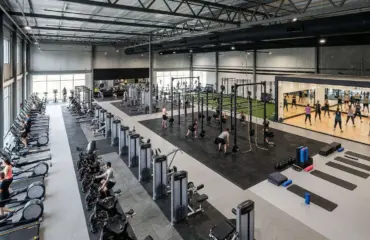
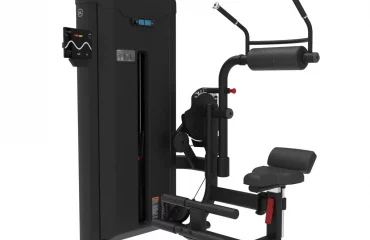
Professional Strength Training Machines: A Buyer Guide
Une machine de musculation professionnelle se distingue par sa structure, ses roulements, ses câbles et la disponibilité de ses pièces détachées. Ces éléments déterminent la durée de vie en usage collectif, bien avant l'apparence ou le nombre de réglages. Light In Fitness distribue et fabrique ces gammes avec livraison, installation et SAV depuis Tours.
A strength training machine becomes professional through its frame, its bearings, its cables and the availability of spare parts. Those four points decide how long a station survives in collective use, long before styling or the number of adjustments does. Light In Fitness manufactures and distributes these ranges for commercial gyms, hotels, clubs, municipalities and rehabilitation centres, and has been doing so since 2013 from Tours, France.
This guide is written for buyers, not for end users: what actually separates a commercial-grade station from a consumer one, which of the three machine families fits which floor plan, and which questions to settle before signing a quotation.
What makes a strength machine professional
Indoor strength equipment intended for unsupervised, shared, high-frequency use falls under EN ISO 20957-1 class S. That classification is the entry ticket for a commercial floor, and it is the first thing to check on a specification sheet. Class I is a professional class designed for inclusive access, not a step above class S in intensity, so the two answer different briefs rather than ranking against one another.
Beyond the classification, four components carry the load over the years:
- The frame. Section thickness and weld quality determine whether the station still feels rigid after several years of continuous use. Light In Fitness backs its steel structures with a warranty of up to 20 years, and its stainless steel structures for life.
- The bearings and guide rods. A guided station is only as smooth as its linear bearings. Rough travel is the first complaint members raise, and it appears long before anything actually breaks.
- The cables and pulleys. Cable diameter, sheath quality and pulley bearing type drive the replacement interval on cable-based stations.
- Spare parts availability. A machine that cannot be repaired is a machine that will be replaced. Ask how long parts remain catalogued before you compare unit prices.
The three families of strength machines
Almost every commercial strength floor is built from three families. They are not competing options: most projects use all three in different proportions depending on the membership profile.
| Family | How it loads | Best suited to |
|---|---|---|
| Selectorised machines | Weight stack with a selector pin | Commercial gyms, hotel fitness rooms, corporate gyms, rehabilitation, mixed-ability memberships |
| Plate loaded and Olympic machines | Olympic discs loaded by the user | Performance gyms, strength-focused clubs, boxes, university and military facilities |
| Multi-station towers | Several stations on one shared frame | Small footprints, hotels, campsites, residential and school gyms |
Selectorised strength training machines are the safest choice where a large and varied membership trains without permanent supervision: the load is set in one movement, the range is constrained, and the learning curve is short. Plate loaded machines suit a stronger, more autonomous population and cost less per station, at the price of floor space for disc storage and a higher demand on technique. Multi-station towers exist for one reason: covering a full muscular programme when the room is too small for a line of individual machines.
The brands on the Light In Fitness catalogue
The catalogue combines an in-house range with international manufacturers, which lets a project mix price levels without mixing quality levels.
- Light In Fitness, the in-house brand, with customisable finishes so a fit-out can follow a club identity rather than a supplier one.
- Bodytone, for technology-led selectorised lines on commercial floors.
- Lexco, positioned on intensive, high-traffic use.
- Ellipse, on durability and efficiency for guided ranges.
- Xebex, better known for air-based cardio, and present alongside the strength lines.
- Ziva, on functional equipment where strength and stability work together.
- Reebok, on ranges that combine styling with commercial specification.
The practical consequence for a buyer is that a single order can cover a whole floor without splitting the after-sales chain across several importers.
Matching machines to the venue
The same room area produces very different equipment lists depending on who trains in it.
- Commercial gyms. A selectorised circuit covering the main muscle groups, completed with plate loaded stations for the strength area.
- Hotels and resorts. A compact multi-station tower plus two or three cardio units usually beats a partial line of individual machines: fewer moving parts, less supervision, less maintenance.
- Boxes and performance clubs. Plate loaded and Olympic stations dominate, with a small selectorised set for accessory and rehabilitation work.
- Municipal and school facilities. Robustness and inclusive access come first, which is where the class I professional range answers a brief that class S alone does not.
- Rehabilitation and care. Low starting loads, fine increments and easy seat access matter more than maximum stack weight.
Budget, lifecycle and total cost
Unit price is the least informative number in a strength equipment project. The figure that matters is the cost per station over its service life, which combines purchase price, the maintenance interval, the price and availability of wear parts, and the residual value when the floor is refreshed. A station bought cheaply and replaced twice within the period of a warranted frame has cost more than the machine it undercut.
Two questions settle most of this at the quotation stage. First, what is warranted, for how long, and on which components: frames, welds, bearings, cables and upholstery are rarely covered on the same terms. Second, how the equipment will be delivered and installed, since heavy stations in an upper-floor room are an access study before they are a purchase.
Frequently asked questions
Can I equip a small room with professional machines?
Yes. A multi-station tower replaces several individual machines on a fraction of the floor area, and remains class S equipment. The compromise is throughput: one user at a time on most stations.
Selectorised or plate loaded for a mixed membership?
Selectorised, as the core of the floor. Plate loaded stations are then added for the strength area rather than used as the main circuit, because they demand more technique and more supervision.
How many machines does a strength floor need?
That depends on peak attendance and on the room, not on a fixed ratio. The usable answer comes from a layout study: circulation, disc storage and the free weight zone consume more area than buyers expect, and they are what determines the final machine count.
Does professional equipment need servicing?
Yes, and it is the cheapest line in the whole project. Cable inspection, bearing checks and upholstery replacement carried out on schedule are what keep a station in service for the length of its frame warranty.
Building your equipment list
More than 2,500 customers have been equipped since 2013, and the pattern is consistent: the projects that age well are the ones where the machine list was drawn after the layout, not before it. Send the room dimensions, the membership profile and the ceiling height, and the equipment list, the layout and the budget can be built around them. Request a quotation for your project.