How to Choose the Thickness of Your Puzzle Tatami
Choosing the thickness of an interlocking puzzle tatami is not a detail of specification: it decides how much energy the floor absorbs when a body lands on it. For judo, karate, boxing, aikido, Brazilian jiu-jitsu and mixed martial arts, the same mat pattern is available in several thicknesses, and the right one depends on who trains on it and what they do. This guide sets out the criteria a club, a school or a facility manager should apply before ordering.
What a puzzle tatami is
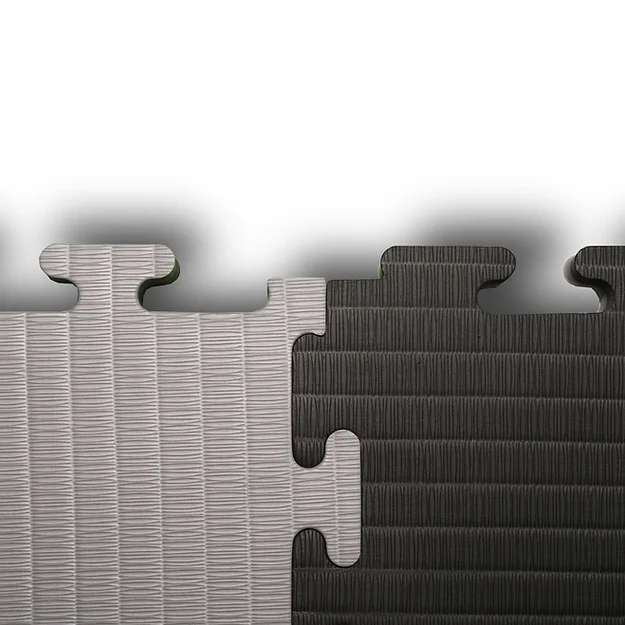
A puzzle tatami is a martial arts floor covering supplied as interlocking tiles with a non-slip surface. The tiles assemble and disassemble, so a mat area can be built to the exact size of the room and taken up again when the space is needed for something else. That flexibility is why the format is used in dojos, sports halls and multi-purpose rooms rather than a single bonded surface.
Because the tiles are laid loose, the subfloor matters. The mat area must sit on a flat, stable base: an uneven or slippery subfloor allows the assembly to shift under load, which undoes the safety the thickness was chosen to provide.
Why thickness governs safety
Throws and groundwork mean falls, and falls that are not damped travel into the practitioner. A thicker tile absorbs more of that impact and reduces the risk of injury. The thicknesses commonly used for puzzle tatami run from 20 to 40 millimetres, and the choice inside that range is a compromise between shock absorption and a stable footing for standing work.
Matching thickness to users and discipline
Three factors decide the answer: the age of the practitioners, the level of practice and the discipline itself.
- 20 to 30 mm is generally sufficient for children and junior age groups.
- 40 mm is the recommended thickness for adults practising high-impact combat sports such as Brazilian jiu-jitsu, judo and MMA.
Discipline matters as much as age. Sports built on throws and breakfalls, such as judo and aikido, call for the greater thickness because the floor is doing most of the protective work. Striking disciplines such as karate and taekwondo, where feet stay on the mat, can use a slightly thinner tile without compromising safety, and the firmer footing is often preferred.
Competition requirements
Federations and event organisers set their own thickness requirements, and they override general guidance. The International Brazilian Jiu-Jitsu Federation specifies a minimum thickness of 35 millimetres for its competitions. National federations publish their own figures for national-level events, so a club that hosts sanctioned competition should check the current rulebook of the governing body concerned before ordering, rather than assume that a training specification will be accepted.
Frequently asked questions
Can two thicknesses be combined in one room?
Only as separate areas. Mixing thicknesses inside a single mat surface creates a step, which is a trip hazard and a point of premature wear on the interlocking edges.
Does a thicker tile always mean better?
No. Above the thickness a discipline needs, the surface becomes soft underfoot and standing technique suffers. Choose for the practice, not for the maximum.
What subfloor is required?
A flat, stable and dry base. Any unevenness will show through the tiles and can cause the assembly to open up under load.
Specifying the right mat
In short: work from the age of your practitioners, their level, the discipline and any competition rules that apply, then choose within the 20 to 40 millimetre range. Our dojo tatami range covers those thicknesses, and for rooms that also carry strength work a rubber gym flooring tile is usually specified alongside rather than instead. For a full combat sports set-up, a floor-level MMA cage is fitted on top of the mat area. Send us your room dimensions and disciplines and we will confirm the specification: request a quote.