Professional Cross Trainers: The Complete Buyer Guide
The cross trainer is the machine that quietly does the most work in a commercial cardio line. It puts a member through a full-body effort without the joint loading of a treadmill, it suits a wider range of ages and fitness levels than almost anything else on the floor, and it needs very little instruction. That combination is why it appears in nearly every specification we price, from a twelve-machine club fit-out to a four-machine hotel room. This guide covers what separates a professional cross trainer from a consumer one, which specifications actually matter, and how to size the purchase to your facility.
What professional means on a cross trainer
The word gets used loosely. On a commercial floor it has a concrete meaning: equipment specified to EN ISO 20957-1 class S, the professional class, built to run for the full opening hours of a facility that is open to third parties. Class S is what an insurer expects to see and what a public tendering authority will ask for. Consumer-grade machines are not a cheaper version of the same thing; they are designed for a duty cycle measured in hours per week rather than hours per day, and they fail accordingly.
In practice the differences show up in the bearings, the frame mass, the flywheel and the drive system, and in whether spare parts will still be available in year seven. None of those are visible in a photograph, which is why the specification sheet matters more than the styling.
The brands on a professional cardio floor
Our cross trainer range is built around a small number of manufacturers, each covering a different part of the market. Bodytone supplies the largest part of it, from the Nexion series with LED or touchscreen consoles up to the EVOE line for premium clubs. Lexco covers the connected end, with machines built for facilities that want session data and networked consoles. Gold Line and Ellipse cover the value and functional segments respectively, which is where most hotel, municipal and residential specifications land.
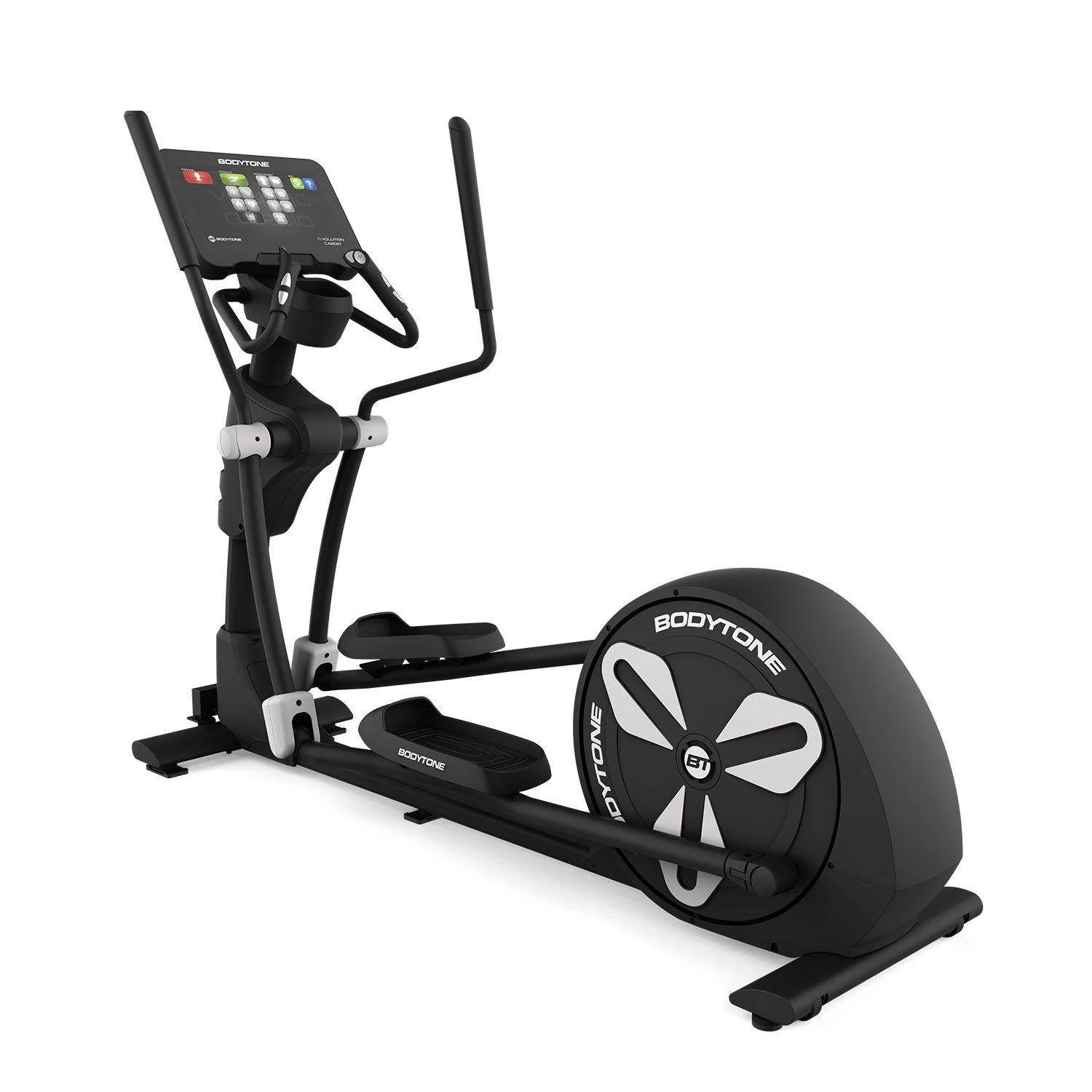
You can see the full range on the professional cross trainers page, and the Lexco cross trainer range separately if connectivity is a requirement. A frequent starting point for club specifications is the Bodytone Nexion E80T with a touchscreen console.
Choosing the model: three constraints that decide it
Footprint and circulation
Cross trainers are long machines. The floor area a specification actually needs is the machine footprint plus the circulation space behind it for mounting and dismounting, and that second figure is what gets forgotten on a plan. A narrow room takes a compact model even if a larger one would be preferable, and the honest answer for a constrained space is often fewer machines rather than smaller ones.
Machine mass and whether it will ever move
Heavier machines are generally more stable in use, which is what you want for a fixed cardio line. If the room is also used for classes, or the equipment has to be moved for events or cleaning, that stability becomes a handling problem. Decide before you specify whether these machines will be moved, because it changes the model.
Maximum user weight
This one is not a detail. Maximum user weight is a safety limit, and a facility open to the public has to be able to serve the full range of people who walk in. Specifying a machine whose limit excludes part of your user base is a service failure and, in a public tender, often a disqualifying one. Check the figure on the datasheet for the exact model, not for the range.
Reading the rest of the specification
Beyond dimensions and user weight, the specification points that change the member experience are the stride length, the resistance system and its number of levels, the console, and the noise level under load. Stride length determines whether tall and short members both get a natural movement; a stride that is too short turns into a shuffle for a 1.90 m user. Console choice is where budgets diverge most: an LED console does everything a municipal facility needs, while a touchscreen with integrated programmes and connectivity earns its cost in a premium club where members expect to track sessions.
What members actually get from it
Cross training on an elliptical machine works the cardiovascular system while keeping the feet in contact with the pedals throughout the movement, which removes the repeated impact of running. That is the single biggest reason it suits older members, members returning from injury and anyone with joint complaints, and it is why rehabilitation centres specify these machines heavily.
It also recruits the upper body when the moving handles are used, so a member trains legs, trunk and arms in one session. On energy expenditure, be careful with the numbers circulating online: what a session burns depends on the member’s bodyweight, the duration and the intensity, and a figure quoted without those three is meaningless. Give members a range based on their own session rather than a headline number.
Three ways to programme the machine
Interval work
Alternating harder and easier periods, for example thirty seconds of high intensity followed by thirty seconds of recovery, delivers a strong conditioning stimulus in a short session. It is the format that gets most use in a club where members have forty-five minutes.
Low-impact steady work
Longer, moderate sessions are what the machine was designed for and what makes it appropriate for deconditioned or older members. This is the format that fills the daytime slots in most facilities.
Cross training between upper and lower body
Alternating emphasis between arms and legs within a session varies the muscular demand without leaving the machine, which keeps longer sessions tolerable and is useful in circuit formats.
FAQ
How many cross trainers does a club need?
It depends on your peak hour rather than your membership total. Count how many members are in the cardio area at your busiest time and how long the average cardio session lasts; that ratio, not the headline membership number, sets the quantity.
LED console or touchscreen?
LED consoles are robust, cheaper to maintain and adequate for municipal, hotel and residential facilities. Touchscreens make sense where members expect connected training and where the club charges for it.
Is a cross trainer suitable for rehabilitation?
It is one of the most commonly specified machines in that setting because of the absence of impact, but the programme belongs to the clinician. The machine supports the protocol; it does not define it.
What standard should we require in a tender?
EN ISO 20957-1 class S for indoor equipment in a facility open to third parties. Wording your specification that way rules out consumer-grade equipment before the bids arrive.
Specifying your cardio line
The right cross trainer is the one that fits your room, your user profile and your opening hours, and that question is answered on a plan rather than in a catalogue. Send us your floor plan, your member numbers and your busiest hour, and we will come back with a configuration and a priced proposal. Start with our quote request form.