Professional steppers and stair climbers: choosing the right cardio station for your facility
Le stepper et le simulateur d'escalier sollicitent la chaîne postérieure avec un impact articulaire faible, contrairement à la course. Le simulateur à marches défilantes reproduit la montée réelle et présente une dépense énergétique élevée. Ces machines occupent peu d'emprise au sol pour un poste cardio complet.
Stepping machines are among the most space-efficient cardio stations a commercial operator can install. A stepper or a stair climber delivers a demanding cardiovascular session while keeping joint impact low, and it does so on a footprint that rarely exceeds that of an upright bike. On a gym floor, in a hotel wellness room or in a club where every square metre is costed, that ratio matters far more than any marketing feature.
What a stepper actually trains
The movement loads the posterior chain – glutes, hamstrings, calves – through a repeated concentric push, without the ground reaction forces that running generates. Members who no longer tolerate treadmill work often keep training on a stepper, which is why the category holds its place in rehabilitation rooms and in facilities with an older or mixed membership.
Energy expenditure is high relative to the perceived effort, because the movement is vertical and continuous: unlike a running stride, there is no passive phase. That combination – high demand, low impact, small footprint – is why the category survives every equipment trend, and why it deserves to be specified properly rather than bought on price alone.
Stepper, stair climber, endless staircase: three different machines
Consumer copy uses the three terms interchangeably. For a buyer they are distinct products, with distinct duty cycles and distinct maintenance profiles.
The stepper works with two independent pedals and an adjustable resistance system. The stride is short, the machine is easy to approach for a beginner, and it is the least intimidating way to introduce a lower-body cardio station on a busy floor. It is also the lightest and the simplest to relocate.
The stair climber uses a revolving staircase: the user climbs real moving steps rather than pushing pedals. It reproduces an actual ascent, and it is normally the most demanding machine of the three. It is also the one that needs the most attention at the specification stage, because the user stands well above floor level and the drive train is a wear part.
Endless-staircase and combined units extend the same principle, sometimes with a continuous step belt, sometimes by pairing a stepper with a second station on one frame. Outdoor ranges apply the movement to open-air circuits, where a different standard applies – see below.
Choosing between them is a question of who trains in your facility, not of which machine is hardest. A box with a young, high-intensity membership and a municipal wellness room do not need the same machine, even though both are buying a stair movement.
Specifying a machine for professional use
Indoor equipment installed in a facility open to third parties must be built for continuous, unsupervised use. The reference is EN ISO 20957-1 class S: machines designed for professional and commercial environments. Anything specified below that level will be judged by its warranty claims rather than by its brochure, usually within the first year.
Beyond the class, four points decide whether a purchase ages well:
- Duty cycle and drive train. A stair climber running eight to twelve hours a day is a mechanical product before it is a cardio product. Ask what the chain, belt or bearing set is rated for, and how it is accessed.
- Frame and finish. Steel structure and stainless components are what determine whether the machine is still on the floor after a decade of shared use.
- Footprint and clearance. A revolving-step climber raises the user significantly above floor level. Ceiling height, lighting fixtures and ventilation ducts all have to be checked before delivery, not on the day of installation.
- Spare parts and service. Consoles, step belts and resistance units are consumables over a ten-year horizon. Availability of parts is worth more than a feature list.
Our professional range is grouped in the stair climbers category, alongside the wider professional cardio equipment line.
Consoles, screens and member engagement
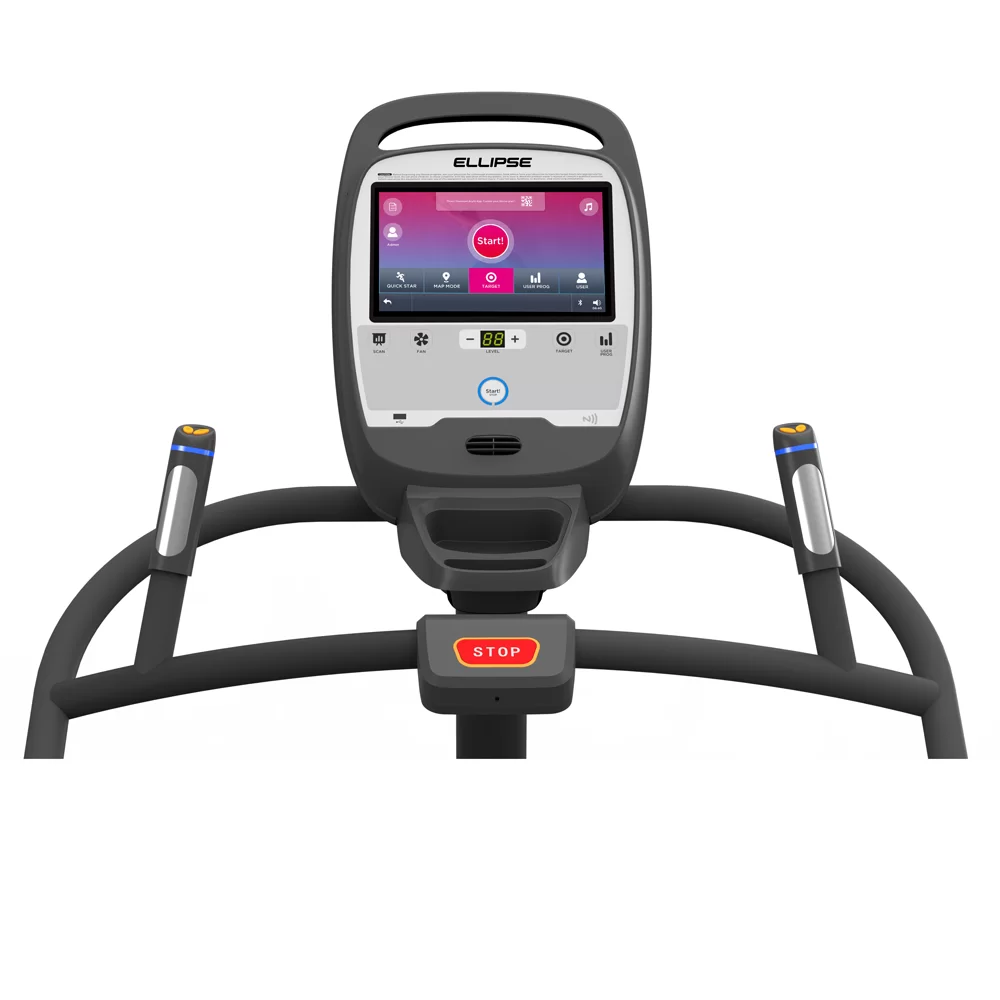
The most visible change in this category over the last decade is not mechanical, it is on the console. Interactive displays, virtual routes, session challenges and connected tracking exist to solve a real operational problem: stair machines are monotonous, and monotony is what drives a member off the machine before the session is over.
Two things are worth keeping in mind when comparing consoles. First, an entertainment screen is an IT asset: it needs a network, it needs updates, and it will need service. A simple LED console on a well-built frame often outlives a media console on a weaker one. Second, gamified programmes only raise retention if someone in the facility actually promotes them – the hardware alone changes nothing.
In practice most operators mix the two: one or two media-equipped units in the visible part of the cardio zone, and simpler consoles on the remaining stations.
Matching the machine to the type of facility
Gyms and fitness clubs. Stair climbers are a differentiator in the cardio zone and a natural complement to treadmills and cross-trainers. Plan for the queue at peak hours rather than for the average.
Hotels and residences. Space is the constraint. A single stepper adds a genuine lower-body cardio option to a room that would otherwise hold only a treadmill and a bike, without the noise a treadmill generates through the floor slab.
Rehabilitation and medical fitness. The low-impact profile is the reason for the purchase. Resistance adjustability and handrail support are more important here than peak intensity.
Municipalities and outdoor circuits. Open-air stepper stations belong to a different regulatory family: adult outdoor fitness equipment falls under EN 16630, and equipment intended for children under EN 1176-1, with impact-attenuating surfacing under EN 1177. These are separate standards and should never be substituted for one another in a tender document.
Installation, servicing and lifespan
Powered stair climbers need a dedicated, properly earthed supply and enough clearance behind the machine for the service panel. Self-powered steppers are simpler but still benefit from a protective floor covering, both for the slab and for acoustic reasons in a building with occupied rooms below.
Preventive servicing is straightforward and pays for itself: keep the step surfaces clean, check the tension and alignment of the drive elements at the intervals the manufacturer specifies, and log the work. The failures that take a machine out of service for weeks are almost always the ones that were audible for months.
Frequently asked questions
Is a stepper or a stair climber better for a commercial gym?
Both, if the floor allows it. The stepper is the accessible entry point and the stair climber is the high-demand station. Facilities with a single slot usually choose according to their membership profile rather than by intensity.
Can this equipment be used by members returning from injury?
The movement is low impact and the resistance is adjustable, which is why it is common in rehabilitation settings. The clinical decision belongs to the practitioner following the member, not to the equipment specification.
What standard should appear in my tender document?
EN ISO 20957-1 class S for indoor professional equipment. EN 16630 for adult outdoor stations, EN 1176-1 with EN 1177 surfacing for children equipment. Naming the wrong standard is the most common reason a technical bid is rejected.
How much floor space should be planned per station?
Take the manufacturer footprint for the specific model and add the circulation and access area required by your layout. Ceiling clearance is the constraint that is most often overlooked with revolving-step machines.
Do these machines suit an unsupervised facility?
Yes, provided the equipment is class S and the console is simple enough to be used without an induction. Handrails and a clear emergency stop matter more than programme depth in an unstaffed room.
Specifying your cardio zone
A stepper or a stair climber is one of the few cardio purchases that improves a floor plan rather than consuming it: high training value, low impact, and a footprint that fits where a treadmill will not. The decision comes down to your membership, your available clearance and the service you can expect over ten years.
Send us your room dimensions and the profile of your users, and we will put together a configuration and a costed proposal. Start here: request a quote.