Playgrounds: Surfacing and Foundations Required by Each Family
Deux chiffres décident du budget d'une aire de jeux : la hauteur de chute libre, qui commande le sol amortissant, et la profondeur de fondation, qui commande le terrassement. Les jeux à ressort sont les moins exigeants (fondation 0,4 à 0,7 m), les structures tubulaires les plus lourdes (jusqu'à 1,1 m), et les ensembles en corde offrent une hauteur constante de 2,85 m qui uniformise le sol à poser. Comparer des offres sur la hauteur totale conduit à se tromper de coût.
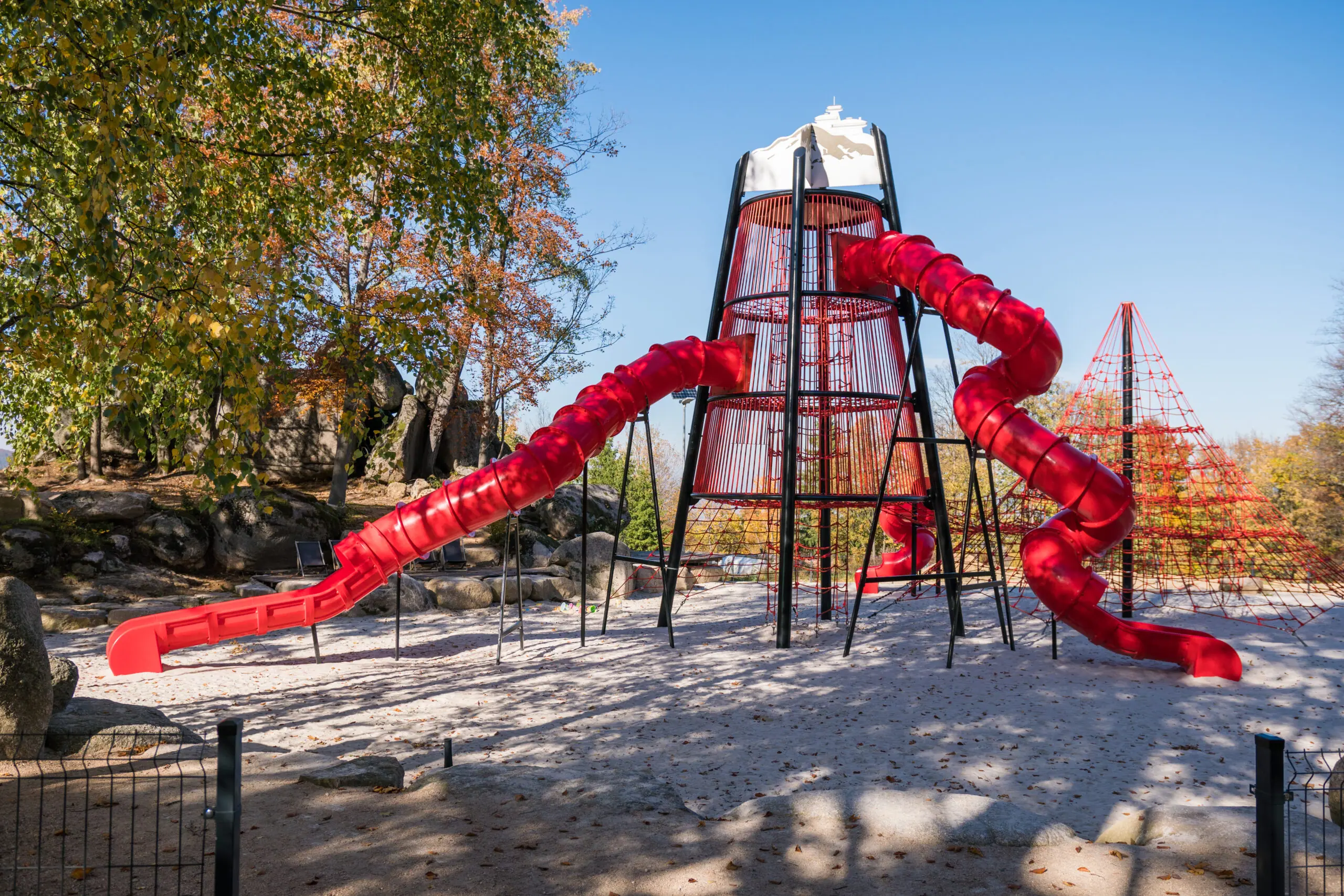
On a playground project, the price of the structures is rarely what breaks a budget. Two figures that never appear on a brochure do that: the free fall height, which dictates the thickness and the extent of the impact attenuating surfacing, and the foundation depth, which dictates the excavation. The table below sets out what each family of equipment demands, so the decision can be made before a model is chosen.
What each family requires
| Family | References | Free fall height | Foundation depth |
|---|---|---|---|
| Spring riders | 24 | Low, up to 1.0 m | 0.4 to 0.7 m |
| Swing sets | 15 | 1.0 to 2.8 m | 0.5 to 1.0 m |
| Rope climbing pyramids | 16 | 1.0 to 2.7 m | 0.7 to 1.0 m |
| Rope play modules | 56 | 1.0 to 3.0 m | 0.8 to 1.0 m |
| Play towers | 12 | 1.5 to 3.0 m | 1.0 m |
| Bespoke playgrounds | 30 | 1.7 to 3.0 m | 0.8 to 1.0 m |
| Elevated playhouses | 9 | 2.6 to 3.0 m | 1.0 m |
| Tubular play structures | 18 | 2.5 to 3.0 m | 0.8 to 1.1 m |
| Rope play sets | 31 | 2.85 m, constant | 1.0 m |
Three useful readings of this table
Extending an existing playground without touching the surfacing
Spring riders are the only family whose surfacing demand stays low and whose foundation goes no deeper than 0.4 m. That is what allows them to be added to an already equipped playground without lifting the existing surface or reopening an excavation.
Check the buried services before the aesthetics
Tubular structures require up to 1.1 m of foundation, the highest figure in the catalogue. On an urban site with buried services, that number is checked before any decision on shape or silhouette: it is what determines whether the project is feasible as designed.
Choose consistency when the surfacing is the sensitive item
Rope play sets all carry a free fall height of 2.85 m. The value is high, but it is identical across the whole range: one surfacing specification, no zoning, and homogeneous excavation at 1.0 m. Elevated playhouses do the opposite, requiring 2.6 to 3.0 m with no way down: that is a budget decision to be taken at design stage, not arbitrated at the end of the project.
The trap of the advertised height
The overall height of a structure says nothing about its surfacing requirement. On rope climbing pyramids, a 3.6 m model can have a free fall height of only 1.0 m while a 3 m model requires 1.8 m, depending on where its platforms sit. Comparing two tenders on advertised height therefore leads to a wrong view of the total cost. The only value worth putting in a comparison table is the free fall height.
What the standards require
Playgrounds fall under EN 1176-1, which is a different standard from EN 16630, the one that applies to outdoor fitness equipment for adults. The two are never interchangeable. The impact attenuating surfacing is certified to EN 1177 and is sized on the free fall height of the model selected. The area to be treated is larger than the footprint of the structure, and on a swing it extends along the axis of the swinging movement.
Building a coherent playground
The families do not cover the same age ranges. Swing sets go down to toddlers, while most rope structures start at five years old. A complete playground therefore combines at least two families, and the surfacing specification follows from the most demanding item on the site rather than from an average.
Our full playground equipment range covers all nine families. The two extremes of the table are the spring riders at one end and the tubular play structures at the other, and the playground surfacing range covers what goes underneath.
Ask for a site layout study: the drawing sets out, item by item, the safety zone and the foundation to allow for.
Frequently asked questions
Which family needs the least groundwork?
Spring riders: 0.4 to 0.7 m of foundation and a low free fall height, so the lowest surfacing demand in the catalogue. It is the only family that can be added to an existing playground without lifting the surface.
Which family needs the deepest excavation?
Tubular structures, up to 1.1 m of foundation depth. To be checked against buried services before any decision on appearance.
Why compare on free fall height rather than overall height?
Because free fall height depends on where the platforms sit, not on where the top of the structure is. A taller structure can need less impact attenuating surfacing than a lower one with a high platform.
What is particular about rope play sets?
Their free fall height is constant at 2.85 m across all 31 references: one surfacing type across the whole area, no zoning, and a homogeneous foundation at 1.0 m.
Is the area to be surfaced the same as the footprint of the structure?
No, it is larger. The safety zone extends beyond the equipment and stretches along the axis of movement on swings. It is shown item by item on the site layout drawing supplied with the quotation.
Réalisations documentées
- Cage street workout ultime, Carcassonne – armée française
- Cage street workout ultime, Tahiti – armée française, Polynésie
- Cage SP Max, centre EPIDE de Combrée – établissement public d’insertion
- Cage SP Max, lycée Saint-Bénigne de Dijon – établissement scolaire
Sources et références
- Décret n° 96-1136 du 18 décembre 1996 – prescriptions de sécurité relatives aux aires collectives de jeux (Légifrance)
- NF EN 1176-1 – Équipements et sols d’aires de jeux, partie 1 : exigences de sécurité et méthodes d’essai générales (AFNOR)
- NF EN 1177 – revêtements de surface amortissants : détermination de la hauteur de chute critique (AFNOR)
- NF EN 16630 – modules fixes d’entraînement physique de plein air : exigences de sécurité et méthodes d’essai (AFNOR)