Outdoor Fitness Trail Equipment for Local Councils
Une mairie qui installe un parcours santé doit traiter trois points avant le matériel : la conformité EN 16630, le sol de réception et le registre de contrôle. Ces éléments engagent la responsabilité de la commune en cas d'accident. Light In Fitness fournit les agrès, l'étude d'implantation, la pose et le dossier de conformité.
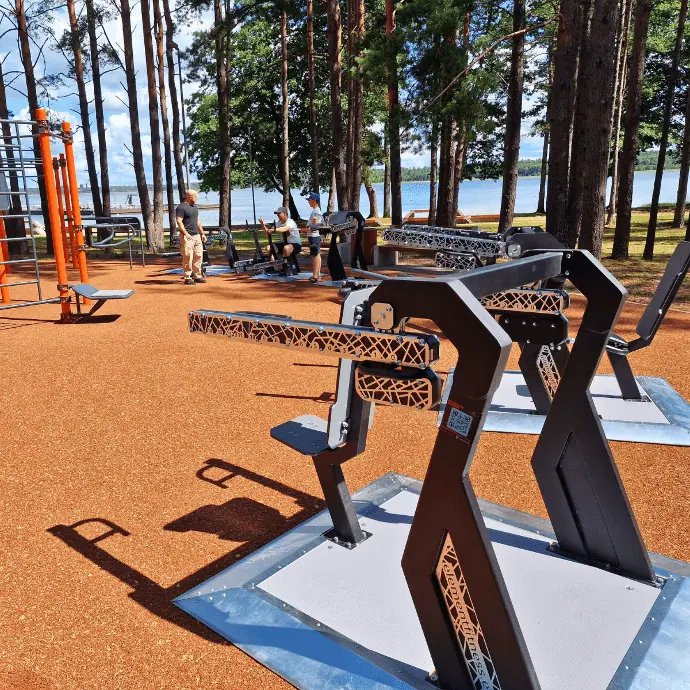
An outdoor fitness trail is one of the few pieces of sports infrastructure a local authority can build that is open every hour of the year, needs no staff, and serves residents from teenagers to pensioners. It is also one of the most scrutinised: once the stations are bolted down, the council owns the safety file. This guide sets out what a municipal buyer needs to settle before choosing equipment, and how Light In Fitness supports councils from the site survey to the compliance pack.
Why councils invest in outdoor fitness trails
Public green space is judged on how much it is actually used. A fitness trail turns a footpath or a lakeside loop into a destination: people come for a specific reason, stay longer, and come back. For a parks department this is measurable footfall for a one-off capital cost and a modest annual inspection budget.
The social effect matters as much as the physical one. Free, unbookable equipment removes the two barriers that keep most adults out of a gym, namely cost and self-consciousness. Trails placed near schools, sports halls or housing estates quickly become meeting points, and that informal supervision is itself a deterrent to vandalism.
Finally, an outdoor trail is complementary to indoor provision rather than competing with it. Municipalities that already run a sports hall use the trail as an entry point: it introduces residents to structured exercise and feeds membership of local clubs.
The standard that governs municipal outdoor gyms: EN 16630
Permanently installed outdoor fitness equipment for adults falls under EN 16630. The standard covers structural strength, entrapment, finger and head traps, protruding parts, fall heights, the free space around each station and the information that must be displayed on site. It is the reference a loss adjuster will open first after an incident.
Three points are regularly missed by first-time buyers:
- EN 16630 applies to adult equipment. Play equipment for children is a different world, governed by EN 1176-1 for the apparatus and EN 1177 for the impact-attenuating surfacing. The two families must never be mixed on the same footprint, nor certified against the wrong standard.
- Compliance is not only about the apparatus. The free space, the ground under and around each station and the signage are part of the assessment.
- The obligation does not stop at handover. The operator has to keep an inspection record: routine visual checks, operational inspections and an annual main inspection, each one dated and signed.
Ask every supplier for the test report and the installation manual before signing, not after delivery. A quotation that mentions no standard at all is a warning sign.
Choosing stations for a genuinely mixed user base
A municipal trail is not a gym floor. Its users arrive with no instructor, no induction and very different capabilities, so the selection has to work without supervision.
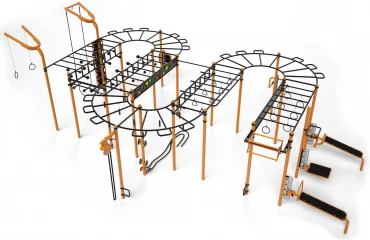
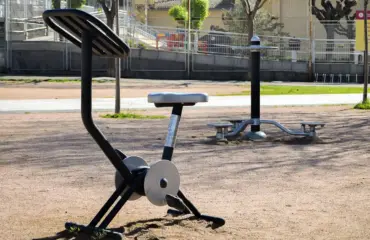
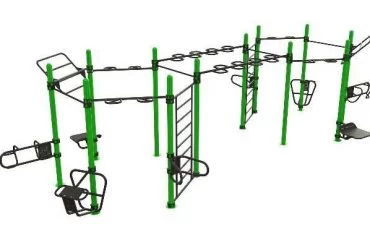
A workable rule is to build the trail in three layers. Body-weight stations such as parallel bars, wall bars, step-up platforms and pull-up frames carry the athletic users and cost very little per unit. Guided-resistance stations, where the load comes from the user own body weight through a lever or a flywheel, suit the majority of residents because the movement is constrained and hard to perform badly. Mobility and warm-up units such as shoulder wheels, waist twisters and pedal trainers serve older users and people returning from injury, and they are usually the busiest items on the whole trail.
Accessibility deserves a decision rather than an afterthought. Stations designed to be used from a wheelchair, with an approach corridor and a transfer height that actually works, change who feels entitled to use the space. Our accessible outdoor gym range is built for that requirement, and it belongs in the same procurement as the rest of the trail, not in a later phase that never arrives.
Materials: what survives fifteen winters outdoors
Outdoor equipment fails at the interfaces, not in the middle of a tube. Water sits in blind holes, road salt attacks welds, and ultraviolet light chalks cheap coatings within three summers.
| Material | Best suited to | Points to check |
|---|---|---|
| Hot-dip galvanised steel with polyester powder coating | General municipal use, inland sites | Coating thickness, sealed tube ends, stainless fixings |
| Stainless steel | Coastal and saline environments, high-vandalism sites | Grade of the alloy, finish of the welds |
| Treated timber with steel cores | Woodland, heritage and landscape-sensitive settings | Ground contact detailing, moisture and insect treatment |
Light In Fitness guarantees its steel structures for up to twenty years and its stainless steel structures for life. Those figures are only meaningful alongside the maintenance regime, so read the warranty and the inspection schedule as one document.
Surfacing, layout and the site survey
The ground under the equipment is part of the installation, not a finishing touch. Fall height dictates the surface: mown grass is acceptable under low stations, while higher apparatus needs a tested impact-attenuating surface, whether wet-pour rubber, rubber tiles or a certified loose fill.
On layout, resist the temptation to line every station along one straight path. Grouping stations in clusters of three or four, spaced along a circuit, keeps the free zones clear, avoids queues at the popular units and lets a maintenance team work on one cluster without closing the whole trail. Leave room for the users, not just for the machines: shade, a bench, a bin and a water point do more for usage figures than an extra station.
Our team surveys the site, checks the available footprint and slopes, and returns a layout with the free zones drawn to scale. You can see the full range of stations on our outdoor fitness trail and outdoor gym equipment pages.
Budget, procurement and whole-life cost
Public buyers are rarely comparing like with like. A price per station means nothing until the quotation covers groundworks, foundations, surfacing, installation, signage, the compliance file and the first year of inspections. Consumer-grade equipment sold for private gardens has no place in this comparison: it is not built for uncontrolled, continuous public use and will not carry an EN 16630 declaration.
Budget for the running cost from the outset. An annual main inspection, a small stock of fixings and one repaint cycle over fifteen years is a realistic frame. Equipment specified correctly at the start is far cheaper over its life than a low tender that has to be replaced in the sixth year.
Funding routes for sports facilities differ from one country to another and often from one region to another. Check with the national or regional sports authority that applies to your territory before you fix the budget, because the eligibility rules usually shape the specification.
Frequently asked questions
Which standard applies to a municipal outdoor gym?
EN 16630 for permanently installed adult outdoor fitness equipment. If children play equipment is installed on the same site, it is covered separately by EN 1176-1, with EN 1177 for its impact-attenuating surfacing.
How much space does a fitness trail need?
It depends on the stations chosen, because each one has a free space defined by the standard. A compact circuit of eight to ten stations is routinely fitted into an existing park path without buying extra land, provided the free zones do not overlap.
Do we need to supervise the equipment?
No, an outdoor trail is designed for unsupervised use. What the operator does need is a documented inspection routine and a record of the checks carried out.
Can we extend the trail later?
Yes, and it is a sensible way to phase a budget. Specify the foundations and the circuit for the final layout from the start, then install in phases, so that the later stations do not force a redesign of the free zones.
Is timber or steel the better choice?
Steel is the default for intensive urban use and the easiest to maintain. Timber is chosen where the landscape argues for it. Both are professional-grade when specified correctly, and both are covered by the same standard.
Talk to us about your project
Light In Fitness has equipped more than five hundred sites since 2013, from small rural councils to city parks departments. We supply the stations, the site study, the installation and the compliance file as one package, so that the technical services team is not left assembling it from three suppliers.
Send us your plan, the surface available and the profile of the residents you want to reach, and we will come back with a layout and a costed proposal. Request a quote and we will take it from there.
Réalisations documentées
- Parcours ninja sur mesure, Rennes – îlot des Hautes-Ourmes
- Double mur ninja extérieur, Sallanches – Haute-Savoie