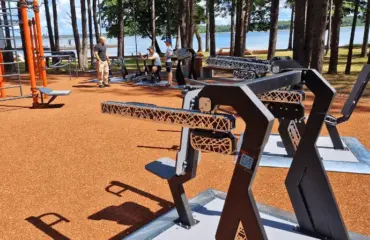
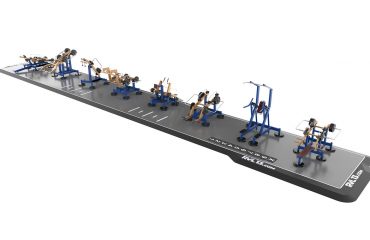
Durable Outdoor Fitness Equipment for Cities
La résistance d'un équipement de parcours santé tient au matériau et à son traitement : acier galvanisé pour la plupart des sites, inox en atmosphère saline ou chlorée. L'acier peint impose des reprises régulières et se dégrade en quelques saisons en accès libre. Le coût de possession sur dix ans, et non le prix d'achat, distingue les gammes.
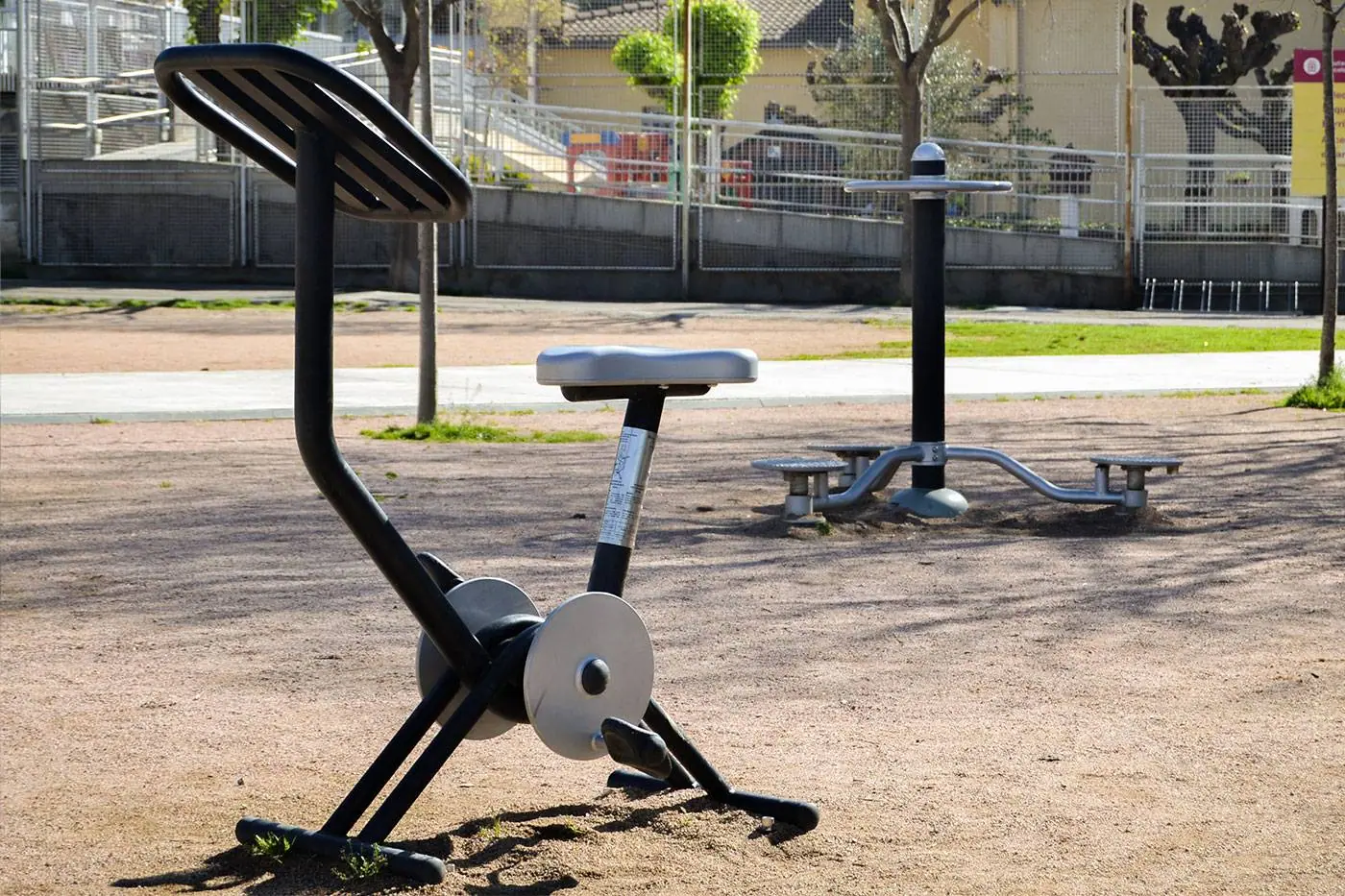
Outdoor fitness trails, also called open-air fitness circuits, are increasingly common in cities. They give residents a free and accessible way to train outdoors, and for a city they are a rare piece of infrastructure that opens itself, needs no staff and serves every age group. The question for the buyer is not whether to build one, it is which specification survives a decade of unsupervised urban use. That comes down to material, treatment and the cost of ownership over ten years, rather than the purchase price.
Why cities install outdoor fitness circuits
Accessible and inclusive by design
Fitness trails are open to everyone, whatever their age or physical condition. They encourage an active lifestyle and let residents train at their own pace, at no cost. Placed in parks, along walking routes or in urban green space, they extend access to quality training facilities into neighbourhoods that have none.
A public health asset
By making training equipment easy to reach, outdoor circuits play a real role in public health. They encourage regular physical activity, reduce stress and support mental wellbeing. For a city, that is a lever on long-term health costs delivered through the parks budget rather than the health budget.
What makes equipment genuinely weather resistant
Material and treatment, in that order
Resistance comes from the material and how it is treated, not from the thickness of the brochure. Hot-dip galvanised steel is the right default for most urban sites, and aluminium is used where light weight matters. Both carry weather-resistant coatings that prevent corrosion. In saline or chlorinated atmospheres, near the coast or beside an outdoor pool, stainless steel is the specification that holds up.
Painted steel is where municipal projects go wrong. It looks identical on delivery, costs less, and then needs repeated repainting; in free public access it degrades within a few seasons. Read the material line of the quotation carefully, because it is the single largest determinant of what the installation will cost you by year ten.
| Specification | Where it belongs | What to expect |
|---|---|---|
| Hot-dip galvanised steel with a weather-resistant coating | Most inland urban parks and green spaces | Long service life, minimal maintenance, repaint cycle late in life |
| Stainless steel | Coastal, saline or chlorinated atmospheres, high-exposure sites | Highest resistance, highest initial cost, lowest lifetime intervention |
| Aluminium components | Where light weight or a specific finish is required | Corrosion resistant, specify the fixings with equal care |
| Painted steel | Not recommended for open public access | Repeated repainting, visible degradation within a few seasons |
Our galvanised steel fitness trail range covers the standard municipal case, and the stainless steel outdoor fitness range covers the exposed and coastal ones.
Ergonomics and safety
Equipment is designed with particular attention to ergonomics and safety. Non-slip surfaces, comfortable handgrips and smooth finishes are among the features that reduce the risk of injury. Clear instruction panels and usage guides help residents perform the exercises correctly, which matters more outdoors than in a gym because nobody is there to correct them.
Permanently installed outdoor fitness equipment for adults is covered by EN 16630, which governs structural strength, entrapment, fall heights, the free space around each station and the on-site information. Children play equipment is a separate family, covered by EN 1176-1 with EN 1177 for the impact-attenuating surfacing, and the two must never be mixed on one footprint.
Variety across the circuit
A circuit works when it offers a range of equipment covering different muscle groups and capabilities. Pull-up bars, dip stations and strength apparatus sit alongside outdoor cardio units such as open-air cross trainers. That variety is what lets a resident build a complete training routine on one circuit rather than repeating the same two stations.
Installation and maintenance
Straightforward installation
The equipment is designed to be installed quickly and cleanly. Specialist installation teams set the circuit up in the location the city has chosen with minimal disruption. Because the structures are modular, the layout can be adapted to the space available and to the specific needs of the neighbourhood rather than forced into a catalogue configuration.
Minimal maintenance, but not zero
Resistant materials and modern manufacturing keep maintenance low. Regular inspections and occasional cleaning are enough to keep the installation in good condition and safe for continuous public use. What matters is that the inspections are documented: the operator of an outdoor fitness area keeps a record of routine visual checks, operational inspections and an annual main inspection.
Budget the ten-year picture rather than the invoice. A correctly specified galvanised or stainless circuit costs more on day one and less over its life than a painted one that needs intervention every few seasons.
Working with the community
Introduction and activation programmes
Equipment that nobody knows how to use gets used by nobody. Introduction and activation programmes, including exercise demonstrations, coaching sessions and community events, are an effective way to familiarise residents with the stations and to promote an active lifestyle. A short programme in the first weeks changes the usage curve for years.
Working with the city
We work closely with city departments to adapt installations to local needs. That can include advice on the best placement for the equipment, integration into urban development plans, and health awareness initiatives run alongside the opening.
Frequently asked questions
Which material should a city specify?
Hot-dip galvanised steel with a weather-resistant coating for most sites, and stainless steel in saline or chlorinated atmospheres. Painted steel is not a sensible choice for open public access.
How much maintenance does an outdoor circuit need?
Regular inspection and occasional cleaning, provided the material specification is correct. The inspection routine is a legal obligation for the operator, not an optional service.
Which standard applies?
EN 16630 for permanently installed adult outdoor fitness equipment. Children play equipment on the same site falls under EN 1176-1, with EN 1177 for its impact-attenuating surfacing.
Can the circuit be adapted to an awkward space?
Yes. The structures are modular, so the layout is built around the space available and the profile of the neighbourhood rather than the other way round.
Is the cheapest quotation ever the cheapest circuit?
Rarely. Compare the ten-year cost of ownership, including repainting, part replacement and downtime, and the ranking usually reverses.
Plan a durable circuit for your city
Light In Fitness designs and manufactures robust outdoor fitness equipment specified for urban environments, and supports the project from the design study through to installation. Browse the full outdoor fitness trail range, then request a quote and our specialists will work through the placement, the materials and the layout with you.
Réalisations documentées
- Parcours ninja sur mesure, Rennes – îlot des Hautes-Ourmes
- Double mur ninja extérieur, Sallanches – Haute-Savoie