OG Outdoor Strength Machines with On-Machine Weight Adjustment
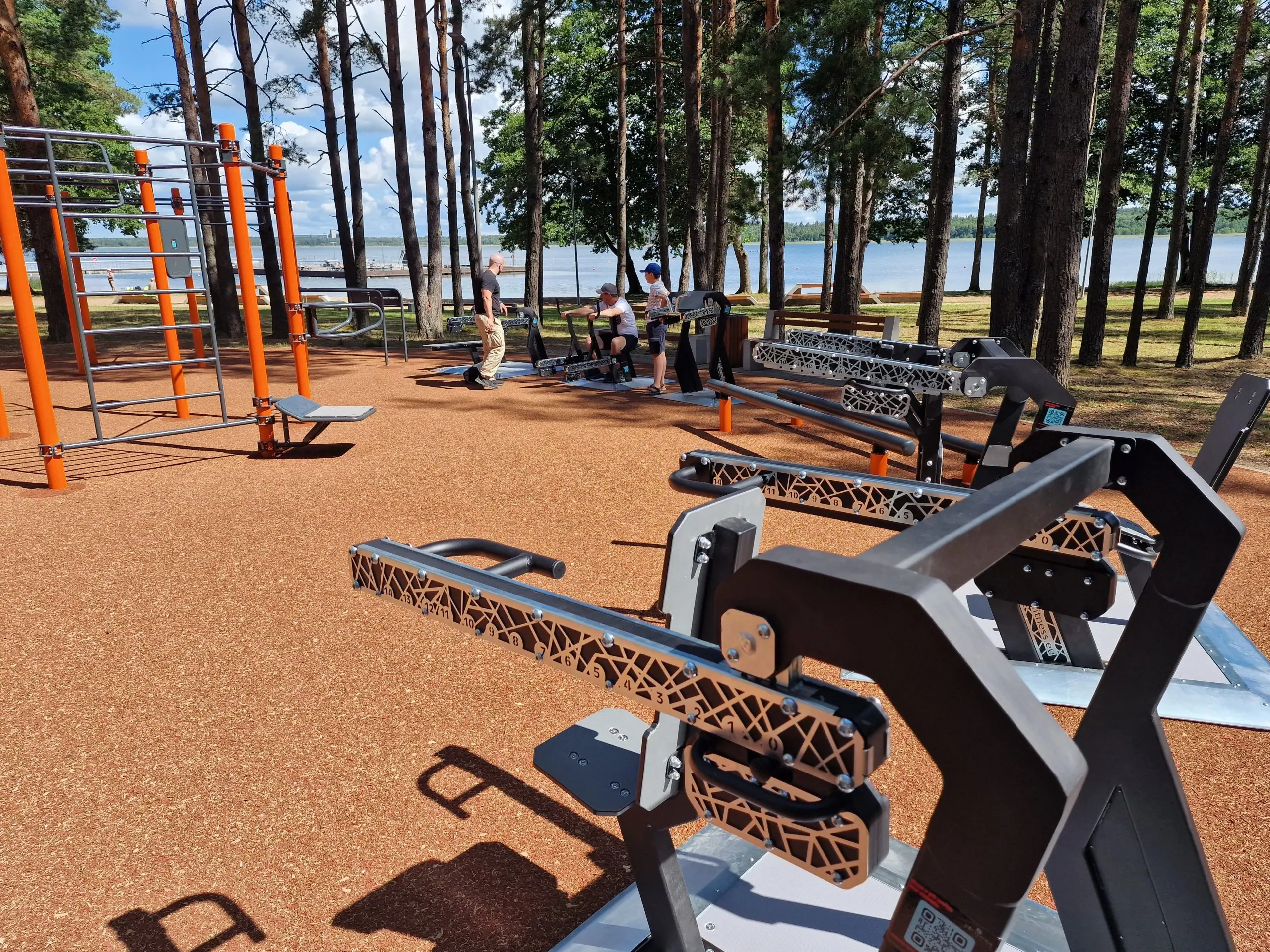
Outdoor strength areas have a recurring weakness: the load is fixed. Most open-air machines work against body weight or a preset resistance, which suits a first-time user and quickly stops suiting anyone else. The OG range answers that with load adjustment built into the machine itself, so a single station serves a beginner and a regular user without any loose weights on site.
For the organisation paying for the installation, that detail is not a training refinement. It decides how many different people a station is useful to, and therefore how well the investment performs over its service life.
Why open-air strength areas get used
An outdoor strength area works for reasons an indoor room cannot reproduce. It is open at the hours people are actually free, it needs no booking and no supervision, and it puts training in a park, on a seafront or inside a holiday site where users already are. For a municipality it is a public facility with no membership barrier; for a campsite or a hotel it is an amenity guests can see from the moment they arrive; for a residential developer it is shared outdoor space that has a function.
The environment itself contributes. Training outdoors offers a change of setting that indoor rooms do not, and open-air facilities tend to draw groups rather than isolated users, which is usually what the operator wanted in the first place.
None of that survives equipment nobody can progress on. This is the specific problem the OG range was built around.
What the OG range is
The OG range is a family of outdoor strength machines designed for permanent installation in public and semi-public spaces. It covers the main movement patterns rather than a single exercise: leg press, bench press, shoulder press, seated row and bicep curl, so a group of stations forms a usable circuit for the whole body instead of a collection of isolated pieces.
Each machine is a self-contained station. There is nothing to carry to it, nothing to store next to it and nothing that can be removed from it, which is what makes the range suitable for an unsupervised site.
The full range is listed under outdoor strength machines, alongside the wider outdoor gym equipment catalogue.
On-machine load adjustment: what it changes for the operator
The defining feature of the range is that the resistance is adjusted on the machine, by the user, in seconds. The consequences are practical.
No loose weights on site. Nothing has to be stored, signed out, secured overnight or replaced after it disappears. On an unstaffed outdoor installation this removes an entire category of maintenance and loss.
One station, several user levels. A resident starting out and a regular user in good condition use the same machine at different settings. The station does not have to be specified for an average user who does not exist.
Progression without a second purchase. Users can increase the load as they improve, which is what keeps an outdoor area in use in year three rather than only in the month after the ribbon is cut.
Fewer failure points from misuse. Because the load stays attached to the frame, there is no scope for weights to be badly seated, dropped or used somewhere they were not intended.
Build and weather resistance
Outdoor equipment fails at the details, not at the concept. The OG machines are built on an S235 structural steel frame with a powder-coat finish, which is what carries the exposure to rain, sun and temperature swings over the years.
The plastic components are made from Elastodur, chosen for impact resistance and for behaviour across a wide temperature range, and the fixings are galvanised to prevent corrosion at the points where water always ends up sitting. The steel structure carries a twenty-year warranty.
These are the specifications that matter when a technical department compares two outdoor ranges that look similar in a photograph. Steel grade, coating, plastics and fixing treatment are the four items worth putting in a comparison table.
Siting, surfacing and safety
Permanently installed outdoor fitness equipment for adults falls under the European standard framework for outdoor fitness equipment, EN 16630, which is the reference to name in a public tender. Equipment intended for children is a different framework entirely and must not be specified under EN 16630.
Beyond the equipment, three site decisions determine whether an installation is a success.
The ground. The machines need a stable, level base sized for the anchoring loads. Uneven or slippery ground around a station is the most common avoidable hazard on an outdoor site.
The spacing. Each station needs its own clear use zone, and the circuit needs enough room for people to pass behind a machine in use.
The inspection routine. Outdoor equipment is inspected on a schedule, with a defined route for reporting a fault. This belongs in the operating plan before the equipment is ordered, not after.
Specifying and budgeting
Each machine in the OG range is listed at 4,600.00 EUR excluding VAT, which makes the range straightforward to budget: the cost of a circuit is the number of stations multiplied by a single figure, plus groundworks and installation.
Footprints are station-specific and should be taken from the individual product pages when drawing the layout. The OG Leg Press, for example, occupies 1.98 m by 1.09 m and stands 1.54 m high, and each station needs its use zone on top of that footprint.
Frequently asked questions
How many stations make a usable circuit?
It depends on the audience and the space, but the aim is coverage of the main movement patterns rather than a fixed number. The five OG machines together cover legs, chest, shoulders, back and arms, which is why they are usually specified as a group.
Is the range suitable for an unsupervised public site?
Yes. That is what the on-machine load adjustment and the absence of loose components are for. The site still needs a posted inspection and fault-reporting routine.
Can the machines be installed on grass or on an existing surface?
They need a prepared, level base designed for the anchoring loads. Whether that sits under a dedicated safety surface or a hard standing is a site decision taken with the layout.
What maintenance should be budgeted?
Routine visual inspection, checking of fixings and cleaning. The material choices are made to keep that routine short, but they do not replace it.
Planning an OG installation
If you are specifying an outdoor strength area for a municipality, a campsite, a hotel, a residence or a club, send us the site plan, the expected user profile and the available area. We will come back with a station selection, a layout and a budget: request a quote.
Réalisations documentées
- Cage street workout ultime, Carcassonne – armée française
- Cage street workout ultime, Tahiti – armée française, Polynésie
- Cage SP Max, centre EPIDE de Combrée – établissement public d’insertion
- Cage SP Max, lycée Saint-Bénigne de Dijon – établissement scolaire
Sources et références
- NF EN 16630 – modules fixes d’entraînement physique de plein air : exigences de sécurité et méthodes d’essai (AFNOR)
- Code du sport, article L322-2 – garanties d’hygiène et de sécurité des établissements d’activités physiques et sportives (Légifrance)