
Outdoor Gym and Calisthenics Modules: A Practical Guide for Public Spaces
Un module de musculation et de gymnastique en plein air combine agrès au poids du corps et stations à charge réglable, en accès libre. Ces équipements relèvent de la norme EN 16630 et se posent sur un sol de réception adapté. Ils s'adressent aux collectivités, résidences, campings et entreprises.
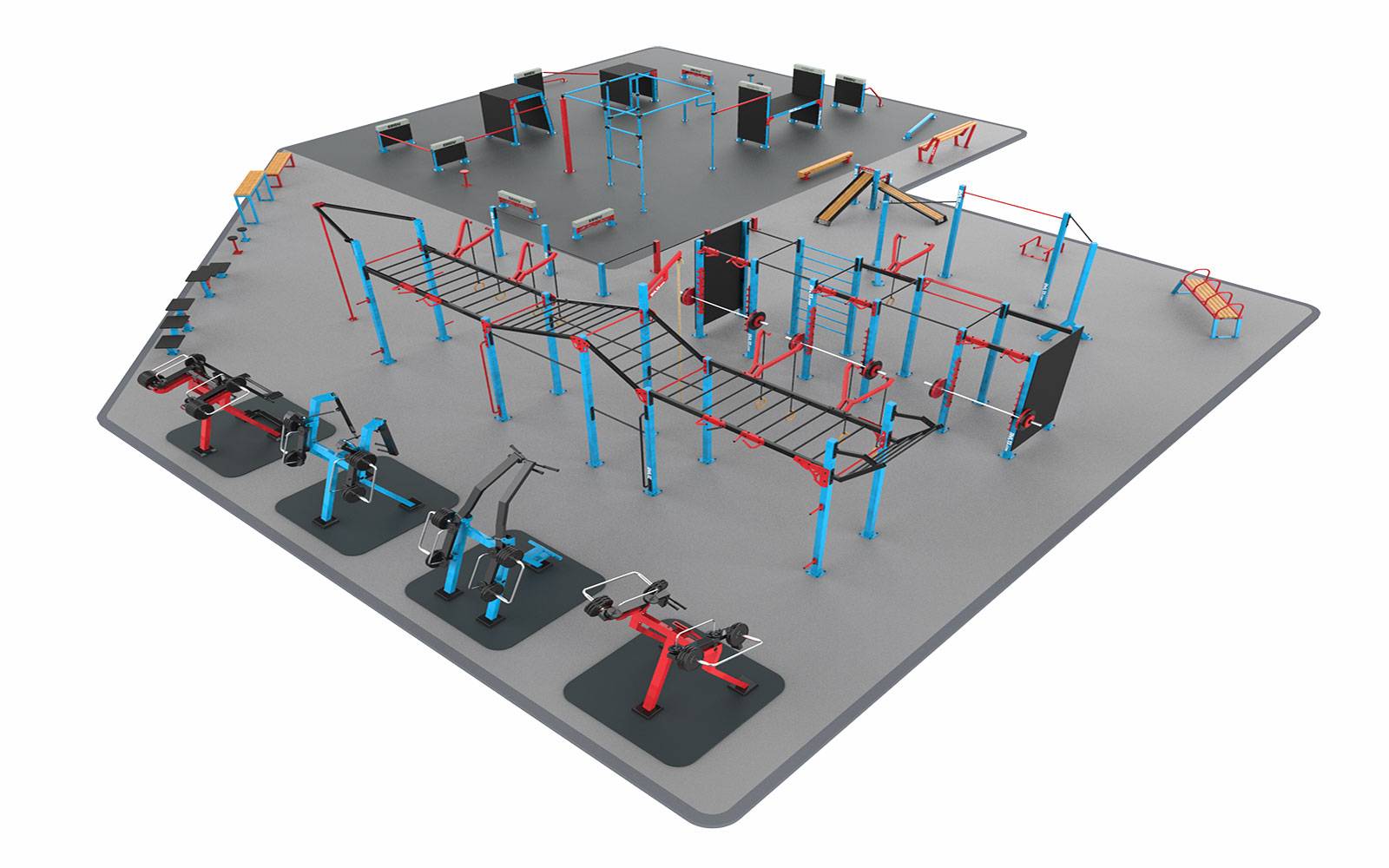
Open-access outdoor training areas have become a standard expectation in public and private developments. For a municipality, a holiday park, a housing association or a hotel group, an outdoor gym and calisthenics module is a durable piece of sports infrastructure: it is specified once, installed on a prepared surface, and then used every day for ten to fifteen years with very little supervision. This guide sets out what these modules contain, which standards apply, and what a professional buyer should settle before requesting a quotation.
What is an outdoor gym and calisthenics module?
An outdoor gym and calisthenics module is a purpose-built installation that lets people train outdoors without a membership or a supervising coach. It combines two families of equipment. The first is body-weight apparatus: pull-up bars, parallel bars, dip stations, wall bars, monkey bars and climbing frames. The second is resistance apparatus: guided stations where the user pushes, pulls or presses against their own body weight or against an adjustable load.
Modules are normally placed in a park, along a promenade, inside a residential development, on a campsite or next to a school or sports hall. Because the equipment is unsupervised and permanently exposed to weather and to vandalism, it is engineered very differently from indoor studio machines: hot-dip galvanised or stainless steel frames, sealed bearings, tamper-proof fixings and powder-coated finishes rather than upholstery and electronics.
Why operators specify outdoor training modules
The business case rarely rests on a single argument. Most projects combine several of the ones below.
Open access, no barrier to entry
Once installed, the equipment is free at the point of use. For a local authority or a social landlord this is the decisive point: physical activity is offered to residents who would never buy a gym membership, without any ongoing subscription to manage.
Training in the open air
Outdoor exercise carries documented benefits beyond the physical: exposure to daylight, better mood and lower perceived stress. For a hotel or a campsite this translates directly into guest satisfaction and into a visible amenity in marketing material.
One footprint, many training goals
A single module can serve cardiovascular work, strength work, mobility work and body-weight training. That density matters when the available ground area is small and the brief has to satisfy several user groups at once.
Social use and animation of public space
Outdoor training areas attract regular groups. They animate a park, discourage misuse of underused corners, and create informal supervision by the simple fact that people are present.
Availability outside opening hours
Unlike a supervised facility, an open-access module is usable whenever the site itself is open. In practice that means early mornings and evenings, when a staffed hall would be closed or fully booked.
What a complete module covers
Cardiovascular stations
Outdoor cardiovascular equipment is built around mechanical resistance rather than motors. Non-motorised treadmills, air walkers, elliptical trainers and step units let users raise their heart rate without any electrical supply on site. Our range of outdoor gym equipment covers these stations in galvanised steel and in stainless steel for coastal or chlorinated environments.
Strength stations
Resistance stations reproduce the main movement patterns of an indoor gym: chest press, lat pull, leg press, shoulder press, rowing. Loading is either the user body weight through a lever ratio, or an adjustable stack protected against weather and interference.
Stretching and mobility
Parallel bars, stretching posts, wall bars and mobility wheels complete a session and make the module usable by older adults and by people returning to activity. These are the cheapest stations to install and often the most heavily used.
Calisthenics and body-weight training
Calisthenics uses body weight alone to build strength and control. A calisthenics rig provides the pull-up bars, dip bars, low bars and hanging points needed for pull-ups, muscle-ups, dips, push-ups and rows. See the full street workout and calisthenics rigs range for single-bay units through to full parks.
Children play areas alongside the fitness zone
Many schemes place a children play area next to the adult training zone so that parents can train while their children play in view. This is a different regulatory world: play equipment falls under EN 1176-1 and its impact-absorbing surfacing under EN 1177, not under the outdoor fitness standard. The two zones are designed together but specified separately, and our playground equipment range is certified accordingly.
Fitness trails
A fitness trail spreads individual stations along a walking or running route rather than grouping them in one plaza. It suits large parks, riverside paths and campsites, and it distributes wear across a wider area.
Standards, surfacing and siting
Adult outdoor fitness equipment installed in a permanently accessible public area is covered by EN 16630. The standard addresses structural strength, entrapment, finger and head traps, fall heights and the information that must be provided to users and to the operator. Ask any supplier for the test report, not simply a declaration.
Where a children play area is part of the same scheme, EN 1176-1 governs the equipment and EN 1177 governs the impact-absorbing surface under and around it. The two must never be substituted for one another, and EN 16630 is never the correct reference for a piece of children play equipment.
Surfacing choice follows the free height of fall of the tallest station. Options range from bonded rubber and wet-pour to loose-fill wood chips and grass reinforcement, each with its own maintenance profile. The surface is not an accessory: on most projects it represents a significant share of the installed cost and it is the item most often under-budgeted at the design stage.
Siting matters as much as the equipment. Allow clear safety zones around every station, keep a circulation route wide enough for a wheelchair between the stations, and consider shade, drainage and sightlines from the surrounding footpaths.
Frequently asked questions
How do users get started on an outdoor training module?
No booking or induction is required. Each station carries a pictogram panel showing the movement and the muscle groups involved. Users should warm up before starting and follow the instruction panel for each apparatus to avoid injury.
Is this equipment suitable for beginners?
Yes. A well-specified module offers several difficulty levels: assisted or lever-ratio stations for beginners, free body-weight bars for experienced users. Beginners should start with simple movements and increase intensity gradually.
Is outdoor fitness equipment safe?
Equipment compliant with EN 16630 and correctly installed on the right surfacing is designed to be safe in unsupervised use. Safety in service then depends on the operator: a documented inspection regime, prompt repair of damage and clear signage are all part of the duty of care.
How much training time should a session represent?
Recommendations for adults are at least 150 minutes of moderate physical activity per week, spread over several days. In practice that is sessions of 30 minutes to 1 hour, which is the format most outdoor modules are laid out for.
Can older adults use these modules?
Yes, and they are one of the main target groups. Balance, mobility and light resistance stations help maintain strength and prevent falls. Users with a medical condition should seek medical advice before starting a new exercise programme.
What maintenance does a module require?
A visual inspection at short intervals, a functional inspection every one to three months and an annual main inspection covering structure, fixings, wear parts and surfacing. Keeping the inspection log is what protects the operator in the event of an incident.
Specifying your project
An outdoor gym and calisthenics module is a long-lived asset, and most of its cost is decided in the first hour of the brief: the user groups to serve, the ground area available, the surfacing, and the standard the equipment must be certified to. Send us the site plan, the intended users and your budget envelope, and we will return a laid-out proposal with equipment references, surfacing quantities and installation requirements. Request a quotation to start.
Réalisations documentées
- Cage street workout ultime, Carcassonne – armée française
- Cage street workout ultime, Tahiti – armée française, Polynésie
- Cage SP Max, centre EPIDE de Combrée – établissement public d’insertion
- Cage SP Max, lycée Saint-Bénigne de Dijon – établissement scolaire
Sources et références
- NF EN 16630 – modules fixes d’entraînement physique de plein air : exigences de sécurité et méthodes d’essai (AFNOR)
- Code du sport, article L322-2 – garanties d’hygiène et de sécurité des établissements d’activités physiques et sportives (Légifrance)
- Décret n° 96-1136 du 18 décembre 1996 – prescriptions de sécurité relatives aux aires collectives de jeux (Légifrance)
- NF EN 1176-1 – Équipements et sols d’aires de jeux, partie 1 : exigences de sécurité et méthodes d’essai générales (AFNOR)
