Lexco LPS-103 Chest Press: What It Adds to a Commercial Gym
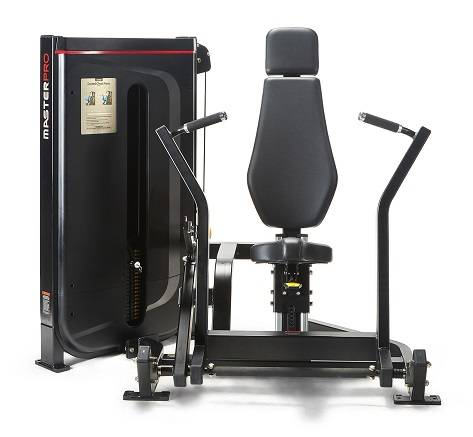
In brief: the Lexco LPS-103 chest press is a single-station selectorised machine built around a guided pressing path, an adjustable seat and a load stack the user changes without leaving the seat. In a commercial room it earns its place because the chest press is one of the movements members ask for first, and one of the few where a badly chosen station creates a queue at every peak hour.
What the LPS-103 is designed to do
The machine drives a horizontal pressing movement with the load on a fixed path. The chest carries the work, with the triceps and front shoulder contributing as they do in any pressing movement, and the frame handles the stabilising that a free barbell would leave to the user.
That is the whole argument for putting a dedicated chest press in a room rather than relying on a bench and a barbell alone. A member can train the movement to a meaningful load without a spotter, without loading plates and without the risk of being trapped under a bar. It suits beginners on their first programme and experienced members using it as accessory volume alongside free-weight work.
The station sits in the Lexco LPS selectorised range, alongside the shoulder press, the pulldown and the leg stations, which matters if you intend to build a visually and functionally coherent circuit rather than a collection of single purchases.
Adjustments and why they decide usage
Two adjustments do the work. The seat height sets where the handles meet the chest, and it is what allows the same station to serve users of very different statures. The load selector changes resistance in seconds, so a member moving between warm-up and working sets never has to leave the seat or handle plates.
The seat is padded and adjustable, and the backrest supports the spine through the press. Good posture on this movement is not a detail: it is what keeps the load on the chest and off the lower back, and it is the single thing worth checking during an induction.
If the chest press is a bottleneck in your room, the answer is usually a second pressing station rather than a bigger stack. Our full chest press machine range covers selectorised and plate-loaded options for exactly that reason.
Correct set-up, in the order your staff should teach it
Set the seat height first, so that the handles arrive at chest level rather than at the throat or the stomach. Plant both feet flat on the floor and keep the back supported by the backrest throughout.
Take the handles with the elbows bent at a comfortable angle. Push forward using the chest, and stop short of locking the elbows at full extension so the joint is not loaded at the end of the range.
Return slowly to the starting position, controlling the load rather than letting the stack fall back. That controlled return is where most of the benefit sits, and it is also the part members skip when they are in a hurry.
What operators can expect from it
Used regularly and correctly, a chest press station supports muscle development in the chest and contributes to upper-body pressing strength that carries over into other movements. Members notice progress because the load is numbered and the movement does not vary, which makes the station easy to build a programme around.
For the facility, the practical returns are different: a station that is used by a broad share of the membership, that needs no supervision, and that does not consume the floor space a bench and barbell setup would. Those three things are what justify a dedicated machine on a fixed footprint.
Frequently asked questions
Does the LPS-103 replace the bench press?
It covers the same pressing pattern in a guided form, which suits unsupervised use and induction programmes. Facilities serving a strength-focused membership generally keep both.
Who can use it without supervision?
The path is imposed by the frame, so autonomous use is the design intent. A short induction on seat height and on not locking out the elbows is still worth the staff time.
Where should it sit in the room?
Near the other upper-body pressing and pulling stations, so a member can work a full programme without crossing the floor repeatedly.
Specifying it for your facility
The Lexco LPS-103 chest press can be supplied on its own or as part of a full LPS circuit. Tell us your surface, your peak-hour attendance and the rest of your equipment list, and we will confirm the configuration and the layout. Request a quote.
À lire aussi sur le même thème
- Combat Sports and Martial Arts: Disciplines, Differences and What Each One Needs From Your Facility
- Roulement musculaire : qu’est-ce que c’est, quels effets ça donne ? Quand et combien de temps faut-il masser ses muscles ? Conseils et exemples d’exercices
- Tractions sur une barre – effets, quels muscles travaillent, technique correcte. Comment commencer à faire du sport sur barre ?
- Boostez vos fessiers avec la Machine Hip Thrust LPS124 Lexco