The Shoulder Press Machine: What It Does and How to Specify It
Le développé épaules sur machine guide la trajectoire de poussée verticale, ce qui sécurise le mouvement pour les publics sans pareur. Il sollicite le deltoide antérieur et moyen ainsi que les triceps. Le réglage de la hauteur de siège conditionne l'alignement de l'épaule et la sécurité articulaire.
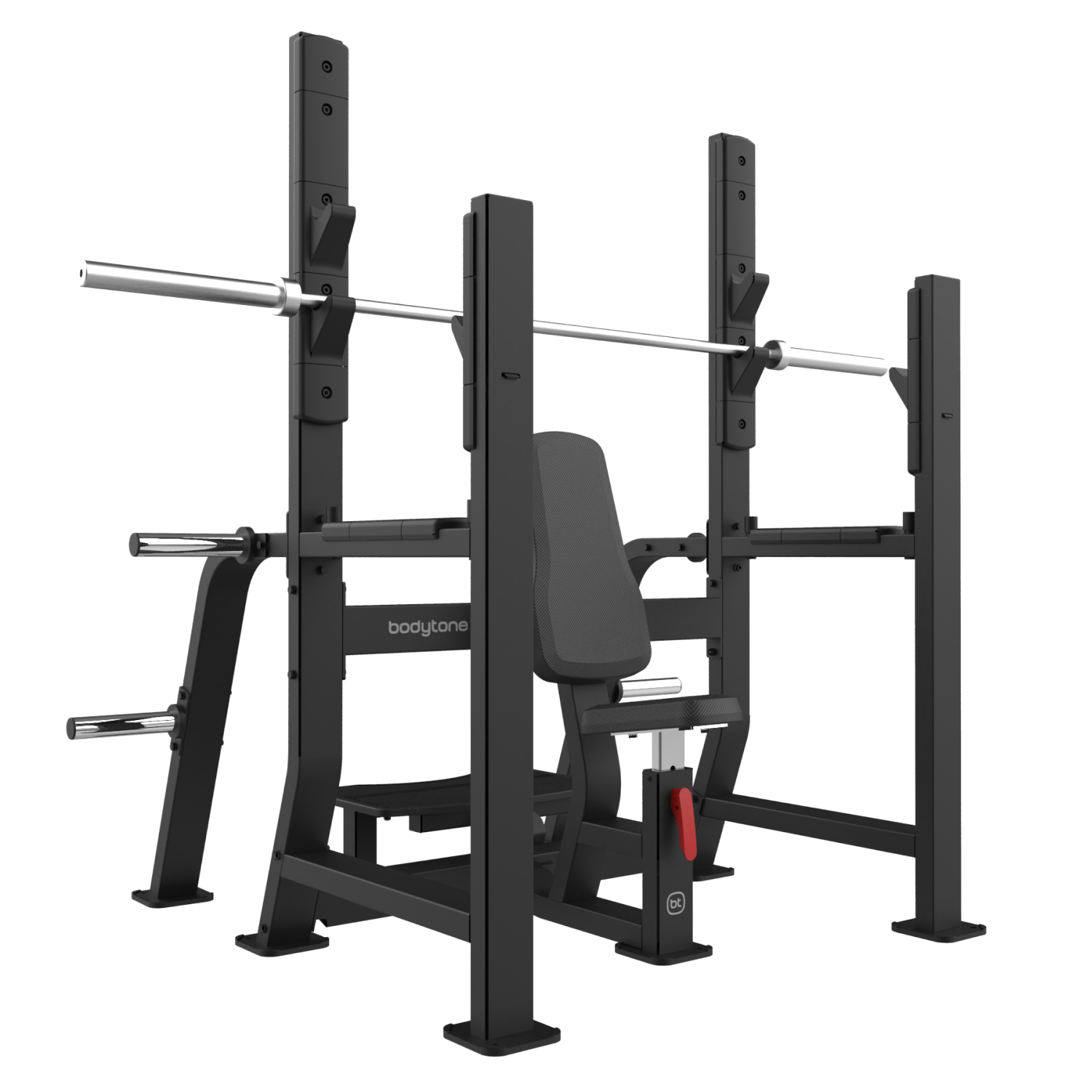
The shoulder press machine is one of the least glamorous and most useful stations on a gym floor. It is used by beginners on their first induction and by advanced members loading heavy, it needs no spotter, and it takes a small, predictable footprint. This article covers what the machine actually does, who it suits, how to set it up and what to look for when specifying one for a professional facility.
What a shoulder press machine is
A shoulder press machine guides the vertical pushing path, which makes the movement safe for users training without a spotter. That single sentence explains why it appears in almost every commercial gym, hotel fitness room, club and rehabilitation centre.
The user sits with the back supported, grips the handles at shoulder height and presses upwards along a fixed or semi-fixed track. Because the trajectory is guided, the load cannot drift forwards or sideways, and a failed repetition ends on the stack rather than on the user. Seat and, on some models, footplate are adjustable so the shoulder can be brought into line with the handle axis.
Selectorised versions change load with a pin, which is what makes them workable in a circuit or during peak hours. Plate-loaded versions cost less to maintain and suit strength-focused sites. Both sit in the strength training machines range.
Which muscles it loads
The shoulder press primarily loads the anterior and medial deltoid, with the triceps working as the elbow extends. The upper back and upper trapezius work as stabilisers rather than as prime movers.
Grip position changes the emphasis: a neutral grip is usually the most shoulder-friendly, a pronated grip loads the medial deltoid more strongly, and a wider grip shifts the angle again. Offering more than one handle position on the same frame is therefore worth more than it looks on a spec sheet, because it lets one station serve members with very different shoulder mobility.
Why it belongs in a professional facility
- It is safe unsupervised. The guided path removes the main failure mode of an overhead barbell press. For a site with limited staffing, that is decisive.
- It trains the stabilisers under control. Shoulder stabilisers are easy to neglect; a fixed path lets a member load them without having to manage balance at the same time.
- It supports posture work. Regular overhead pressing, combined with pulling work, is part of a balanced upper-body programme rather than a cosmetic exercise.
- It is predictable in a layout. Seated stations have a known envelope and a known access side, which makes them easy to line up along a wall.
In a circuit, the shoulder press pairs naturally with a row or a lat pulldown so that pushing and pulling volume stay balanced. Selectorised stations are listed under selectorised machines.
Setting it up correctly
Most of the value of the machine is lost if the setup is wrong. Four points cover it:
- Load first, ego second. Start with a load that allows full control and progress gradually as strength develops.
- Set the seat so the shoulder lines up with the handles. Seat height is the setting that governs shoulder alignment and joint safety; a seat that is too low pushes the press behind the head, a seat that is too high shortens the range.
- Move slowly and under control. No swinging, no bouncing off the bottom. The contraction should be felt on every repetition.
- Avoid overloading and partial, distorted repetitions. Movement quality matters more than the number on the stack.
For a commercial site, this is also a signage question: a clear instruction plate on the frame does more for injury prevention than any number of reminders at the desk.
Specifying the machine
When comparing models, look at:
- Usage class. Indoor equipment in a facility open to third parties is specified to EN ISO 20957-1 class S. Class I is the professional class for inclusive access, not a level above class S.
- Adjustment range. The span of seat positions determines how many body sizes the station actually serves.
- Handle options. Neutral and pronated positions on the same frame widen the user base.
- Upholstery and pad replacement. Pads wear before frames do. Check that they are a stocked spare part.
- Footprint and access side. The envelope for a seated station includes the entry path and the weight stack service access.
Where the plan includes free-weight pressing alongside the machine, adjustable benches from the weight benches range complete the area.
Frequently asked questions
Machine or barbell overhead press?
They answer different needs. The barbell press trains stabilisation and coordination and belongs in a supervised strength area; the machine gives a guided, repeatable path suitable for unsupervised members, inductions and return-to-training work.
Is it suitable for beginners?
Yes, and it is one of the better first exposures to overhead pressing precisely because the path is guided. Load should still start light and progress gradually.
Selectorised or plate-loaded?
Selectorised for throughput and circuits, since the load changes in seconds. Plate-loaded where the members are stronger, the site is strength-focused and simple mechanics are preferred.
What is the most common setup error?
Seat height. Getting the shoulder out of line with the handle axis is what turns a safe guided press into an uncomfortable one, and it is the first thing to check when a member reports discomfort.
Specifying your upper-body area
A shoulder press station is rarely bought alone: it is one element of a pushing and pulling sequence that has to fit the room, the member profile and the supervision model. Light In Fitness manufactures and supplies professional strength equipment for gyms, clubs, hotels, local authorities, schools and rehabilitation centres. Send us your floor plan and your intended use and we will return a configuration and a costed proposal – request a quote.